How to Choose Roofing Materials for Your Climate and Budget
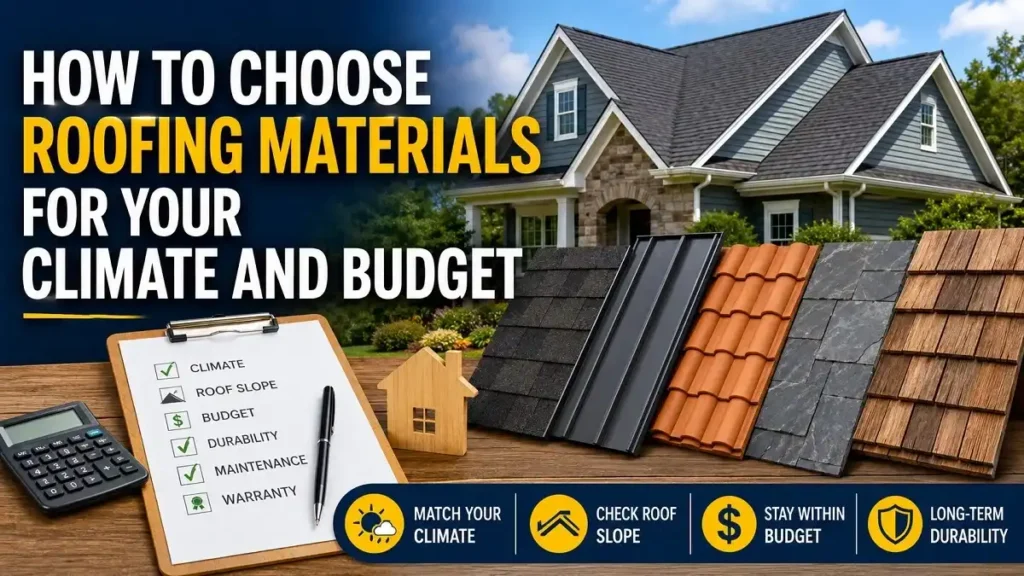
Learning how to choose roofing materials starts with your home, not a color chart. Climate, roof slope, budget, structural limits, wind, hail, fire risk, and local rules can quickly narrow your options.
The visible roofing material is also only one part of the system. It must work with the roof deck, water-resistant underlayment, flashing, ventilation, fasteners, and drainage. An expensive roofing material can still fail early if the rest of the system is poorly designed or installed.
Start by ruling out materials that do not suit your roof or local weather. Then compare the remaining choices by installed cost, expected lifespan, maintenance, local repair support, and appearance.
Table of Contents
- Start With a Quick Roofing Material Comparison
- Use Climate to Eliminate the Wrong Choices
- Check Roof Slope Before Comparing Materials
- Can the Structure Carry the Roofing Material?
- Compare Roofing Materials by Cost, Lifespan, and Maintenance
- Initial Price Is Only One Part of Your Roofing Budget
- Warranty Length Does Not Equal Roof Life
- Color and Profile Can Affect the Whole House
- Check Insurance and Local Repair Support
- Questions to Ask Before Choosing a Roofing Material
- How to Make Your Final Roofing Material Choice
Start With a Quick Roofing Material Comparison
There is no single best roofing material for every home. Asphalt shingles are often the easiest option for a lower upfront budget. Standing-seam metal costs more but can offer a much longer service life. Tile and slate can last for decades, but their weight and installation cost can rule them out for some homes.
| Roofing material | Typical installed cost | Typical lifespan | Worth considering when |
|---|---|---|---|
| Asphalt shingles | About $3.50–$8 per sq. ft. | 15–30+ years | Upfront cost and easy local repair matter |
| Standing-seam metal | About $9–$18 per sq. ft. | 40–70 years | Long life and weather performance are priorities |
| Clay or concrete tile | About $10–$25 per sq. ft. | 50–100 years | The structure can handle the weight and the style suits the home |
| Natural slate | About $15–$30+ per sq. ft. | 75–150+ years | Longevity matters more than initial cost |
| Wood shakes or shingles | Varies widely | About 20–40 years | Natural appearance is important and local fire rules allow it |
| Synthetic roofing | Varies by product | Often 30–50 years | You want the look of slate or shake with less weight |
| Low-slope membrane | About $3.50–$8 per sq. ft. | About 15–30 years | The roof is too low-sloped for conventional shingles or tile |
These are broad U.S. planning ranges, not contractor quotes. Product grade, labor rates, roof size, slope, removal work, access, flashing, and repairs can move the final price significantly.
Roofers also use the term “square.” One roofing square equals 100 square feet of roof surface.
Use Climate to Eliminate the Wrong Choices
Your climate is one of the first filters to use. A roof that performs well in a mild inland area may face very different problems near the coast, in a hail-prone region, or in a place with heavy snow.
| Climate or risk | Materials worth comparing | What matters most |
|---|---|---|
| Hot and sunny | Metal, tile, suitable asphalt products | Heat, UV exposure, color, and solar reflectance |
| Cold and snowy | Metal, asphalt, slate where structure allows | Snow, ice, freeze-thaw cycles, and ventilation |
| Coastal | Corrosion-resistant metal, tile, approved shingles | Salt exposure, wind, and wind-driven rain |
| Hail-prone | Impact-rated shingles and suitable metal systems | Impact resistance and repairability |
| Wildfire-prone | Roof systems with suitable fire ratings | Complete roof assembly, vents, edges, and fire resistance |
| Low-slope roof | Membrane systems designed for low slopes | Drainage, seams, and waterproofing |
Hot climates place extra stress on roofing surfaces and underlayment. In these areas, compare roof color and solar reflectance as well as material type. A surface that reflects more sunlight can absorb less solar heat, although insulation and ventilation also affect indoor comfort.
Cold climates bring different problems, including snow, ice, and repeated freezing and thawing. Coastal roofs must deal with salt, strong wind, and rain driven under vulnerable roof edges.
Hail resistance and fire ratings can also matter in higher-risk areas. These ratings do not make a roof damage-proof, so compare the complete roof system rather than relying on one label.
Check Roof Slope Before Comparing Materials
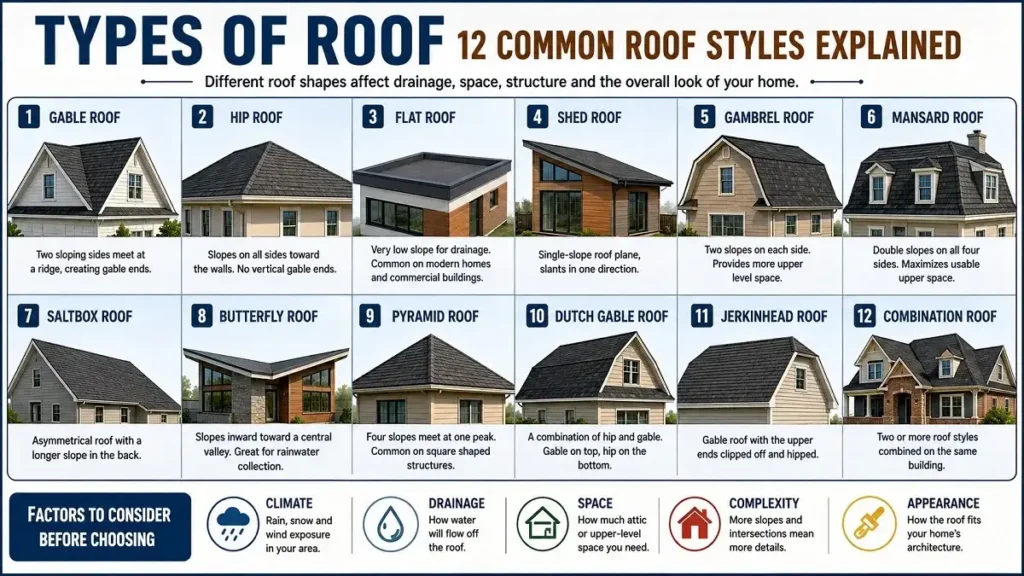
Roof slope describes how steep the roof is. It affects how quickly rain and melting snow leave the surface, and not every roofing material can be installed on every slope.
A steep roof sheds water quickly. A low-slope roof drains more slowly and usually needs a roofing system designed for that condition.
Do not choose shingles, tile, or decorative panels until you confirm that the product is approved for the roof’s slope. Manufacturer instructions and local building requirements should guide the final choice.
Some homes need more than one roofing system. A steep main roof may use shingles or metal while a nearly flat porch or addition uses a membrane roof.
Can the Structure Carry the Roofing Material?
Weight can remove some materials from your shortlist. Asphalt shingles and many metal roofs are relatively light. Concrete tile, clay tile, and natural slate can be much heavier.
Before replacing a lightweight roof with a heavy material, confirm that the existing framing can safely support it. Some homes may need a structural review before tile or slate is installed.
The roof deck and framing condition also matter. In high-wind areas, the way the roofing system is attached can be just as important as the material itself.
Confirm these limits before ordering materials rather than discovering a structural problem after the old roof has been removed.
Compare Roofing Materials by Cost, Lifespan, and Maintenance
The lowest purchase price does not always mean the lowest long-term cost. A cheaper roof may need replacement sooner, while a more expensive system may remain in service for several decades.
Asphalt shingles remain attractive to many homeowners because they have a relatively low initial cost and are widely installed and repaired. Architectural shingles generally cost more than basic three-tab products but can offer a longer service life.
Standing-seam metal has a higher upfront price, but a service life of several decades can make it worth comparing for homeowners planning to stay in the property long term.
Clay and concrete tile can also last for decades. Their weight, underlayment needs, breakage risk, and repair access should be considered along with the surface material.
Natural slate offers one of the longest potential service lives among common roofing materials. Its high price, heavy weight, and need for contractors familiar with slate make it a specialized choice rather than a universal upgrade.
Expected lifespan is only a planning range. Climate, product quality, installation, ventilation, maintenance, and storm exposure can shorten or extend the actual service life.
Initial Price Is Only One Part of Your Roofing Budget
Do not compare roofing materials using the product price alone. The full project can include removal of the old roof, disposal, deck repairs, underlayment, flashing, fasteners, ventilation work, permits, labor, and cleanup.
Roof shape can also have a major effect on price. Valleys, dormers, chimneys, skylights, multiple levels, and steep sections create more cutting and flashing work. They can also increase material waste.
Think about how long you expect to own the home. Paying more for a roof designed to last many decades may make sense for a long-term property, while a simpler system may better fit another homeowner’s budget and plans.
For a line-by-line approach to roofing bids, use our roof replacement estimate checklist. The same basic scope questions are useful even if the home is outside Florida.
Warranty Length Does Not Equal Roof Life
A 30-year, 50-year, or “lifetime” warranty does not guarantee that the roof will last exactly that long. Warranty terms can include exclusions, reduced coverage over time, registration requirements, and rules about transferring coverage to a new owner.
Material and workmanship warranties also cover different things. The manufacturer generally covers qualifying product problems, while the contractor’s workmanship warranty addresses certain installation issues.
Check whether the warranty requires specific underlayment, ventilation, accessories, or installation methods. Read the actual documents instead of choosing a roof based only on the largest number in a brochure.
Color and Profile Can Affect the Whole House
Once climate, slope, structure, and budget have narrowed the choices, appearance becomes easier to evaluate.
View full-size samples outdoors if possible. Small samples can hide texture, color variation, and reflectivity. Look at the roofing material next to the home’s siding, masonry, trim, gutters, and other exterior finishes.
A dark roof can appear visually heavy on some low-profile homes. Strong patterns can also make a roof with many valleys and dormers look busier.
Check HOA, neighborhood, and historic-district requirements before ordering. Local rules may limit roof colors, profiles, or materials.
Check Insurance and Local Repair Support
Insurance requirements can vary by insurer, location, roof age, and material. Before choosing an unusual roofing system, ask whether the material affects eligibility, required documentation, or available coverage.
Local repair support matters too. Ask whether contractors in your area regularly work with the material and whether replacement pieces, flashing, fasteners, and other accessories are easy to obtain.
A roof can perform well on paper but become inconvenient to own if every small repair requires a specialist to travel from another area.
This is especially worth checking for natural slate, specialty tile, wood roofing, and newer synthetic products.
Questions to Ask Before Choosing a Roofing Material
- Does this material suit my local climate?
- Is it approved for my roof slope?
- Can the existing structure carry its weight?
- What is the realistic installed cost for my roof?
- How long does this type of roof typically last?
- What routine maintenance does it need?
- Which underlayment, flashing, and fastening system will be used?
- Can local contractors repair it in the future?
- Are replacement pieces and accessories readily available?
- What do the material and workmanship warranties actually cover?
- Does my insurer have requirements for this material?
- Could future solar panels or other roof equipment affect the system?
How to Make Your Final Roofing Material Choice
Start with climate, roof slope, and structural limits. These factors can eliminate materials that do not suit the building before you spend time comparing colors or brands.
Next, compare the remaining materials by installed cost, expected lifespan, maintenance, insurance considerations, and access to local repairs. If two options still look similar, get written quotes for both systems using the same project scope.
Do not assume the most expensive material is automatically the best choice. A premium roof can be poor value if it does not suit the structure, climate, or length of time you expect to own the home. The cheapest option can also become expensive if it needs early replacement or frequent repairs.
The right roofing material is the one that fits the specific home and works as part of a complete water-shedding system. Once you have a shortlist, our residential roofing guide can help you evaluate the contractor and installation plan.