8 Cheaper Alternatives to Bifold Closet Doors That Actually Work
Alternatives to bi-fold closet doors do not have to involve an expensive remodel. If your current bifolds block too much of the opening, take up awkward space or keep falling out of adjustment, there are simpler ways to cover a closet.
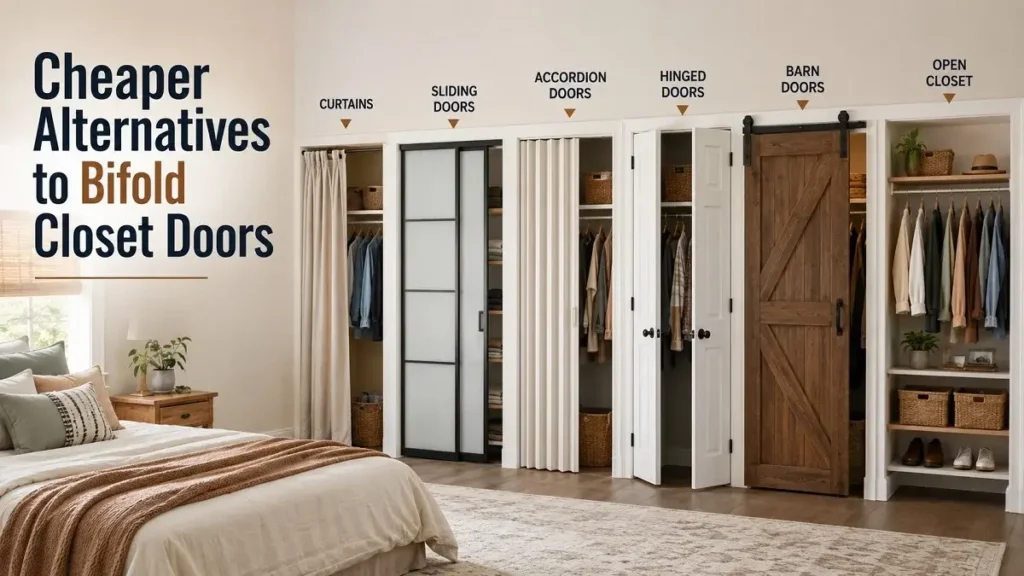
The best replacement depends on what you actually want to fix. Curtains and accordion doors keep costs low. Hinged doors give better access when there is room for them to swing, while bypass sliders work better in tight bedrooms. Barn and pocket doors solve different layout problems, although neither is automatically the cheaper choice.
So rather than choosing a door because it looks better in a photo, start with the problem: cost, access, swing space or appearance. Then choose the least complicated option that solves it.
Table of Contents
8 Cheaper Bifold Closet Door Alternatives at a Glance
| Option | Pros | Cons | Best For |
|---|---|---|---|
| Curtains | Very cheap, easy to install, almost full access | Less finished appearance | Renters and tight budgets |
| Accordion doors | Compact, affordable, DIY-friendly | Cheap versions can feel flimsy | Small rooms |
| Open closet | Almost free, complete access | Clutter stays visible | Organised wardrobes |
| Basic hinged doors | Full access, simple hardware | Need swing clearance | Rooms with open floor space |
| Bypass sliding doors | No outward swing, easy to find | Part of the closet stays blocked | Tight bedrooms |
| Double swing doors | Wide access, conventional appearance | Need more clearance | Wide openings |
| Barn doors | No floor swing, strong visual upgrade | Need clear wall space beside the closet | Rooms with spare wall space |
| Pocket doors | Excellent space efficiency | Retrofit can be expensive | Larger remodels |
Curtains
If the main goal is spending as little as possible, curtains are hard to beat. A simple rod or ceiling track and two properly sized panels can cover a wide closet without hinges, pivots or a door projecting into the room.
They also give you almost full access when pulled aside, which is useful if you are tired of working around folding or overlapping panels. Heavier fabric and a properly mounted track usually look more intentional than a thin curtain hanging from a temporary tension rod.
The trade-off is that fabric never feels quite as permanent as a conventional door. It does little for sound control, pets can push through it easily, and some homeowners simply prefer a more finished look. For a rental, guest room or low-budget update, though, curtains are one of the few options that can genuinely cost very little.
Accordion Doors
Accordion doors are one of the closest substitutes for a bifold closet door. Instead of two larger folding panels, they use narrower connected sections that collapse into a compact stack.
That makes them useful where space is tight but you still want a physical door rather than fabric. Many are sold as complete kits, so they can also be appealing for a straightforward DIY replacement.
Quality matters here. Very cheap versions can flex, rattle or feel less substantial than the door they replaced. A better track and sturdier panel material can make a noticeable difference in everyday use.
Open Closet
The cheapest alternative of all is simply removing the bifold doors and leaving the closet open. You get full access, there is no hardware to maintain, and nothing takes up floor or wall space.
An open closet can look intentional when shelves, drawers, baskets and hangers are organised consistently. In a small bedroom, it can even make the storage feel less boxed in.
The obvious downside is that nothing is hidden. Clothes, laundry and storage boxes remain visible, and there is no barrier against pets or dust. If closing the closet door is how you make the room look tidy, this option probably solves the wrong problem.
Basic Hinged Doors
A regular hinged closet door is simple, familiar and often good value. There are no folding joints to adjust and no overlapping panels sitting in front of the storage once the door is open.
A narrow closet may need only one hollow-core door, while wider openings can sometimes take two smaller swing doors. Standard panels are easy to paint, easy to match with other interior doors and use hardware that is widely available.
The limitation is room clearance. If a bed, dresser or narrow walkway sits directly in front of the closet, even an inexpensive hinged door can become awkward. Where the room has space, though, this is one of the strongest permanent replacements for bifolds.
Bypass Sliding Doors
Bypass sliding closet doors make sense when floor space is the bigger concern. The panels stay within the closet opening and slide past each other instead of swinging into the room.
They are widely available in plain, decorative and mirrored finishes, so they can be a straightforward replacement for older white bifold closet doors.
The compromise is access. One panel always sits in front of another section of the closet, which means you may have to move the doors back and forth to reach drawers, baskets or clothes at opposite ends. If floor space matters more than seeing the entire closet at once, that trade-off can still be worth it.
Double Swing Doors
For a wider opening, double swing doors can give you much better access than either bifolds or bypass sliders. These are sometimes described as French-style closet doors, although they do not need glass. Simple hollow-core or shaker-style panels can create the same balanced look.
Open both doors and almost the whole closet is available, which is particularly useful when shelves or drawers sit close to the edges of the opening.
They work best when standard door sizes fit. Custom panels, new jambs or framing changes can quickly increase the cost, and the room still needs enough space for both doors to swing freely.
Barn Doors
Barn doors avoid floor swing by sliding across the face of the wall. That can make them attractive in bedrooms where a conventional door would interfere with furniture.
The important measurement is not only the closet opening. The door needs enough uninterrupted wall beside it to slide completely clear. A light switch, window, dresser, nearby doorway or short wall can rule the idea out before installation begins.
Hardware kits are easy to find, but that does not automatically make barn doors cheap. Once the slab, track, handles and mounting hardware are included, a basic hinged or accordion setup may still cost less.
Pocket Doors
A pocket door is the cleanest option when space is extremely limited because the panel slides inside the wall. When open, it uses neither floor space nor the wall beside the closet.
The problem is getting it there. Retrofitting one can mean opening drywall, changing framing and dealing with wiring, switches, plumbing or other services hidden in the wall.
If you are already remodelling and the wall is open, a pocket door can make excellent sense. As a simple budget replacement for a working bifold door, it usually does not.
What Is Actually Replacing Bifold Closet Doors?
There is no single style replacing bifolds. Small bedrooms often suit bypass sliders or accordion doors because they avoid a large door swing. Wider closets benefit from paired hinged doors when full access matters, while curtains remain attractive when price is the main concern.
Barn and pocket doors are usually chosen because a particular room layout suits them, not because they are universally cheaper. That is why the best substitute depends more on the room than on whichever door style happens to be fashionable.
Before Buying New Doors, Check Whether the Bifolds Can Be Saved
Sometimes the cheapest move is not replacing the doors at all. If the panels are still straight and in good condition, worn pivots, guides or rollers may be causing most of the frustration.
A bifold door repair kit, new knobs or a fresh finish can cost far less than changing the whole system. This is especially worth considering with solid wood, mirrored or shaker-style bifold closet doors that would be expensive to replace with something of similar quality.
Repair makes less sense when the folding layout itself is what bothers you. If the panels physically block the part of the closet you use most, better hardware will only give you a smoother version of the same problem.
Measure the Room, Not Just the Closet Opening
For hinged doors, check the floor area they will swing into. For barn doors, measure the clear wall beside the opening. With bypass sliders, look at where drawers and shelves sit and decide whether having part of the opening covered will matter.
Pocket doors need even more investigation because the inside of the wall becomes part of the project. Accordion and sliding kits can also have their own finished-opening requirements, so do not assume the measurements of the old bifold doors will transfer directly.
A cheap door that needs unexpected framing or custom work is no longer a cheap door.
Choosing the Best Alternative to Bifold Closet Doors
If I were keeping costs as low as possible, I would start with curtains, an open closet or a decent accordion door. If I wanted something that still felt like a conventional permanent door, a basic hinged setup would be my first choice whenever the room had enough clearance.
Bypass sliders make more sense when floor space matters most. Double swing doors are better when full access is the priority. Barn doors need the right wall, while pocket doors make the most sense when renovation work is already happening.
The best choice is not simply the one that looks better than a bifold. It is the one that fixes the problem you already have without creating another one every time you open the closet.