Smart Home Solar: How It Works and What You Save
A smart home solar system combines solar panels, a battery, and a smart inverter with your home’s connected devices. It monitors energy production and usage in real time, shifts heavy loads to peak solar hours, and stores surplus power for later. Most homeowners save $37,000 to $154,000 over 25 years. The 30% federal tax credit may end for residential installs as early as December 31, 2025.
Your electricity bill went up again. You are not imagining it. U.S. residential electricity prices have climbed over 85% since 1990, and projections show rates continuing to rise well into the late 2020s. At the same time, solar technology has gotten smarter, cheaper, and far easier to connect with the devices already running your home.
This article breaks down exactly how smart home solar works, what it costs, what it saves you, and what you need to do before a key financial deadline passes.
What a Smart Home Solar System Actually Does
A basic solar install generates electricity. A smart home solar system manages it.
The difference comes down to connectivity. Smart systems link your panels, battery, and inverter to a central energy management platform. That platform watches your energy production and consumption in real time. It knows when your solar output peaks, when your grid rate is highest, and which appliances are running.
What makes solar panels “smart” is the entire interconnected system of advanced inverters, power optimizers, energy management platforms, and IoT connectivity that work together to maximize efficiency and provide real-time control. This shifts the idea of home energy from passive generation to active, intelligent management.
The Four Components You Actually Need
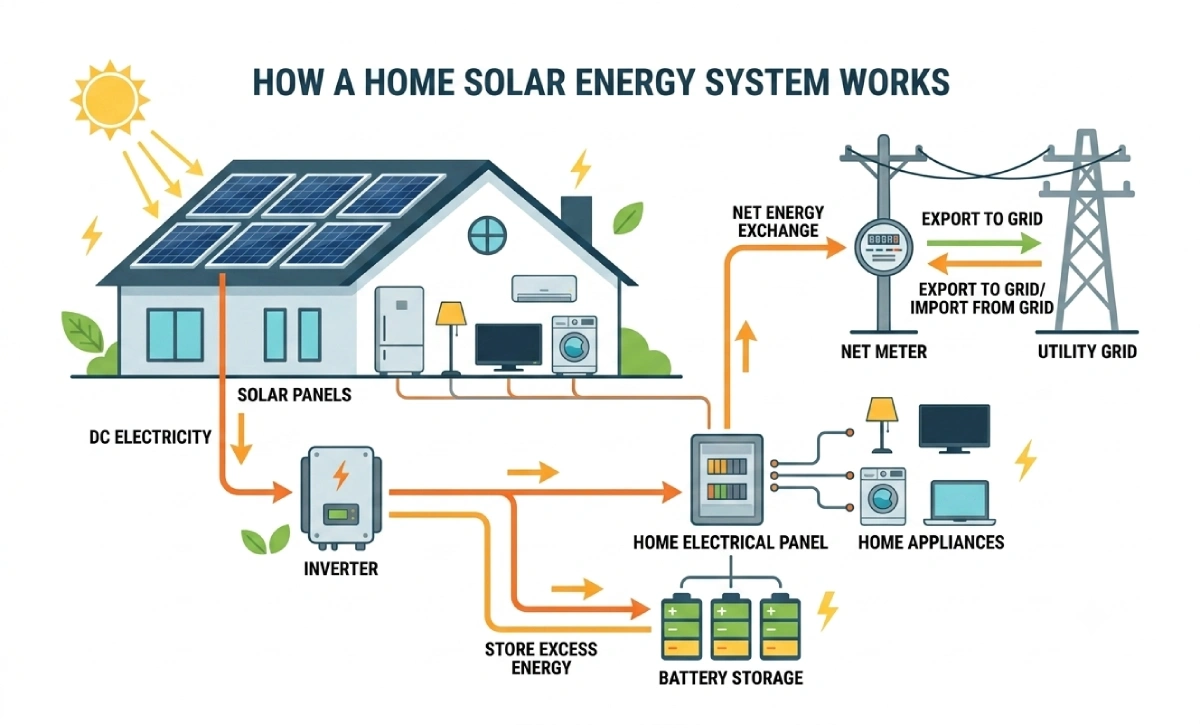
Before you buy anything, understand what a complete smart home solar setup requires:
- Solar panels. These capture sunlight and convert it to direct current (DC) electricity. Panel efficiency has improved significantly, meaning you need fewer panels for the same output.
- A smart inverter. This converts DC electricity into the AC power your home uses. Smart inverters from brands like Enphase and SolarEdge also communicate with your home’s energy management system.
- Battery storage. This stores surplus power generated during the day so you can use it at night or during outages. The percentage of new residential solar installs paired with battery storage surged from less than 12% in 2023 to over 28% in 2024. In California, that figure is already approaching 40% to 50%.
- An energy management platform. This is the software layer, either through your inverter’s app or a third-party system, that automates and monitors everything.
Smart Home Solar Saves You Real Money
The numbers matter here, so let’s be specific.
Most homeowners save $37,000 to $154,000 over 25 years after installing solar panels. The wide range reflects differences in system size, local electricity rates, and how much of the grid you replace. Typical payback periods for smart solar systems range from 6 to 10 years, compared to 8 to 12 years for traditional installations. The faster return comes from better energy management.
Smart systems earn those savings by doing things a basic install cannot:
- Shifting your dishwasher, EV charger, and laundry cycle to run during peak solar production hours
- Automatically deciding whether to store surplus power in your battery or sell it back to the grid
- Flagging underperforming panels before they cost you money
AI algorithms in modern smart solar systems can accurately predict 85 to 90% of maintenance needs before failures occur. That means fewer surprise repair bills over the life of your system.
In high-cost states like Hawaii, California, and New England, electricity costs could cross $200 to $300 per month by 2028. A comparable solar lease in 2026 might cost $130 to $200 per month. The math is getting harder to ignore, even in lower-rate states.
How to Connect Solar to Your Smart Home
You do not need to replace your existing smart home devices to add solar. Most major platforms already support solar integration.
Step 1: Choose a compatible inverter. Enphase and SolarEdge are the two most widely supported brands. Both offer APIs that connect to Google Home, Amazon Alexa, and Apple HomeKit. Tesla’s system works natively within its own app.
Step 2: Install a smart electrical panel. This is the critical link between your solar system and your home’s devices. Brands like Span and Leviton make panels that let you control individual circuits, route solar power to priority loads, and monitor usage by room.
Step 3: Connect your high-consumption devices. Your HVAC, water heater, EV charger, and washing machine draw the most power. Smart home devices and platforms are increasingly designed to share energy usage data, enabling smarter scheduling, load shifting, and more coordinated energy use across the home. Setting these to run when solar output is high cuts your grid draw significantly.
Step 4: Set your automation rules. Most energy management apps let you create schedules and priority tiers. Tell your system to charge the battery first, power your home second, and export to the grid only when both are satisfied.
The Tax Credit Window Is Closing
This is the part most homeowners do not know about.
The federal Solar Investment Tax Credit (ITC) currently offers 30% back on installation costs, covering both panels and battery storage. However, recent legislative proposals may end the residential credit as early as December 31, 2025. If that happens, a $30,000 system that would have cost you $21,000 after the credit could cost you the full amount instead.
For an average-sized 12 kW system, the gross cost runs roughly $30,505 before incentives. After applying the 30% federal tax credit, the net cost falls to approximately $20,754. That is over $9,700 in savings that may not be available to homeowners who wait.
Beyond the federal credit, many states and utilities offer additional rebates. Some utilities provide extra incentives for grid-interactive systems, where your battery can supply power back to the grid during demand peaks. Check your state’s energy office for current programs before you install.
Will Solar Work With My Existing Smart Home Setup?
Most smart home platforms support solar integration through their energy management settings. Google Home, Amazon Alexa, and Apple HomeKit all work with compatible inverters and smart panels. If your home already runs on one of these platforms, adding solar does not require starting over.
The key is choosing an inverter with open API access. Enphase’s Envoy and SolarEdge’s monitoring platform both offer this, which means your energy data can flow into whatever dashboard or automation system you already use.
The Bottom Line on Smart Home Solar
Smart home solar is not just about generating electricity. It is about managing your home’s energy with precision, reducing what you spend, and protecting against grid volatility. The technology is mature, the savings are documented, and the tax incentives are real but time-limited.
If you have been considering solar, 2026 is the year to get serious. Get at least three quotes, confirm what incentives are available in your state, and ask each installer specifically about smart panel and battery compatibility with your existing devices.
FAQs
How much does a smart home solar system cost in 2026?
Average installed costs run about $2.58 per watt before incentives, putting a typical 12 kW system around $30,500 gross. EnergySage After the 30% federal tax credit, that comes down to roughly $21,000 for most homeowners. Battery storage adds $10,000 to $20,000, depending on capacity.
Do I need a battery to make solar “smart”?
No, but a battery significantly increases the value of a smart system. Without storage, you can still automate load shifting and monitor usage. With storage, your system can power your home through outages, sell back to the grid at peak rates, and reduce your grid dependence to near zero on high-production days.
What is the payback period for a smart solar system?
Smart solar systems typically pay back in 6 to 10 years, compared to 8 to 12 years for basic installations. SolarTech: The exact timeline depends on your local electricity rate, system size, and how actively you use energy management features.
Can I add smart features to an existing solar system?
Yes. If your current inverter supports third-party integrations, you can add a smart panel, energy monitor, or home energy management software without replacing your panels. If your inverter is older and lacks connectivity, upgrading just that component is often the most cost-effective path.
Will solar increase my home’s value?
Yes, in most markets. Homes with solar sell faster and at a premium in states with high electricity rates. The value added varies by location, system size, and whether battery storage is included, but the trend is consistent across multiple U.S. real estate studies.