Wilsonart SOLICOR Laminate: Is It Better Than Standard Laminate?
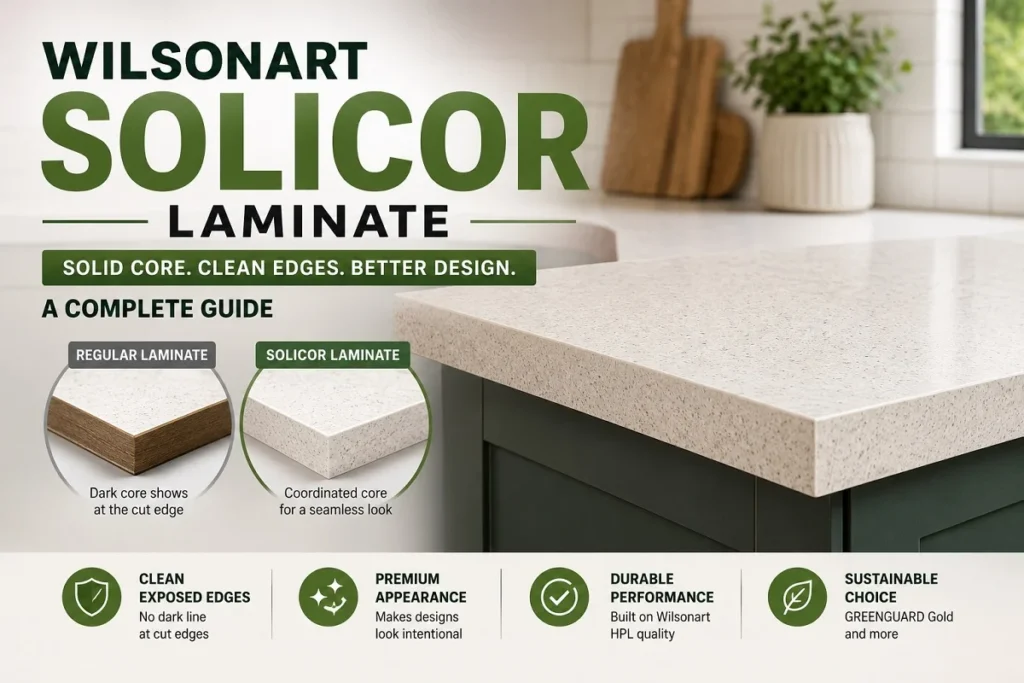
Wilsonart SOLICOR is a specialty laminate made for projects where exposed edges are part of the finished look. Standard laminate usually reveals a dark brown inner layer when it is cut, while this product uses a core color coordinated with the decorative surface.
That difference can create a cleaner appearance on countertops, cabinet panels, open shelving, furniture, and other surfaces with visible cuts. It does not, however, make this solid-core option the best choice for every project.
The real question is whether you will see enough of the edge to justify paying more. If the edges will be hidden, or the project needs curved, heat-formed laminate, a conventional product may be more practical.
What Makes SOLICOR Different From Regular Laminate?
Most decorative laminate has a finished surface over a darker inner layer. Once the sheet is cut, that layer can become visible along the edge.
Wilsonart’s specialty laminate takes a different approach. Its core color is selected to work with the surface design, reducing the strong contrast that can appear along exposed cuts.
This difference is especially noticeable with light-colored surfaces where a dark line would stand out. It also gives designers and fabricators more freedom to leave certain edges visible rather than automatically covering them with a separate finish.
A darker inner layer may show along exposed cuts.
A coordinated core reduces the visual contrast at the edge.
Where Does the Cleaner Edge Actually Make a Difference?
Not every laminate project needs a coordinated core. The benefit becomes much easier to justify when edges are intentionally visible.
Countertops are an obvious example. A square or exposed edge can look more consistent when there is no strong dark line separating the top from the cut edge.
Open shelves can benefit for a similar reason. Their front edges and undersides are often visible from across the room, making small finishing details easier to notice.
Cabinet panels and furniture are other useful applications, especially when the design includes thin profiles, exposed panel edges, or routed details.
If every edge will be covered by trim or another material, much of this visual advantage disappears.
SOLICOR vs. Standard HPL: What Changes?
HPL means high-pressure laminate, the familiar decorative sheet material used on countertops, cabinetry, furniture, and many commercial surfaces. The solid-core product belongs to this broader laminate family but is designed to solve a more specific visual problem.
| What Matters | Standard HPL | SOLICOR |
|---|---|---|
| Cut edge | Dark core may be visible | Core color works with the face design |
| Best fit | General laminate projects | Projects with visible edges |
| Curved forming | Suitable grades are available | Not intended for postforming |
| Cost | Usually lower | Typically carries an added cost |
The buying decision is fairly straightforward. If the edge itself contributes to the look of the project, the upgraded core has a clear purpose. If it will never be seen, conventional HPL may deliver what you need for less.
Standard Sheet or SOLICOR Compact: Which One Do You Need?
The word Compact can cause confusion because it refers to a different product construction, not simply another decorative finish.
The standard sheet is thin and needs to be bonded to a suitable supporting panel. In technical language, that supporting material is called a substrate.
SOLICOR Compact is a much thicker, self-supporting panel intended for suitable applications where a thin decorative sheet would normally need separate backing. Available thicknesses, designs, and fabrication requirements should be checked in Wilsonart’s current specifications before ordering.
A thin decorative surface that needs a suitable supporting panel.
A thicker panel made for suitable self-supporting applications.
These two formats should not be treated as interchangeable. The right choice depends on how the surface will be supported, fabricated, and used.
When Is Standard Laminate the Smarter Choice?
Paying more for a feature you cannot see rarely makes sense.
If the edges will be concealed by trim or another finish, standard laminate can be the more economical choice. It also deserves consideration when a project requires a curved edge made by heating and forming the sheet, a process known as postforming.
Budget matters too. A simple countertop with a conventional edge treatment may gain very little visually from upgrading the core. In that situation, spending the difference elsewhere in the project could be more useful.
The solid-core option makes more sense when:
✓ Exposed edges are part of the finished design.
✓ You want less contrast between the surface and cut edge.
✓ The project does not require postforming.
✓ The visual improvement is worth the added material cost to you.
Can You Use Wilsonart SOLICOR for Kitchen Countertops?
Yes. Countertops are one application where this material can be particularly useful, provided the selected product suits the planned construction.
A modern square edge or exposed end can reveal more of the laminate construction than a traditional edge treatment. That makes the coordinated core easier to appreciate.
The standard sheet still needs the correct supporting material and proper fabrication. A Compact panel works differently, so the two formats should not automatically be treated as interchangeable countertop materials.
If a cabinet shop or countertop fabricator is doing the work, confirm the exact product before approving the design. This matters most when the finished edge is central to the look you want.
What Designs and Finishes Are Available?
The collection is not limited to plain black and white. Wilsonart has offered solid colors as well as decorative looks inspired by stone, wood, and textiles.
The important distinction is that the core color is coordinated with the chosen surface. A woodgrain or stone pattern should not be interpreted as running through the full thickness of the sheet.
Collections can change over time, so check the current range before building a project around a particular color, finish, or panel configuration. This is more reliable than depending on an older list of designs.
What Should Your Fabricator Know Before Cutting It?
The most important limitation to discuss is postforming. If the design requires a rounded laminate edge created by heating and bending the sheet, another suitable grade may be needed.
Cutting and bonding should also follow the current fabrication instructions. Homeowners do not need to learn every adhesive or tool specification, but the person doing the work should confirm that the supporting panel, adhesive, and cutting method suit the exact material being installed.
Careful fabrication is particularly important when visible edges are a major part of the design, since poor cutting can undermine the cleaner appearance you are paying for.
How Do You Clean the Finished Surface?
Everyday care should be fairly simple. Start with the cleaning method recommended for the exact finish and use gentle, non-abrasive cleaning for ordinary dirt and spills.
Avoid experimenting with harsh chemicals, scouring pads, or aggressive cleaners unless they are approved for that surface. Decorative finishes can differ, so a cleaning method that works for one should not automatically be assumed safe for another.
If a difficult stain appears, checking the current care instructions before moving to a stronger cleaner is the safer approach.
What Is SOLICOR-CR, and Do Homeowners Need It?
SOLICOR-CR is a specialized product intended for demanding environments where chemical resistance is an important requirement, including certain laboratory applications.
That is a different buying decision from choosing decorative laminate for a kitchen, vanity, cabinet, shelf, or piece of furniture. Most residential projects do not need laboratory-focused specifications when comparing everyday surface materials.
How Much More Should You Expect to Pay?
The specialty construction generally carries a premium over conventional HPL, but there is no useful universal price for every sheet or panel.
The final amount can change with the design, finish, format, distributor, location, shipping, and availability. A price displayed by one retailer today may not represent what another buyer will pay later.
A better approach is to request a quote for your preferred design and a comparable standard laminate. The difference between those two prices shows what you are actually paying for the upgraded edge appearance.
Where Can You Buy Wilsonart SOLICOR Laminate?
The product can be sourced through Wilsonart sales channels and distributors that stock it or can place an order.
Before buying, confirm the exact design, finish, size, and product type. If a professional shop will fabricate the panels, letting them verify or source the material can reduce the chance of ordering something unsuitable for the planned construction.
For projects requiring several matching pieces, check availability before work begins rather than assuming identical material will be immediately available later.
Is the Extra Cost Worth It?
It can be when exposed laminate edges are important to the finished design. Countertops with visible square edges, open shelving, cabinet panels, and custom furniture are the kinds of projects where a coordinated core has a clear visual purpose.
If those edges will be hidden, the main reason for paying extra largely disappears. Conventional laminate may also be the better fit when the design needs postformed curves or the priority is simply getting a practical surface at a lower material cost.
Choose based on what will actually be visible in the finished project. That is a more useful test than assuming a specialty material must automatically be an upgrade.
Frequently Asked Questions
Can SOLICOR be postformed?
No. It is not intended for postforming. A project that requires laminate to be heated and formed around a curved edge needs a suitable alternative.
Does the standard sheet need a substrate?
Yes. The thin sheet needs a suitable supporting panel. The Compact version is a different, thicker product intended for suitable self-supporting uses.
Can it be used for bathroom vanities?
It can be considered for suitable vanity applications, but the exact product, fabrication, edge treatment, and installation should match the conditions of the project. Moisture exposure needs to be considered across the complete vanity assembly, not just the decorative surface.
Is SOLICOR better than regular laminate?
Not in every situation. Its main advantage is the appearance of visible edges. If your project does not benefit from that feature, conventional HPL may be the more practical and economical option.