Top-Down Bottom-Up Roman Shades: Privacy Without Losing Daylight
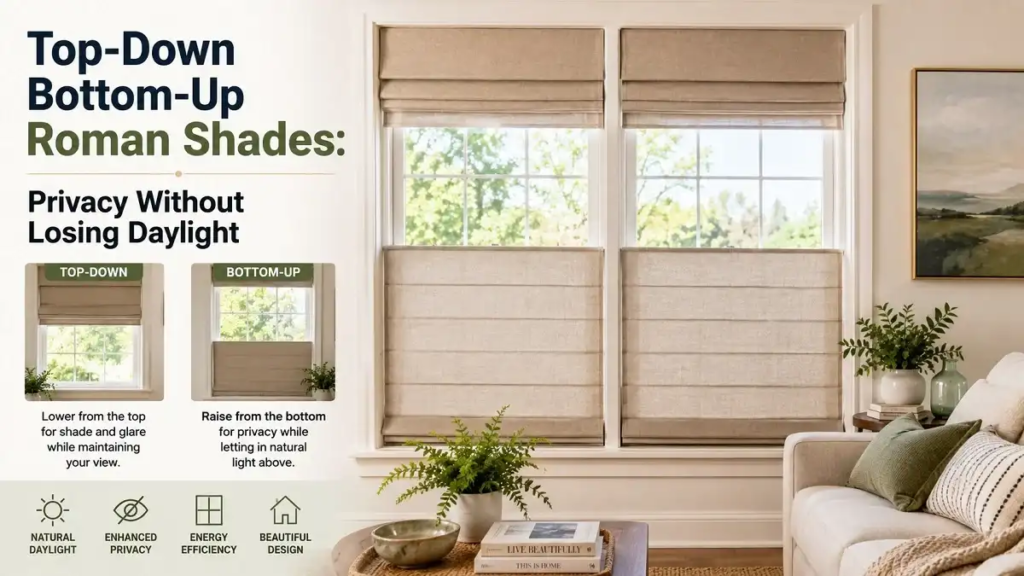
Top-down Roman shades give you lower-window privacy while allowing natural light to enter from above. They solve a problem that standard shades cannot: they can cover the part of a window that needs privacy while leaving the upper glass open to daylight. That makes them especially useful for street-facing bedrooms, bathrooms, home offices, and living rooms.
The idea is simple, but buying the right shade takes more than choosing a fabric. The operating system, lining, mount, window depth, and control type all affect how well it works. This guide explains what to check before ordering, including the limitations sellers do not always make obvious.
Table of Contents
- How Top-Down Bottom-Up Roman Shades Work
- The Privacy Benefit Has One Important Limit
- Choose the Fabric Before You Choose the Color
- Inside Mount or Outside Mount?
- Measure Each Window in Three Places
- Cordless, Motorized, or Manual Controls?
- Roman Shades Are Stylish, but Cellular Shades Insulate Better
- Where This Shade Style Works Best
- What a Quote Should Include
- Six Checks to Make Before You Order
- Care and Maintenance Without Damaging the Folds
- Are Top-Down Bottom-Up Roman Shades Worth It?
How Top-Down Bottom-Up Roman Shades Work
A standard Roman shade raises from the bottom and folds into soft horizontal pleats. A top-down bottom-up version adds another moving rail, allowing the upper edge to be lowered as well.
You can close the lower part for privacy, lower the top for daylight, or raise the shade in the usual way. The exact movement depends on the product. Some models offer independent top and bottom controls, while others have more limited positions.
Roman fabric still stacks when the shade is raised. Measure the folded stack before buying because it can cover part of the glass on a short window or sit in front of trim on an outside mount.
The Privacy Benefit Has One Important Limit
These shades work best when the privacy concern is at eye level. Covering the lower half can block a sidewalk view while the open upper section admits sky light. In a bathroom, the covered area should extend above the sightline from outside, not merely reach the center of the window.
Fabric choice matters after dark. Light-filtering material softens daylight but may reveal silhouettes when indoor lights are on. A privacy or blackout lining gives stronger screening, although light can still enter around the sides of an inside-mounted shade.
Before ordering, view a fabric sample against a bright lamp at night. This quick test gives a better answer than a small opacity label on a website.
Choose the Fabric Before You Choose the Color
Color affects the room, but fabric weight and lining determine how the shade hangs and performs. A loose weave can look relaxed yet provide less privacy. A heavier fabric creates fuller folds but adds bulk to the stack.
- Light-filtering fabric: Best where softened daylight matters more than full darkness.
- Privacy lining: A balanced choice for living rooms, offices, and street-facing spaces.
- Blackout lining: Useful in bedrooms and media rooms, but side gaps may prevent a fully dark room.
- Performance fabric: Worth considering near kitchens or humid rooms if the manufacturer approves it for that setting.
Order samples and hold them against the actual window in morning, afternoon, and evening light. A warm white can appear yellow beside cool gray walls, while a dark shade may dominate a small room more than expected.
Inside Mount or Outside Mount?
An inside mount sits within the window recess and gives a clean, built-in look. It requires enough depth for the headrail and clear space around locks, handles, screens, and tilt-in sashes.
Inside-mounted shades also need operating clearance, so narrow light gaps at the sides are normal. Those gaps can matter in a bedroom even when the shade has blackout lining.
An outside mount attaches above or around the opening. It can cover shallow trim, hide an uneven frame, and reduce visible side light when sized with suitable overlap. The trade-off is a more noticeable profile on the wall.
Do not assume an old shade measurement will work. Measure the opening itself and follow the selected brand’s instructions because manufacturers make different deductions for inside mounts.
Measure Each Window in Three Places
For an inside mount, measure width at the top, middle, and bottom. Measure height on the left, center, and right. Record each figure without rounding, then use the manufacturer’s stated rule for which measurement to submit.
Check depth at the shallowest point. A projecting lock or handle can reduce usable depth even when the frame looks deep enough. Confirm the minimum depth for a secure mount and the larger depth needed for a fully recessed appearance.
For an outside mount, decide how far the shade should overlap the opening on every side. Mark the headrail position first and make sure the mounting surface is solid. Window trim, drywall anchors, and hidden studs can change the installation plan.
Cordless, Motorized, or Manual Controls?
Cordless operation gives a cleaner appearance and removes a loose operating cord. It is usually the simplest choice for reachable windows, but a very wide or tall shade may feel heavier to move.
Motorization is useful for high windows, grouped shades, or rooms where scheduled opening matters. Confirm that the exact Roman style supports both top-down and bottom-up movement. Some motorized products control only the lower rail, so “motorized Roman shade†does not automatically mean fully motorized top-down bottom-up operation.
Ask how the motor is powered, where batteries are accessed, what happens during a power or network outage, and whether a wall control works without an app. Also check warranty coverage for the motor separately from the fabric.
Current U.S. safety requirements have moved stock window coverings toward cordless, short-cord, or inaccessible-cord designs. Homes with young children should avoid accessible cords and loops, including older treatments that may still be installed.
Roman Shades Are Stylish, but Cellular Shades Insulate Better
A lined Roman shade can reduce drafts and direct sun compared with bare glass. Its flat fabric face also brings softness, pattern, and texture into a room.
However, insulation should not be oversold. Cellular shades trap air in honeycomb pockets and are generally the stronger option when thermal performance is the main goal. Roman shades are often the better choice when tailored fabric and room style carry more weight.
Roller shades have a smaller stack and a simpler profile. They suit modern rooms and shallow windows, though they do not create the layered folds that make Roman shades decorative.
Where This Shade Style Works Best
Street-facing living rooms: Lower coverage reduces direct views from outside without making the room feel closed all day.
Bedrooms: A lined shade can add privacy and light control. Check side gaps and nighttime opacity before relying on it for darkness.
Bathrooms: Top-down operation can preserve upper daylight, but choose material and hardware approved for humidity. Avoid placing untreated natural fibers where repeated moisture is likely.
Home offices: Adjusting the open portion can reduce screen glare while keeping some natural light. Test the position at the time of day when glare is strongest.
Dining rooms: Roman folds add a softer finish than a roller shade. A stain-resistant fabric is easier to live with near food and busy walkways.
What a Quote Should Include
Price depends on window size, fabric grade, lining, fold style, control system, hardware, installation, and brand. Ready-made options are limited because top-down bottom-up Roman shades often require custom sizing. Manual custom shades commonly cost several hundred dollars per window, while large motorized versions can pass $1,000 before or after installation.
Those figures are broad planning ranges, not a universal price list. Request an itemized quote showing the shade, lining, control, motor or battery, remote or hub, installation, shipping, and warranty. A low base price can rise sharply after required options are added.
For several windows, compare the cost of treating every opening with Roman shades against using them only on focal or privacy-sensitive windows. Standard shades on secondary windows may keep the room coordinated without pushing the budget too far.
Six Checks to Make Before You Order
- Confirm the movement. Make sure both the top and bottom can be positioned as expected.
- Test nighttime privacy. View the fabric sample with a bright light behind it.
- Check mount depth and obstacles. Include handles, screens, locks, and trim.
- Ask about side gaps. This is especially important for bedrooms and media rooms.
- Review control safety. Choose cordless or inaccessible-cord operation where children may be present.
- Read the complete warranty. Fabric, hardware, motor, battery, and installation may have different coverage.
Care and Maintenance Without Damaging the Folds
Use a vacuum upholstery attachment on low suction or a soft duster for routine care. Support the fabric rather than pulling against the lift cords or rails.
Spot-clean only with the method approved for the fabric. Water can leave rings, shrink natural fibers, or disturb protective finishes. If the care label calls for professional cleaning, follow it; Roman shades contain hardware and structured folds that should not be treated like ordinary curtains.
Operate the shade regularly and watch for uneven lifting, rubbing, or a rail that no longer sits level. Addressing a small alignment problem early can prevent stress on the fabric and mechanism.
Are Top-Down Bottom-Up Roman Shades Worth It?
They are worth considering when a room needs privacy at the lower part of the window but benefits from daylight above. Their strongest advantage is control: you can change the balance of view, light, and coverage as the day changes.
They are less compelling when the priority is maximum insulation, the smallest possible stack, or the lowest price. In those cases, a cellular or roller shade may be a better fit.
The best purchase is the one matched to the window rather than the trend. Verify the operating system, test the fabric, measure carefully, and compare complete quotes. Those four steps prevent most expensive surprises.