Rug Sizes for Living Room: How to Get It Right Every Time
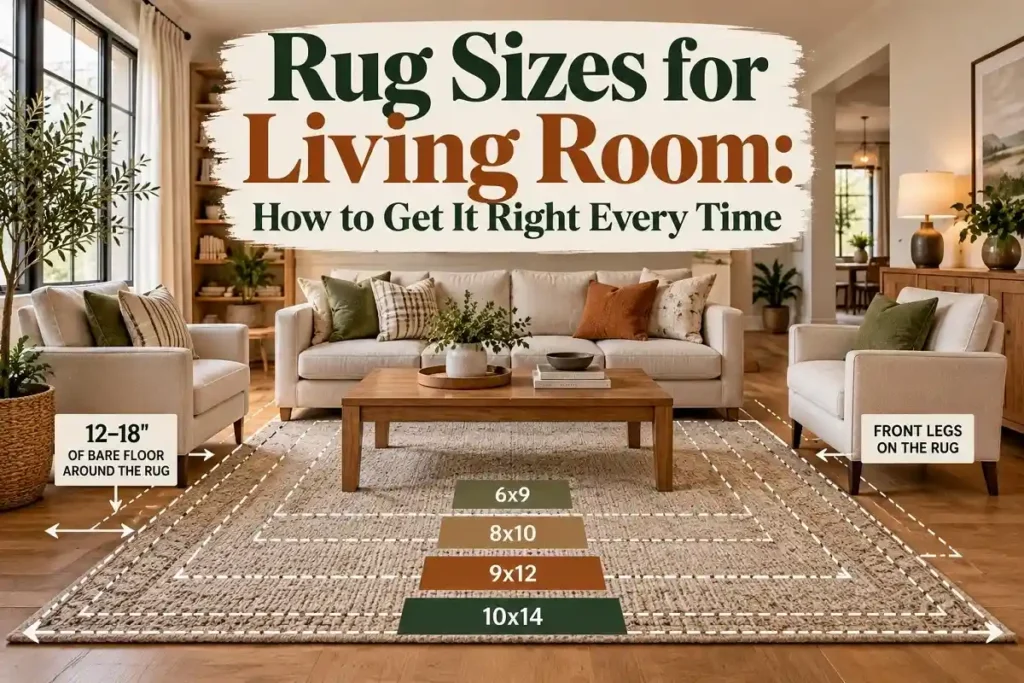
An 8×10 rug works for many medium living rooms, while a 9×12 gives a larger sofa, sectional, or seating group more room. A 5×8 or 6×9 can work in a small living room. Large seating areas may need a 10×14 or 12×15.
Do not choose by room size alone. The rug should fit your seating area. At minimum, try to get the front legs of the sofa and main chairs onto the rug. In a larger room, you can put the entire seating group on it.
If you are stuck between two sizes, mark both on the floor with painter’s tape before you buy. You will see right away which one fits the furniture and walking paths better.
- 5×8: Small living room or compact seating group
- 6×9: Small room where a 5×8 does not reach enough furniture
- 8×10: Medium living room with a sofa and chairs
- 9×12: Larger seating group or many sectional layouts
- 10×14: Large living room or open-plan seating zone
- 12×15: Very large room or furniture group
Choose the Rug Around the Furniture
Room square footage can narrow your choices, but it cannot tell you the right rug size by itself.
A 12-by-16-foot living room with a loveseat and two small chairs may need a different rug than a room of the same size with a deep sectional.
Instead, arrange the sofa and chairs first. Then choose one of these three layouts.
All Legs on the Rug
Put the sofa, chairs, and other main seating fully on the rug.
This works well in large living rooms and open floor plans because the rug creates a clear boundary around the seating area.
The rug should extend beyond the furniture rather than stopping directly at the legs.
Front Legs on the Rug
Put the front legs of the sofa and chairs on the rug while the back legs stay on the floor.
This is a practical choice when you want the rug to connect the furniture without buying one large enough to sit under every piece.
For many living rooms, this is the easiest layout to get right.
Furniture Off the Rug
A smaller rug can sit inside the seating area with the furniture legs off it. This is most useful in compact rooms.
Be careful with scale. If the rug sits only under the coffee table with a large gap before the sofa and chairs, it can look disconnected from the seating area.
What Size Rug Do You Need?
| Rug Size | Good Starting Point For |
|---|---|
| 5×8 | Compact seating arrangements and small living rooms |
| 6×9 | Small rooms that need more coverage than a 5×8 |
| 8×10 | Medium rooms with a standard sofa and one or two chairs |
| 9×12 | Larger furniture groups and many sectional layouts |
| 10×14 | Large living rooms and open-plan seating zones |
| 12×15+ | Oversized rooms and large furniture groups |
Use the table to find a size worth testing, not as a rule. Sofa depth, chair placement, room shape, and walkways can change the answer.
Measure the Area the Rug Actually Needs to Cover
Leave the furniture where you want it before measuring.
- Measure the full width of the seating group.
- Measure from the front of the seating area to the back.
- Decide whether you want all legs or only front legs on the rug.
- Find the closest standard rug size.
- Mark that size on the floor with painter’s tape.
Now walk through the room as you normally would.
Check the doorway, path around the coffee table, route to nearby rooms, fireplace hearth, floor vents, and any doors that swing over the proposed rug.
This catches problems that room measurements alone cannot show.
Check the Rug Width Against the Sofa
A rug can be long enough for the room and still look too narrow under the sofa.
As a starting point, look for some rug showing beyond both ends of the sofa. Around 6 to 8 inches per side is a useful check, but it does not need to be exact.
A sectional, chaise, fireplace, or narrow room may require a different amount.
The important test is simple: the rug should look wide enough to belong to the whole seating group, not just the coffee table.
Leave Some Floor Around the Rug
You do not need exactly 18 inches between the rug and every wall.
For a large rug with all the furniture on it, about 12 to 18 inches of exposed floor is a useful starting range. Smaller rooms may need less.
Do not sacrifice a good furniture layout just to hit that number. Doors, fireplaces, built-ins, and unusual room shapes matter more than maintaining the same border on every side.
Small Living Room? Do Not Automatically Buy a Small Rug
A small room can still need an 8×10 rug.
If a 5×8 sits in the middle of the seating area without reaching the sofa or chairs, moving up a size can connect the furniture better.
Test the larger size before ruling it out. If an 8×10 reaches the front furniture legs, leaves usable walking space, and does not crowd the walls, it may work better than the smaller rug.
A 5×8 or 6×9 still makes sense when the furniture itself is compact. Match the rug to the seating footprint, not the label “small living room.”
Sectionals Need Their Own Measurement
Do not choose a rug for a sectional based only on the room dimensions.
Measure the full sectional, including the chaise. Then decide whether the rug will sit under all of it or only the front portion.
A compact sectional may work with an 8×10. A larger L-shaped sectional may need a 9×12 or 10×14.
Watch the chaise when you tape the rug outline. A rug that reaches the sofa but stops awkwardly halfway across the chaise may need to be larger or turned in the other direction.
Use the Rug to Mark an Open-Plan Seating Area
In an open floor plan, measure the living area rather than the entire open room.
The rug should connect the sofa and chairs and help show where the living zone ends. It does not need to extend toward the dining table or kitchen simply because those spaces share the same floor.
Also check the main path between zones. Avoid placing a rug edge where people constantly cross between the living room and kitchen or dining area if another size or orientation gives you a cleaner route.
Try Turning the Rug Before Changing Sizes
Sometimes the dimensions are fine but the orientation is wrong.
In a long living room, the long side of a rectangular rug will often work best in the same direction as the main seating group.
Sectionals and asymmetrical layouts are less predictable. Tape the rug in both directions before deciding you need another size.
Rotating an 8×10 costs nothing. Replacing it with a 9×12 does.
When a Standard Rug Size Does Not Fit
You do not have to force an 8×10 or 9×12 into an unusual room.
A custom-size rug can make sense when one standard size looks too small but the next one blocks a doorway, crowds a fireplace, or extends too far into another zone.
Before ordering a custom size, tape its exact dimensions on the floor. Check the layout for a few days if possible, since custom rugs may be harder to return or exchange.
Quick Answers
What is the best rug size for an average living room?
An 8×10 is a good size to test first in many medium living rooms. If it does not reach the front legs of the main seating or looks narrow against the sofa, test a 9×12.
Should a living room rug go under the sofa?
It does not have to go under the entire sofa. At minimum, placing the sofa’s front legs on the rug is a reliable way to connect it to the seating area.
Should a rug be wider than the sofa?
Usually, yes. Having some rug extend beyond each end of the sofa helps the rug look proportional to the seating group. Around 6 to 8 inches per side is a useful starting point.
Is an 8×10 rug big enough for a living room?
It often is for a medium living room, especially with a front-legs-on layout. Measure your actual furniture before buying because a large sectional may need a 9×12 or larger.
Is a 5×8 rug too small for a living room?
Not always. A 5×8 can work with a compact furniture group or a floating-rug layout. It is usually too small when it sits under the coffee table but does not visually connect to the sofa or chairs.
What size rug works with a sectional?
There is no single sectional rug size. An 8×10 may work with a compact sectional, while larger sectionals often need a 9×12 or 10×14. Measure the sofa and chaise together before choosing.
How far should a living room rug be from the wall?
About 12 to 18 inches of exposed floor is a useful starting point for many layouts, but smaller rooms can use less. Furniture placement and clear walking paths matter more than hitting an exact number.
What should I do if I am between two rug sizes?
Mark both sizes with painter’s tape. Choose the one that connects the seating better without blocking doors, crowding the walls, or creating an awkward walking path.
Measure First, Then Shop
Choose the furniture layout before choosing the rug.
Measure the seating group, decide which furniture legs will sit on the rug, and tape the closest standard size on the floor. Check the sofa, chairs, doors, fireplace, and walking paths before you buy.
If the first size does not work, test the next one. That is more reliable than choosing a rug from room square footage alone.