What Does a Professional Deep Oven Clean Cover in Croydon?
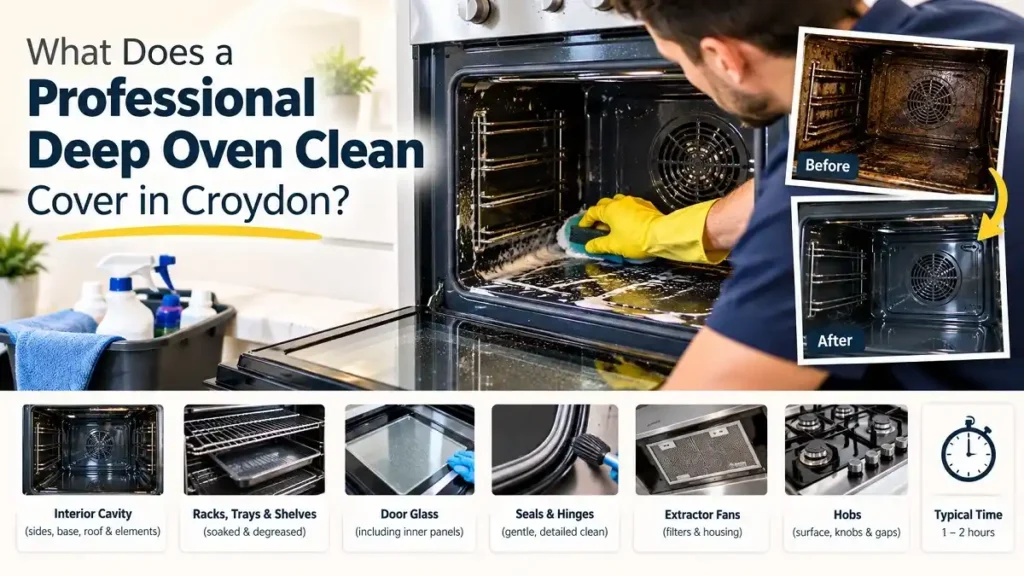
A professional oven deep clean goes beyond a quick wipe-down, targeting the burnt-on grease and carbon buildup that accumulate inside your oven over time.
The process typically covers the interior cavity, racks, trays, door glass, and seals, using specialist degreasing products not usually found in your local store.
To help you set realistic expectations before booking and make it easier to compare quotes, here’s exactly what expert cleaning usually covers.
Table of Contents
What A Professional Oven Deep Clean Typically Includes
A standard deep oven cleaning in Croydon includes the full interior cavity of the oven, including the base, sides, roof, and any visible heating elements that can be safely accessed.
Grease and carbon build-up is broken down using specialist, oven-safe degreasing products rather than standard household cleaners.
Racks, trays, and shelves are usually removed entirely and soaked separately, often in a dedicated dip tank, so they can be cleaned far more thoroughly than they would be left inside the oven.
Most professional cleans also include a final wipe and polish of the interior once grease has been broken down, leaving surfaces streak-free rather than just visibly cleaner.
Interior light covers and pan supports are also removed and cleaned where possible, since grease often collects unnoticed around these fittings. Leaving them in place would mean an otherwise thorough clean missing a visibly grubby spot once everything else looks fresh.
How Racks, Trays, And Removable Parts Are Cleaned
Removable parts are typically soaked in a specialist solution that loosens baked-on grease, so they don’t need to be scrubbed by hand straight away. This soaking stage often takes the longest part of the whole visit.
Once loosened, remaining residue is scraped or brushed away before each part is rinsed and dried thoroughly. Chrome racks in particular come up noticeably brighter once years of built-up grime have been removed.
Some professional services also clean grill pans, oven trays, and even microwave interiors as add-ons during the same visit, since the same dip-tank soak works well for other kitchen items.
A quick inspection at the end of the soak lets the technician spot any residue that needs a second pass before everything is dried and refitted.
Dealing With Grease, Carbon, And Burnt-On Residue
Heavy carbon deposits are usually softened with a specialist gel or paste before being scraped away with tools designed not to scratch the oven’s interior coating. This is a very important step that often needs the longest dwell time of the whole clean.
Ovens that haven’t been deep cleaned in a year or more often need a longer soak and a repeat application in the worst-affected spots, such as the base beneath the heating element.
Self-cleaning ovens still benefit from a professional deep clean occasionally, since the built-in pyrolytic function doesn’t always reach every corner or fully clear grease from the door glass.
Enamel and stainless steel interiors respond differently to the same treatment, so professionals often adjust the solution strength and dwell time based on the oven’s interior finish. Using too strong a solution on a delicate finish risks dulling it rather than restoring its shine.
Glass Doors, Seals, And Hard-To-Reach Areas
Oven door glass often has more grease trapped between the layers than is visible from the outside, and a full clean sometimes involves separating the panels to clean between them properly.
Rubber door seals are wiped down carefully, since they perish if scrubbed too aggressively.
Corners, hinges, and the narrow gap around the door are usually cleaned with smaller brushes or detail tools that reach where a cloth can’t. These areas often hold the most stubborn, longest-standing grime in the whole appliance.
Where a door’s inner glass panel isn’t designed to be separated, professionals will typically clean as far as they safely can without risking the seal on the glass unit.
Extractor Fans And Hobs: Are They Included?
Extractor fans and hobs are sometimes included in an oven clean package and sometimes quoted as separate add-ons, so it’s worth checking exactly what a booking covers before assuming everything nearby is included.
Extractor filters often need degreasing in the same solution used for oven racks.
Hob cleaning typically includes the surface, control knobs, and the gap where the hob meets the worktop, which easily collects spilt food and grease. Gas hob burners and grates are often removed and soaked in the same way as oven racks.
Bundling an oven, hob, and extractor clean into a single visit is usually more cost-effective than booking each separately, since the technician is already on site with the same equipment and solutions.
Induction hobs need a slightly different approach again, since the glass surface scratches more easily than gas or ceramic equivalents and calls for non-abrasive products throughout.
Letting the technician know the hob type in advance means the right products are brought along on the day and no time is wasted.
How Long A Professional Oven Clean Usually Takes
A single oven deep clean typically takes between one and two hours, depending on how much built-up grease and carbon needs to be broken down. A heavily neglected oven can take noticeably longer than one cleaned every few months.
Adding a hob, extractor fan, or a second oven extends the visit, so it helps to mention every appliance that needs attention when booking rather than adding them on the day.
Most of the visit is spent on soaking and dwell time rather than active scrubbing, so the oven is often unusable for cooking until the appointment is complete.
Ovens with double cavities or range cookers naturally take longer than a single built-in oven, simply because there’s more surface area and more removable parts to work through.
Conclusion
A good professional oven clean leaves the interior, racks, door glass, and seals free of grease and carbon, not just wiped over on the surface. It makes all the difference in the world in how your food tastes and how long the appliance lasts.
Booking regularly, rather than waiting until residue has built up for years, keeps each visit shorter and the results more consistent.
And if you’re moving out of a rental, the experts can restore the oven to your landlord’s standards so you don’t incur any deposit deductions. This saves you money and needless stress, and ultimately ensures a much smoother relocation.