How to Choose a Glass Table: Safety, Thickness and Care
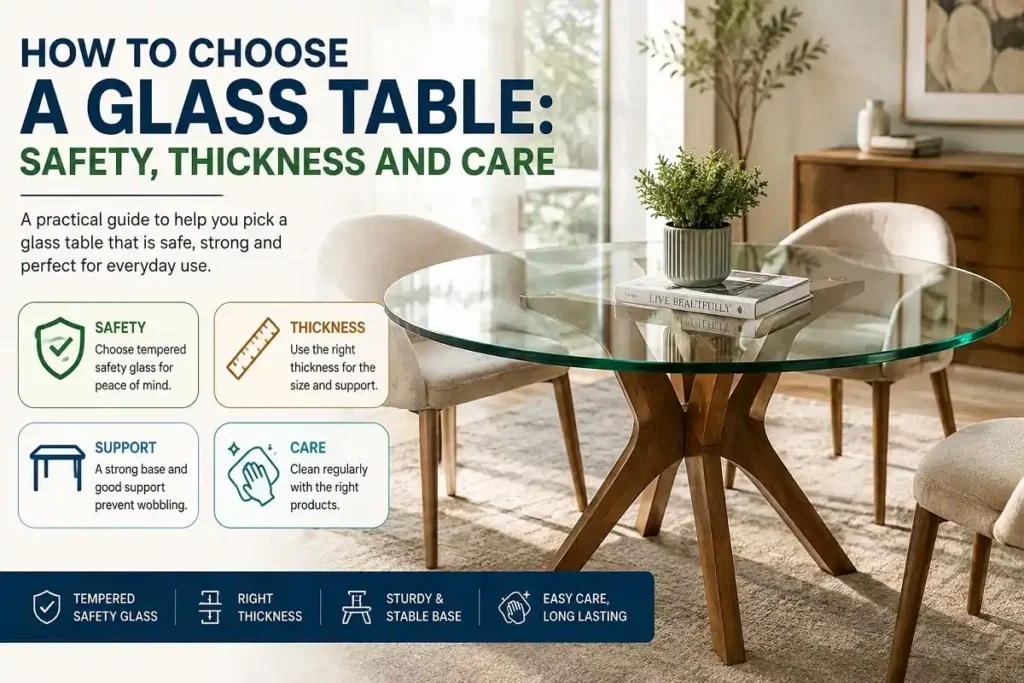
A glass table can make a crowded room feel lighter without taking away useful surface space. But its clear top can hide an important fact: two tables that look almost identical may differ greatly in safety, stability, and durability.
The best choice depends on more than style. You need to consider the type of glass, how the top is supported, its thickness, the edge finish, and how the table will be used each day.
I would check those details before comparing colors or base designs. A beautiful table is not a good purchase if it wobbles, scratches easily, or feels unsafe around children.
This guide explains how to choose a glass table that fits your room and holds up to real use.
Start With Tempered Safety Glass
The product description should clearly state that the tabletop is made from tempered or toughened safety glass. Do not assume that every glass table uses it.
Tempered glass is processed to make it stronger than ordinary annealed glass. If it breaks, it usually crumbles into many small pieces instead of forming long, sharp shards. This does not make the table unbreakable, but it helps reduce the chance of severe cuts.
Use this quick check before trusting a product description:
Exact glass thickness
Tested weight capacity
Polished, undamaged edges
The base wobbles
Edges have chips
No weight limit is provided
Let the Support System Determine the Thickness
There is no single correct thickness for every glass table. The required thickness changes with the size of the top, the distance between supports, the amount of overhang, and the loads placed on it.
A protective glass cover resting directly on a solid wooden table needs less structural strength than a freestanding glass top supported at only four points.
These ranges are useful starting points, not universal engineering specifications. A custom glass supplier should calculate the suitable thickness for the actual dimensions and support arrangement.
Long panels and pedestal bases need particular attention. The farther the glass extends beyond its support, the more leverage is placed on the center and mounting points.
Measure the Room Before Choosing the Shape
A transparent table can look smaller than it really is. The floor space it occupies, however, does not change.
Mark the proposed tabletop dimensions on the floor with painter’s tape. Pull the dining chairs out as though people were sitting in them. Then walk behind the chairs and check the route to doors, cabinets, and counters.
Allow approximately:
- 36 inches between the table and a wall for basic chair movement
- 42-48 inches where people regularly walk behind seated diners
- Enough clearance for cabinet and appliance doors to open
- A safe route that does not place sharp corners in a busy walkway
A round glass table works well in a compact square room because it removes projecting corners. It can also make conversation easier.
A rectangular table uses length efficiently and usually provides more seating. An oval top softens its visual footprint while keeping much of a rectangular table’s capacity.
Inspect the Base as Carefully as the Glass
Many glass-table problems begin underneath the top.
A narrow base can make a large top feel unstable. Poorly positioned supports can allow the glass to flex. Hard metal contact may also create concentrated pressure unless suitable pads or mounting components are used.
Before buying, check whether:
- The table rocks when pressure is applied near an edge
- The base sits flat on the floor
- Protective pads separate the glass from hard supports
- Suction cups or fasteners are intact
- The tabletop is centered on the base
- The manufacturer approves the top-and-base combination
I would also press gently near each usable edge in the showroom. Any movement, clicking, or uneven contact deserves an explanation before the table reaches your home.
Choose Edges and Corners for the Way You Live
The edge finish changes both the appearance and everyday comfort of a glass table.
A flat-polished edge has a clean, modern appearance. A beveled edge catches more light and adds a decorative border. Rounded corners reduce the severity of everyday bumps, making them a sensible choice for tight rooms and active households.
Inspect the entire perimeter. The finish should feel consistent, with no rough sections, chips, or unexpectedly sharp points.
Chipped tempered glass should be assessed by a glass professional. Damage around corners, holes, and edges matters because those areas can be vulnerable to impact.
If small children regularly use the room, rounded corners and properly attached guards can reduce bump injuries. They do not turn an unsuitable or damaged table into a safe one.
Clear, Tinted, Frosted, or Low-Iron Glass?
Clear glass creates the lightest visual effect and keeps an attractive base visible. It also reveals fingerprints, crumbs, and dust quickly.
Smoked or tinted glass adds contrast and may look less stark in rooms with dark furniture. Some marks, however, become more visible when light strikes the surface.
Frosted or acid-etched glass offers more visual privacy and can hide some fingerprints. Its textured finish may need more careful cleaning because residue can settle into the surface.
Decide Whether Glass Fits Your Household
Glass is not automatically the best table material.
It works well when you want open sightlines, an easy-to-wipe surface, or a sculptural base that deserves attention. It can be especially effective in a smaller dining room where a solid top feels visually heavy.
There are trade-offs:
- Fingerprints and dust appear quickly.
- Plates and cutlery can sound louder on the surface.
- Scratches may be difficult to remove completely.
- A thick top can be extremely heavy.
- Transparent edges may be harder to notice in a busy walkway.
- Clear glass can expose clutter beneath the table.
Prevent Scratches Instead of Trying to Remove Them
Tempered glass is strong, but it is not scratch-proof.
Fine scratches commonly come from ceramic dishes, gritty dust, metal decorations, and objects dragged across the surface. Once a scratch is deep enough to catch a fingernail, DIY polishing may distort the finish without making the damage disappear.
Use:
- Coasters under drinks
- Placemats under dishes
- Felt pads beneath decorative objects
- A soft microfiber cloth for dust
- Trivets under hot cookware
- Two people when lifting or repositioning a large top
Never slide a rough vase, plant pot, or ceramic bowl across the table. Lift it instead.
Clean Glass Without Leaving a Hazy Film
Start with a clean microfiber cloth. Remove loose grit before wiping with moisture so particles are not dragged across the surface.
- Wipe away dry dust and crumbs.
- Apply a small amount of suitable glass cleaner to the cloth.
- Clean the top in overlapping passes.
- Dry it with a second microfiber cloth.
- Inspect the surface from an angle for residue.
Avoid abrasive pads, gritty powders, and aggressive scraping. Take extra care with coated, printed, tinted, or frosted glass because the manufacturer may specify different products.
Do not spray excessive liquid around attachment points or beneath a removable top. Moisture trapped between glass and wood can mark the underlying finish.
A persistent cloudy film may come from cleaner residue rather than damage. Try a fresh cloth and use less product before moving to a stronger cleaning method.
Use This Final Check Before You Buy
A suitable glass table should pass more than a visual test. Confirm these points:
- The top is identified as tempered or otherwise suitable safety glass.
- Its thickness matches the dimensions and support system.
- The manufacturer states a weight limit.
- Edges and corners are polished and undamaged.
- The base does not wobble.
- Support pads and mounting hardware are correctly positioned.
- The table leaves enough movement space in the room.
- Its cleaning demands suit your household.
- Replacement parts or a matching top can be sourced later.
- Delivery includes safe handling and installation where needed.
I would walk away if the seller cannot identify the glass type, explain the support system, or provide basic specifications. Those details matter more than a fashionable base or temporary discount.
A Lighter Room Still Needs a Well-Built Table
The right glass table can open sightlines, reflect light, and make a strong base feel less dominant. Its success depends on details you cannot judge from a styled product photo.
Begin with safety glass. Match the thickness to the table’s size and support. Check the base, edges, clearance, and daily cleaning demands before deciding whether the design belongs in your home.
When those points are right, a glass table can feel light without being fragile and practical without disappearing into the room.