
Bench With Drawer Storage: What to Check Before You Buy
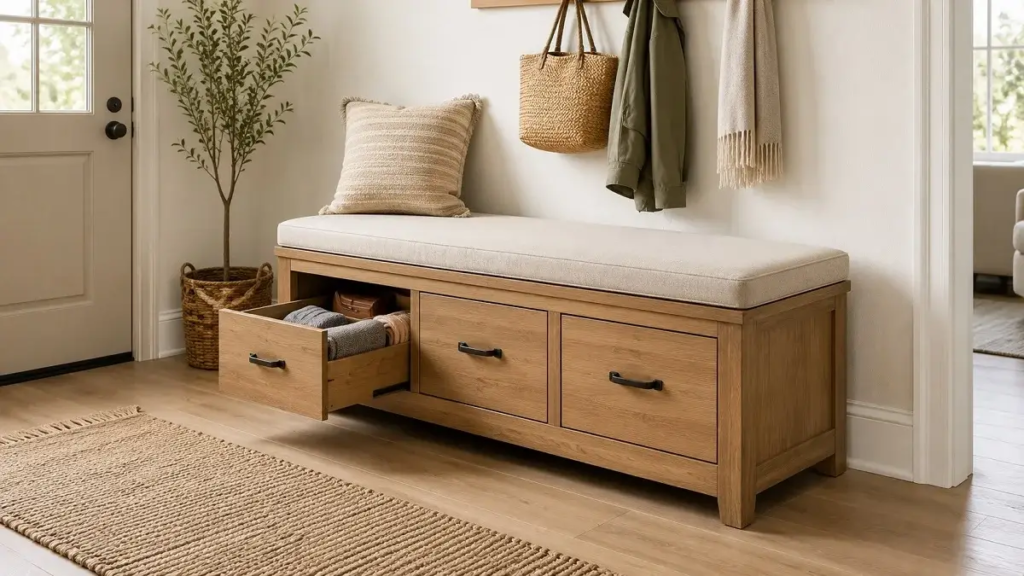
A bench with drawer storage should fit the room, open without hitting anything, hold the items you plan to store, and safely support anyone who sits on it. Before you buy, check five details: overall dimensions, drawer clearance, usable drawer size, separate weight ratings, and frame and slide construction.
A good-looking bench can still become an expensive obstacle if it narrows a walkway or has drawers too shallow for your shoes. The checks below help you compare listings without relying on promotional language or staged photos.
Table of Contents
- Decide What the Bench Needs to Store
- Measure the Space and the Drawer’s Opening Path
- Check Interior Drawer Dimensions, Not Just Bench Size
- Verify Seating and Drawer Weight Limits Separately
- Examine the Frame, Panels, and Connections
- Check Drawer Slides and Hardware
- Compare Drawers, Lift-Top Storage, and Open Cubbies
- Match the Bench to the Room
- Review Upholstery, Cleaning, and Moisture Risks
- Read the Assembly, Warranty, and Return Terms
- Inspect the Bench After Delivery
- Final Bench With Drawer Storage Checklist
- Frequently Asked Questions
Decide What the Bench Needs to Store
Start with the items, not the furniture. Make a short list of what must go inside: low shoes, winter boots, gloves, pet supplies, folded linens, toys, bags, or seasonal accessories.
Drawers are useful for smaller items accessed often. Separate compartments prevent gloves, leads, chargers, and shoes from becoming one pile. However, several shallow drawers may hold less than one large lift-top compartment.
Measure the largest item you expect to store. Boots need more height than sneakers. Folded comforters need a deep, wide compartment. A product labeled “large storage” may still have a drawer only a few inches high.
Frequency matters too. Daily items need quick access. Seasonal blankets can sit in a less convenient compartment. If everyone drops shoes at the door, open cubbies may provide better ventilation and faster access than closed drawers.
Measure the Space and the Drawer’s Opening Path
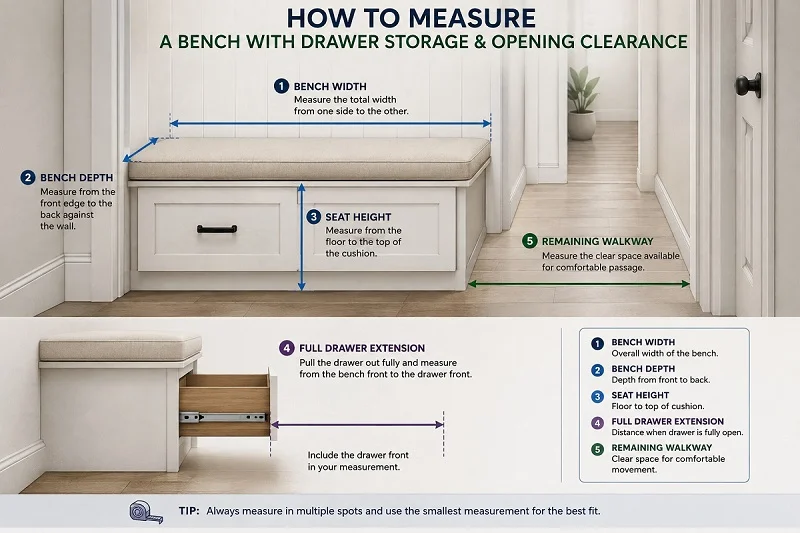
Measure the available wall width, floor depth, and usable height. Then identify baseboards, outlets, floor vents, radiators, trim, and doors that affect placement. Record the smallest usable measurement rather than the widest open point.
A comfortable seat commonly falls near standard chair height, but the product’s stated height should suit its users. Children may find a lower seat easier, while some adults may struggle to rise from a low bench.
Depth has a direct effect on traffic flow. In a narrow hall, mark the proposed front edge with painter’s tape. Walk past it while carrying bags and open the nearby door fully. This simple test is more reliable than judging a listing photo.
Allow Room for the Drawers to Open
The bench can fit against a wall while its drawers remain unusable. Measure the drawer’s full extension, then add room for your hand and body. Check whether an opposite wall, bed, console, or open door blocks that path.
Full-extension slides allow the drawer to come farther forward, improving access to items at the back. They also demand more open floor area. Partial-extension slides need less reach but can hide part of the usable compartment.
Check Interior Drawer Dimensions, Not Just Bench Size
Exterior dimensions include the frame, panels, legs, drawer front, and slide hardware. They do not show how much usable space remains inside. Look for interior width, depth, and height for each drawer.
For example, a bench can be more than 40 inches wide while using two drawers that are each under 12 inches wide. A drawer only four inches high may suit gloves but not upright footwear.
If the listing omits interior measurements, ask the seller or manufacturer. Do not estimate capacity from product images because wide-angle photography and small props can distort scale.
Use a cardboard box or taped floor outline matching the stated interior dimensions. Place the intended shoes or linens inside it. This quick test shows whether the drawer works before delivery.
Verify Seating and Drawer Weight Limits Separately
A seating rating does not tell you how much each drawer can hold. Manufacturer documents may provide separate limits for the bench top, drawers, cabinets, or internal base. Read each figure independently.
One documented storage bench lists a top capacity of 177.8 pounds, a 22-pound drawer limit, and a 44-pound cabinet limit. This difference shows why a strong seat does not guarantee heavy-duty drawers.
“Evenly distributed” means the load must be spread across the supported surface. Concentrating weight on one edge or standing on the bench creates a different load and may exceed the design.
If the manufacturer provides no seating limit, do not assume the unit is suitable for adults. A storage chest, toy organizer, or decorative cabinet may resemble a bench without being designed as a seat.
Examine the Frame, Panels, and Connections
Material names help, but construction matters just as much. A solid wood label does not guarantee strong joints, and an engineered panel is not automatically unsuitable for light indoor use.
| Material | Useful qualities | Limitations | Suitable setting |
|---|---|---|---|
| Solid wood | Strong, repairable, and often refinishable | Costs more and can move with humidity | Regular-use entryways and bedrooms |
| Plywood | Stable and strong for its weight | Quality and edge finishing vary | Everyday household use |
| MDF | Smooth finish and moderate cost | Edges and fasteners can suffer after moisture exposure | Dry bedrooms or living rooms |
| Particleboard | Lower price and light weight | Limited moisture resistance and weaker screw retention | Light use in dry spaces |
| Metal frame | Strong with a lighter visual profile | Finish can scratch or corrode | Dry modern interiors |
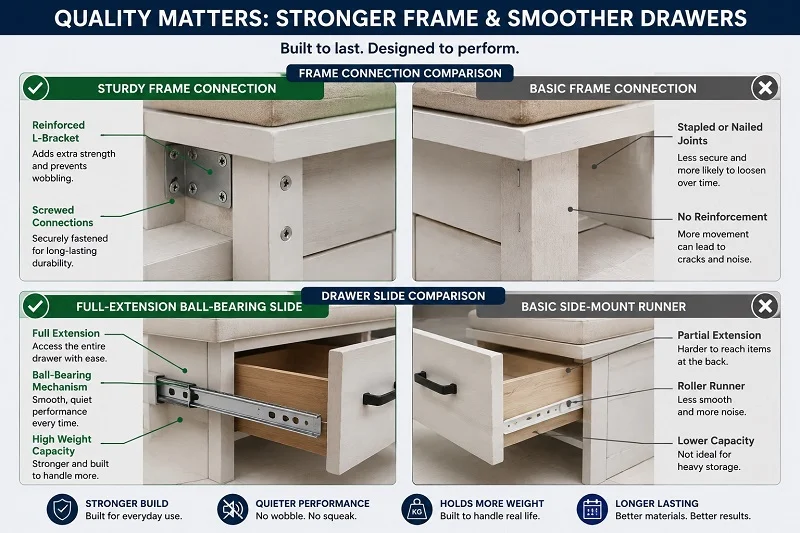
Look for corner blocking, center support on wider seats, secure leg connections, and panels thick enough for the span. Reviews mentioning repeated wobble, pulled-out screws, or a sagging center deserve more attention than comments about color.
Check Drawer Slides and Hardware
Drawer hardware often determines whether the bench remains pleasant to use. Ball-bearing slides usually move more smoothly under repeated loads than basic plastic runners. Full-extension slides provide better access to the back.
Soft-close hardware reduces slamming, but it does not increase the drawer’s load rating. Drawer stops help prevent accidental removal. In homes with children, check that stops and handles do not create avoidable pinch or snag hazards.
Look for a stated slide capacity and a way to adjust alignment. Replacement parts are valuable because handles and slides can wear before the main frame. Reviews that mention sticking should be checked for assembly errors as well as hardware failure.
Compare Drawers, Lift-Top Storage, and Open Cubbies
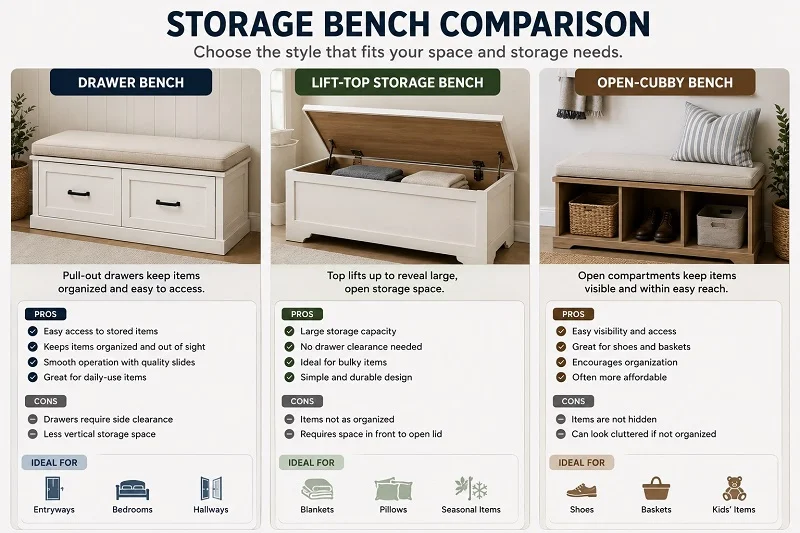
No mechanism is best for every home. Choose according to the items, access frequency, available clearance, and tolerance for visible clutter.
| Feature | Drawers | Lift-top compartment | Open cubbies |
|---|---|---|---|
| Access | Fast for sorted daily items | Seat must be lifted | Immediate |
| Best storage | Shoes, gloves, accessories, linens | Bulky blankets and seasonal items | Shoes, baskets, and children’s items |
| Clearance | Required in front | Required above | No moving-panel clearance |
| Organization | Built-in separation | One large space can become mixed | Baskets can create sections |
| Visibility | Mostly concealed | Concealed | Visible unless baskets are used |
| Ventilation | Limited unless designed with vents | Limited | Better for damp footwear |
Drawers suit frequent access and smaller categories. Lift-top storage favors bulky items used less often. Cubbies suit quick drop-off and wet shoes. A hybrid bench can combine a small drawer with open footwear storage.
Match the Bench to the Room
Entryway
Prioritize walking clearance, a stable seat, durable surfaces, and access to daily items. Check the front-door swing and avoid handles that project into a narrow path.
Mudroom
Moisture resistance and cleaning matter more here. Closed drawers can trap damp footwear and odors, so use them for dry accessories unless the design provides suitable ventilation.
Bedroom
A drawer bench can hold folded linens or clothing while providing a dressing seat. At the foot of a bed, leave enough space to walk and open the drawers without hitting the bed frame.
Living Room
Check whether the bench will serve as occasional seating, storage, or a table-like surface. Upholstery improves comfort but is less practical under drinks, plants, or heavy daily wear.
Review Upholstery, Cleaning, and Moisture Risks
A removable, washable cushion is easier to maintain in a busy entry. Tightly woven performance fabrics generally release dirt more easily than delicate, loosely woven materials. Check the manufacturer’s care instructions before using cleaners.
Inspect whether the cushion attaches securely or slides when someone sits. If the bench stands near a sunny window, ask about fading. Pet owners should also consider hair, scratching, and snag resistance.
Use floor pads suited to the flooring material. Wet items should dry before entering closed storage. Periodically check fasteners because repeated sitting and drawer movement can loosen hardware.
Read the Assembly, Warranty, and Return Terms
Confirm whether the bench arrives assembled, partly assembled, or flat-packed. Review the tools, estimated assembly time, package count, and procedure for missing hardware. “Easy assembly” is not a measurable specification.
Check whether the warranty covers the frame, upholstery, and drawer hardware for the same period. Also review return shipping, restocking charges, and whether an assembled product can be returned.
Keep the packaging until the unit passes inspection. Large furniture can be expensive to send back, so unclear return terms may matter as much as a small price difference.
Inspect the Bench After Delivery
- Check the package and panels for damage.
- Confirm that all parts and hardware are present.
- Assemble it on a protected, level floor.
- Check for wobble before loading the drawers.
- Open every drawer fully and inspect alignment.
- Make sure fronts do not rub or leave uneven gaps.
- Confirm that stops and soft-close parts work.
- Tighten connections according to the instructions.
- Test the seat gradually within its stated limit.
- Keep documents and packaging until you accept the item.
Final Bench With Drawer Storage Checklist
- The bench fits the available wall and floor space.
- The remaining walkway is comfortable.
- Doors, vents, and trim remain clear.
- Every drawer can open fully.
- Interior dimensions suit the planned items.
- The seating and per-drawer ratings are stated separately.
- Frame materials and connections suit the expected use.
- Slide type and replacement options are clear.
- Upholstery and finish suit the room’s moisture and cleaning needs.
- Assembly, warranty, and return terms are acceptable.
The right bench is not the one with the strongest sales claim. It is the one whose measurements, ratings, materials, access, and policies match your room and routine. If important specifications are missing, ask before ordering or compare another model.
Frequently Asked Questions
What is a comfortable height for a storage bench?
A height close to a standard dining chair works for many adults, but comfort varies. Compare the stated seat height with a chair you already use comfortably.
Are drawer benches suitable for storing shoes?
They can work for dry footwear if the internal dimensions fit. Wet shoes need ventilation and should dry before being placed in a closed drawer.
Should a storage bench be anchored to the wall?
Follow the manufacturer’s instructions. Taller units, hall-tree combinations, and furniture used around children may require anti-tip anchoring. A low bench still needs a stable base and level placement.