Cubitac vs Fabuwood: A Complete 2026 Cabinet Comparison (Most Guides Won’t Tell You)
If you’ve spent any time researching kitchen cabinets, you’ve probably landed on a Cubitac vs Fabuwood comparison already — and noticed they all say roughly the same thing: both are New Jersey-based, semi-custom, plywood-box brands; Fabuwood includes Blum hardware as standard; Cubitac wins on color choice and price. All true.
But there’s a piece of this story that almost nobody selling you these cabinets is mentioning, and it matters more than which brand has more paint colors. We’ll get to it right after the quick verdict.
Quick Verdict
- Choose Fabuwood if you want guaranteed Blum hardware across every line, a genuine frameless option, documented sustainability certifications, and a manufacturer with no pending financial or fulfillment risk.
- Choose Cubitac if budget is the deciding factor, you want the widest color and finish selection, and you’re working with a dealer who can confirm current stock and lead times in writing.
- Neither is the right call if you need true full-custom sizing (look at KraftMaid or Omega) or you’re outfitting a short-term rental on the tightest possible budget (look at stock cabinets from a big-box retailer instead).
Before You Buy: What Cubitac’s 2024 Bankruptcy
This is the part of the comparison most articles skip entirely, and it’s arguably the single most important thing to know before signing a quote.
Cubitac Corp filed for Chapter 11 bankruptcy protection in the U.S. Bankruptcy Court for the District of New Jersey on October 28, 2024 (case #2:24-bk-20659). Chapter 11 is a reorganization filing rather than a full shutdown — companies that file it are generally trying to restructure debt and keep operating rather than liquidate — but public court filings also show a subsequent UCC Article 9 notice covering the sale of certain personal property belonging to Cubitac Corp and an affiliated entity, Cabitac Corp, initiated on behalf of a secured lender. In plain terms: the company went through financial distress serious enough to end up in bankruptcy court, and at least some of its assets were put up for a secured-creditor sale afterward.
What this actually means for a homeowner shopping today:
- It doesn’t automatically mean you can’t buy Cubitac cabinets. Companies routinely continue selling product through and after a Chapter 11 filing.
- It does mean warranty and fulfillment certainty is lower than it would be for a financially stable manufacturer. A 5-year or lifetime warranty is only as good as the company that has to honor it.
- Lead times and stock availability may be less predictable than a brand’s website claims, since production and distribution can be affected during a reorganization.
- You should ask your dealer directly whether they’ve had any recent fulfillment issues, whether warranty claims are still being processed normally, and get everything in writing before you order — not just for Cubitac, but this brand specifically given the above.
None of this means Cubitac cabinets are bad cabinets. The build quality discussed below hasn’t changed. But “which brand builds a better box” and “which brand can I trust to still be answering the phone in five years if a hinge fails” are two different questions, and most comparison articles only answer the first one. If a warranty backing you for the life of your kitchen matters to you, this is a real factor to weigh — not just a footnote.
What Are Cubitac Cabinets?
Cubitac is a semi-custom cabinet brand founded in 2011 and headquartered in Ridgefield, New Jersey. The company sources materials internationally and assembles domestically, with hand-sanding and hand-glazed finishing done in New Jersey. Cubitac’s product line spans four tiers — Imperial, Prestige, Basic, and Presto — across roughly 18 door styles in traditional, transitional, and modern profiles. Cubitac builds framed cabinets only; there’s no frameless line in its catalog.
What Are Fabuwood Cabinets?
Fabuwood is a semi-custom brand launched in 2009 and based in Newmark, New Jersey. It builds around a self-defined “Q12” standard — a 12-point internal specification covering material and construction requirements — and sources parts globally with domestic assembly. The current lineup includes Allure, Illume, and Ovela, plus Value Premium and Quest at different price points, spanning both framed and frameless construction with door designs across all three major style categories. Fabuwood publishes FSC-certified wood sourcing and CARB2 compliance, and its finishes are marketed as low-VOC.
Hardware, Line by Line — Not Just “Standard vs. Upgrade”
Every comparison article mentions that Fabuwood includes Blum hardware as standard and Cubitac treats it as an upgrade. That’s true, but it undersells the real difference, which is which specific lines get it.
1. Fabuwood
Blum soft-close hinges and undermount drawer slides are standard across essentially all of its main collections — entry-level and flagship lines get the same Austrian-made hardware.
2. Cubitac
Blum hardware is reserved for the Imperial line. The Prestige, Basic, and Presto tiers ship with unbranded soft-close mechanisms rather than Blum, and upgrading to Blum on those tiers costs extra.
Why this matters beyond the spec sheet: hinges and drawer glides are the parts that get used the most — opened and closed daily for years — so they’re also the first parts to reveal a quality gap. Blum mechanisms are rated for hundreds of thousands of cycles and replacement parts are widely available almost anywhere. Unbranded soft-close hardware can perform fine for years, or it can loosen and fail early; it’s inconsistent in a way branded hardware generally isn’t. If you’re comparing a Cubitac quote against a Fabuwood quote at a similar dollar figure, know that the Fabuwood number already has the better hardware baked in — a like-for-like Cubitac comparison should really be against Cubitac Imperial, not Basic or Presto.
Framed vs. Frameless: The Difference Nobody Explains Clearly
This is a genuine construction distinction that changes what’s actually possible in your kitchen layout, and most comparisons mention it in a single sentence if at all.
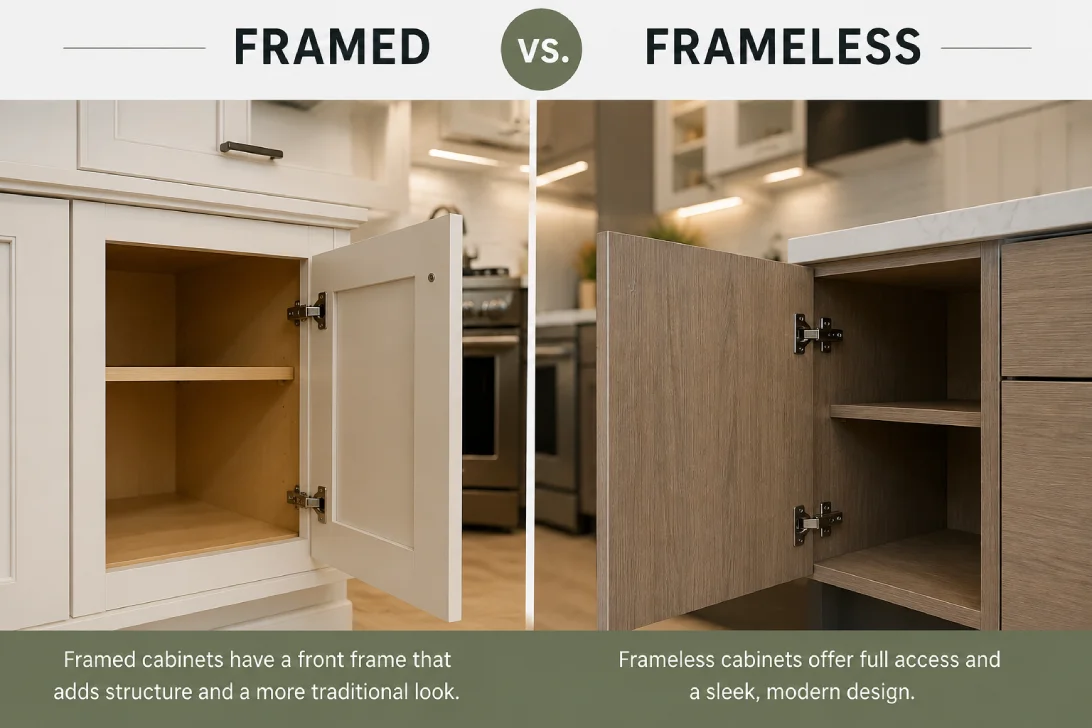
- Framed cabinets (Cubitac’s entire lineup, plus Fabuwood’s Allure and similar lines) have a solid wood frame across the front of the box. This is the traditional American cabinet-building method — sturdy, familiar, and slightly reduces the size of the opening compared to the box itself.
- Frameless cabinets (Fabuwood’s Ovela) skip that front frame, giving you a full-access opening — more usable interior storage space and a cleaner, more European look on drawers and doors. Fabuwood’s Illume series, worth flagging separately, uses an engineered box construction rather than full plywood, so if all-plywood construction is a hard requirement for you, Allure or Ovela are the Fabuwood lines to look at, not Illume.
Cubitac has no true frameless option in its catalog at all. If frameless is part of your design vision — a common ask for modern, minimalist kitchens — this decides the comparison by itself, no further analysis needed.
Real 2026 Pricing By Product Line
Pricing varies significantly by dealer, region, and the specific modifications you choose, so treat these as directional ranges rather than a quote. Generally:
| Tier | Cubitac | Fabuwood |
|---|---|---|
| Entry | Presto — packages can start around $3,500 for a modest kitchen | Galaxy — packages typically start closer to $4,000 |
| Mid | Basic / Prestige — per-linear-foot cost can dip below $300 | Value Premium / Quest — generally in the mid-$300s to $400s per linear foot |
| Upper | Imperial (Blum hardware included) — closes the price gap with Fabuwood’s mid tier | Allure / Ovela — typically $400+ per linear foot, hardware and certifications included at every tier |
The overall pattern holds across every source we checked: Cubitac is cheaper at the entry point, but the gap narrows — sometimes to a few hundred dollars — once you’re comparing Cubitac Imperial against Fabuwood’s mid-tier lines, because that’s the point where both brands are including Blum hardware in the price. Below that tier, you’re not comparing equivalent kitchens even if the dollar figures look close.
Customization and Design
Cubitac’s strength is color and finish breadth — its catalog includes over 5,000 custom color options, with hand-glazed and hand-sanded finishing done domestically, plus 18 door styles across its four lines. If you want a very specific paint match or an unusual finish, Cubitac gives you more room to get there.
Fabuwood leans the other way: more flexibility in cabinet dimensions and configurations, which matters more if your kitchen has an irregular layout, unusual ceiling height, or non-standard appliance openings. Its finish options are more standardized — including Sherwin-Williams custom color matching — but narrower than Cubitac’s palette.
Neither brand offers true full-custom sizing the way a brand like Omega or a local cabinet shop would. Both are “semi-custom,” meaning modifications happen within a set structure, not built from scratch to your exact specs.
Warranty and Post-Bankruptcy Reliability
- Fabuwood offers warranties ranging from 5 years to limited lifetime depending on the collection, backed by a financially stable, growing company with over 100 dealer locations across the US and Canada.
- Cubitac’s standard warranty is 5 years, upgraded to a limited lifetime warranty for the original residential purchaser — a genuinely competitive offering on paper. The open question, covered above, is less about the warranty terms themselves and more about the company’s post-bankruptcy capacity to honor them consistently, and dealers’ ability to source replacement parts and process claims without the delays some recent reviews describe.
Practical advice for either brand: get the current written warranty from your dealer before you order, keep it with your receipt, and photograph everything on delivery before you sign for it — freight damage is the most common source of claims for both brands, and a day-one photo makes the difference between an easy replacement and a drawn-out dispute.
What Real Buyers Are Saying
Online sentiment for both brands is mixed rather than one-sided, which is worth knowing going in.
Cubitac owners commonly praise the color selection and finish quality, especially on the Imperial line, and several DIY-inclined buyers appreciate that the Presto line is straightforward to install yourself. The most consistent complaint is hardware on the lower tiers — buyers describe unbranded soft-close mechanisms feeling noticeably cheaper than Blum equivalents, with some reporting hinge failures within the first few years. Post-bankruptcy, there are also scattered reports of slower dealer communication and fulfillment delays, which lines up with the financial picture above.
Fabuwood owners consistently highlight the hardware — Blum across every line means the doors and drawers feel premium even on entry-level cabinets — along with reliable delivery timelines and fewer reports of damaged or missing parts on arrival. The most common criticism is price: buyers who cross-shop expect Fabuwood to cost noticeably more than Cubitac at a similar spec level, and it generally does.
Neither brand has a reputation problem severe enough to rule it out. The difference is more about consistency: Fabuwood’s experience is more uniform across its lineup, while Cubitac’s experience varies more depending on which tier you buy and, currently, which dealer you’re working with.
Who Should NOT Choose Either Brand?
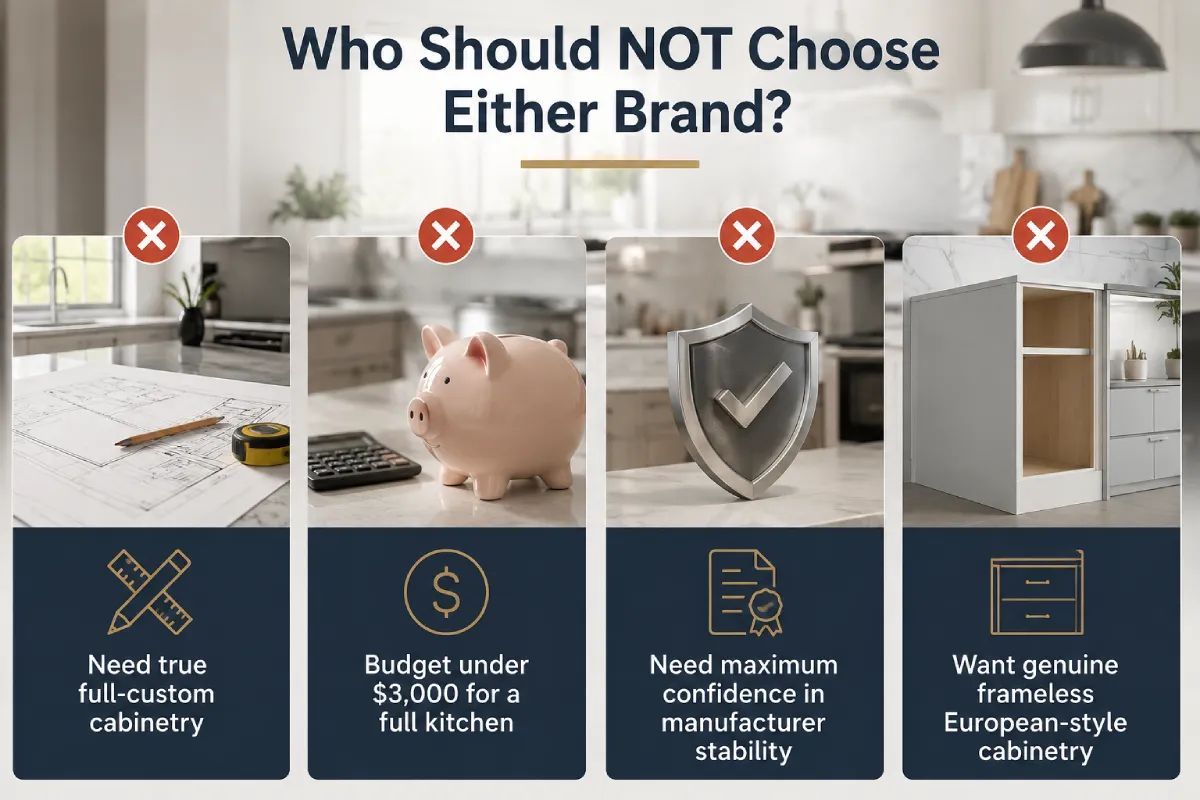
- If you need true full-custom cabinetry — exact non-standard sizing, bespoke storage solutions, furniture-grade joinery beyond dovetail drawers — look at Omega Cabinetry or a local custom shop instead. Both Cubitac and Fabuwood are semi-custom, and neither will get you there.
- If your budget is under $3,000 for a full kitchen and you don’t need plywood-grade construction, a stock cabinet line from a big-box retailer (or American Woodmark through Home Depot) will likely undercut both brands.
- If financial stability of the manufacturer is a non-negotiable for you — for instance, you’re planning a kitchen you intend to keep for 15–20 years and want maximum confidence the brand will still exist to honor a lifetime warranty — Fabuwood or a larger, more established manufacturer like KraftMaid is the safer bet over Cubitac right now.
- If you want genuine frameless European-style cabinetry and it’s non-negotiable, Cubitac is out entirely; Fabuwood’s Ovela or a dedicated frameless brand is where to look.
How They Compare to Other Brands
| Brand | Tier | Customization | Notable Difference vs. Cubitac/Fabuwood |
|---|---|---|---|
| KraftMaid | Mid-high | Full custom sizing on most lines | Wider door catalog, larger dealer network (Home Depot/Lowe’s), higher price point |
| American Woodmark | Low-mid | Stock to semi-custom | Available primarily through Home Depot; more particleboard use on lower lines |
| J&K Cabinetry | Low-mid | Semi-custom, RTA options | Faster stock lead times, no MDF/particleboard policy similar to both brands here |
| Omega Cabinetry | Premium | Full custom | Genuinely bespoke build; not a budget-conscious option like Cubitac or Fabuwood |
Conclusion
Strip away the marketing language and both brands are genuinely solid, all-plywood, dovetail-drawer, mid-range cabinet lines built by companies that know how to hit a price point without cutting the corners that actually matter most (particleboard, mainly). The real decision points are narrower than most comparisons make them sound: hardware tier by tier, framed versus frameless, and — the one most guides leave out — whether you’re comfortable with Cubitac’s post-bankruptcy footing for a purchase you’re expecting to last a decade or more.
Get a written quote from a dealer for both, ask directly about current lead times and warranty processing, and make the call based on your specific kitchen rather than either brand’s marketing copy.