James Brown House: Inside the Godfather of Soul’s Beech Island Estate
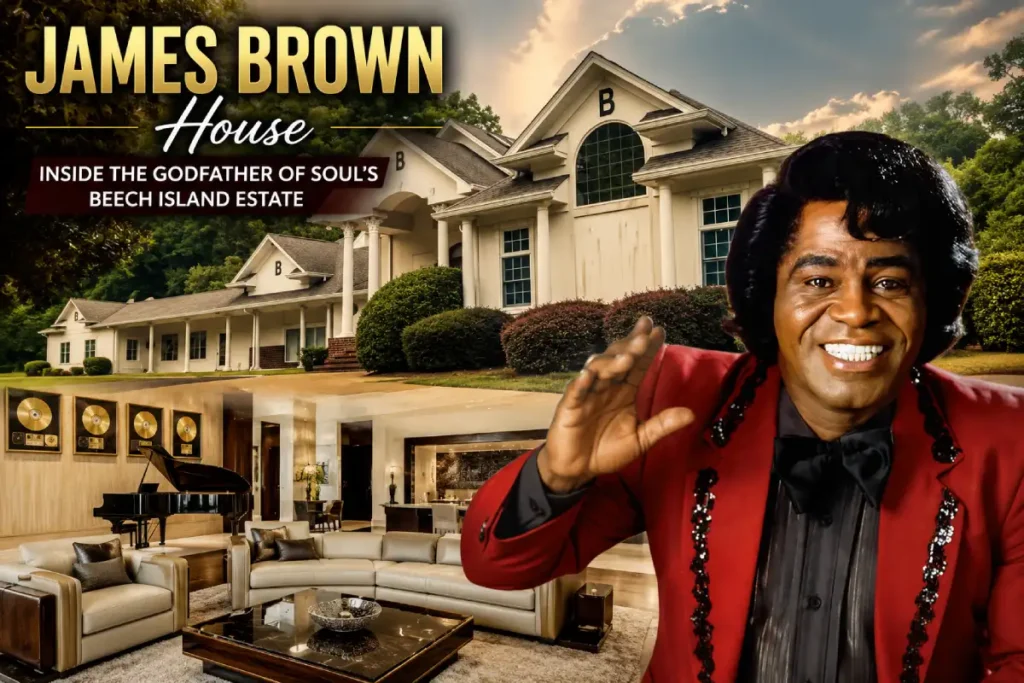
Step inside the world of music royalty, where funk was born and soul lived on. The James Brown House is more than a celebrity home. It’s a cultural monument to one of America’s most influential performers. Set on 62.8 acres in Beech Island, South Carolina, just across the Savannah River from Augusta, Georgia, the estate tells the story of James Brown’s journey from poverty to stardom.
Brown lived here from the late 1970s until his death on Christmas Day 2006, and much of the house has stayed largely untouched since. In December 2021, music company Primary Wave bought the assets of his estate, mansion included, in a deal reported at around $90 million. Its goal is a Graceland-style destination where fans can see how the “Hardest Working Man in Show Business” lived when he was off the road.
At a Glance
| Facts | Details |
|---|---|
| Location | Beech Island, Aiken County, South Carolina (on James Brown Boulevard) |
| Land | 62.8 acres |
| Brown’s Years There | Late 1970s until his death in December 2006 |
| Current Owner | Primary Wave (acquired December 2021, reported ~$90 million for the estate’s assets) |
| Notable Contents | About a dozen cars, two tour buses, stage costumes, personal hair salon, memorabilia |
| Earlier Homes | Augusta, Georgia (childhood); St. Albans, Queens, New York (1960s) |
| Burial Site | Interred at his daughter Deanna’s home on Beech Island |
| Public Access | Private; no public tours as of 2026 |
| Closest Way to Visit | James Brown Family Historical Tour in Augusta, Georgia |
Privacy note: This article does not publish an exact street address. The estate is described only by town and road name, as widely reported in news coverage.
From Wooden Shack to Musical Empire
James Brown’s story begins on May 3, 1933, in Barnwell, South Carolina. His family lived in deep poverty in nearby Elko, in a one-room wooden shack, before moving to Augusta, Georgia, when he was four or five. He picked cotton, shined shoes and performed buck dances for World War II troops to earn money.
Those humble beginnings shaped his character and his later success. He never forgot where he came from, and he carried reminders of his past throughout his life, as the house still shows today.
By the late 1970s, Brown was an international star and one of the defining voices of soul and funk. He chose to settle across the river from the city that raised him, on a big spread of South Carolina countryside close to his birthplace. In 1986 he was named one of the first ten inductees into the Rock and Roll Hall of Fame, and Beech Island stayed his home base through all of it.
Before Beech Island: His Homes in Augusta and Queens
The Augusta Childhood Home
In Augusta, young James lived at his Aunt Honey’s house at 944 Twiggs Street. Her real name was Handsome Washington, and she ran the place as a brothel, complete with gambling and moonshine. Customers tossed pennies at the boy’s feet when he danced, which is where the future showman first learned to work a crowd. Today the site is a stop on Augusta’s “Soul Starts Here” heritage trail, with audio stories from his daughter Deanna about his years there.
The Castle in Queens
In the 1960s, when hits like “Papa’s Got a Brand New Bag” made him a national star, Brown moved to Addisleigh Park in St. Albans, Queens. The leafy enclave was known as “Black Hollywood East,” and his neighbors over the years included Count Basie, Ella Fitzgerald and Jackie Robinson. His 1931 Medieval Revival house looked like a small castle, with a moat and a bridge leading to the front door. Brown had moved on by the early 1970s, and the house remains a private residence today.
Where Things Stand Now: Primary Wave and the Graceland Plan
Today the Beech Island estate is owned by Primary Wave, the music company that bought the assets of Brown’s estate in December 2021. The mansion isn’t on the open market. It changed hands as part of that estate deal rather than through a public listing.
The December 2021 deal covered far more than the house. It included Brown’s publishing catalog, a share of his master recording income, the rights to his name and likeness, and the Beech Island property with everything inside. Reports described the contents in detail: about a dozen cars, two tour buses, and even food left in the kitchen cabinets since his death. The documents behind the sale have never been made public, so the $90 million figure remains an estimate.
The company’s founder has talked about a museum at the mansion similar to Elvis Presley’s Graceland, along with possible TV projects and a Broadway musical. Russell Bauknight, the estate’s fiduciary, has overseen the property, where remaining items have been photographed, tagged and catalogued.
The Graceland idea isn’t new. Brown’s family floated a similar shrine after his death, but it never got off the ground. As of 2026, Primary Wave has not announced an opening date for public tours of the mansion.
Can You Visit the James Brown House?
Not yet. The Beech Island estate is private property, and fans shouldn’t show up at the gates expecting a tour. Keep an eye on Primary Wave’s announcements if you’re waiting for the museum.
The best way to follow Brown’s footsteps right now is in Augusta, where the James Brown Family Historical Tour runs every Saturday from 11 a.m. to 12:45 p.m. The James Brown Family Foundation, led by his daughter Deanna Brown-Thomas, operates it. Tickets cost $25 per person, and the tour departs by bus from the Augusta Museum of History. Stops include:
- The elementary school Brown attended
- The house where he lived as a child
- Businesses he owned in Augusta
- The first family home he bought for his father, added to the tour in May 2024
- The James Brown statue on Broad Street
- The James Brown Arena
Your ticket also covers the Augusta Museum of History’s James Brown exhibit, the largest public collection of his memorabilia. Augusta has plenty of hotels and restaurants, which makes it an easy base for a James Brown weekend.
The Grand Entrance Experience
Iron gates welcome visitors to the estate on James Brown Boulevard. Yes, the street bears his name. The gates open onto a winding driveway that leads to the main residence, and a lookout tower rises above the grounds.
The property’s size makes an impression right away, with rolling lawns and mature trees creating a park-like setting around the house. Two tour buses marked “James Brown” in bold letters have been kept on the grounds. They served as his mobile headquarters during decades of touring and remain there like museum pieces, frozen in time.
Inside the Godfather’s Personal Sanctuary
The foyer bursts with color, with vibrant green walls, a chandelier and luxurious furnishings that match Brown’s flamboyant personality. A copy of Jet magazine with Brown on the cover sits on a side table where he left it.
The heart of the house is a music atrium Brown used for rehearsals and parties, built around a sunken marble bar. Heart-shaped mirrors, a director’s chair from his film appearances and some of his most famous stage costumes, including the “Sex” jumpsuit, fill the rooms. A display case holds an original master pressing of “Get Up (I Feel Like Being a) Sex Machine,” and the family Bible is still in the house. When reporters toured the home years after his death, still-wrapped Christmas presents sat under a holiday tree.
The family room has hand-carved wooden walls, black-and-white checkered floors and rich leather furniture. Light switch covers throughout the house feature photos of Brown holding street signs with his name, and the letter “B” appears on surfaces all over the home.
Cotton vases placed around the house serve as constant reminders of Brown’s agricultural roots. They contrast sharply with the luxury around them, and Brown deliberately kept them there to stay grounded.
“Untouched” doesn’t mean complete, though. Some items were removed years ago for a Christie’s auction, and what remains has been tagged and catalogued for the estate.
The Famous Hair Salon
Brown’s personal hair salon is still fully stocked with dozens of hair products and professional equipment. His signature processed hairstyle needed daily maintenance, making this room essential to his routine. Shelves overflow with pomades, gels and styling tools.
A massage table and monogrammed towels complete the setup, providing relaxation after grueling performance schedules. His daughter Deanna recalls his standing order to hair product suppliers: “Give me everything you’ve got.”
Hair curlers fill baskets, and professional salon chairs wait for their next client. The room shows how Brown understood that image mattered as much as musical talent.
Cars, Bars and Daily Life
Reports list about a dozen cars on the property, including a 1941 Lincoln, parked in a multi-car garage alongside the two tour buses that carried his show across the country.
An intercom system connects rooms throughout the house, though Brown’s daughter says he rarely used it. He simply shouted when he needed someone, and that famous voice carried easily through the home.
The house has more than one bar. The personal bar displays memorabilia from venues where Brown performed, including the MGM Grand, along with promotional stickers from appearances around the world. Cultural artifacts from African, Native American, Indian and East Asian traditions decorate rooms across the house, reflecting his belief in music as a universal language.
Christmas 2006 and the Long Fight Over the Estate
After Brown died, the house sat largely untouched while his family, his widow and trustees fought over the estate for 15 years. Once that dispute was settled in 2021, the house and its contents went to Primary Wave, which plans to turn it into a museum.
Brown died on December 25, 2006, at age 73, at Emory Crawford Long Hospital in Atlanta. Atlanta was only where he was treated at the end; Beech Island was his home. He was eventually interred at his daughter Deanna’s home on Beech Island, near the estate he had lived on for nearly three decades.
What followed was one of the longest estate battles in music history. Tomi Rae Hynie, who had married Brown in 2001, was locked out of the Beech Island house shortly after his death. Photographers captured her at the iron gates, and the legal status of the marriage was contested in court for years.
At the center of the fight were Brown’s will and his wish to fund scholarships for needy students, with children, grandchildren, Hynie and trustees all pressing their claims before the 2021 settlement cleared the way for the sale.
Conclusion
The James Brown House in Beech Island captures the whole arc of a remarkable life: the cotton vases from his childhood, the salon that built his image, the atrium where the music happened, and the gates where the fight over his legacy played out. Until it opens as a museum, Augusta’s family-run tour is the closest fans can get.
The legacy of the Godfather of Soul lives on through this property and the effort to preserve it. His South Carolina home stands as a testament to the power of music, determination and never forgetting your roots.
Looking for a different James Brown House? Two historic buildings share the name but have no connection to the singer. The one in Manhattan, at 326 Spring Street, was built in 1817 for a Revolutionary War veteran named James Brown and now houses the Ear Inn bar. The one on King Street in Charleston, South Carolina, is an 18th-century home.