Idris Elba House: Inside His $3.1M Hackney Victorian Home
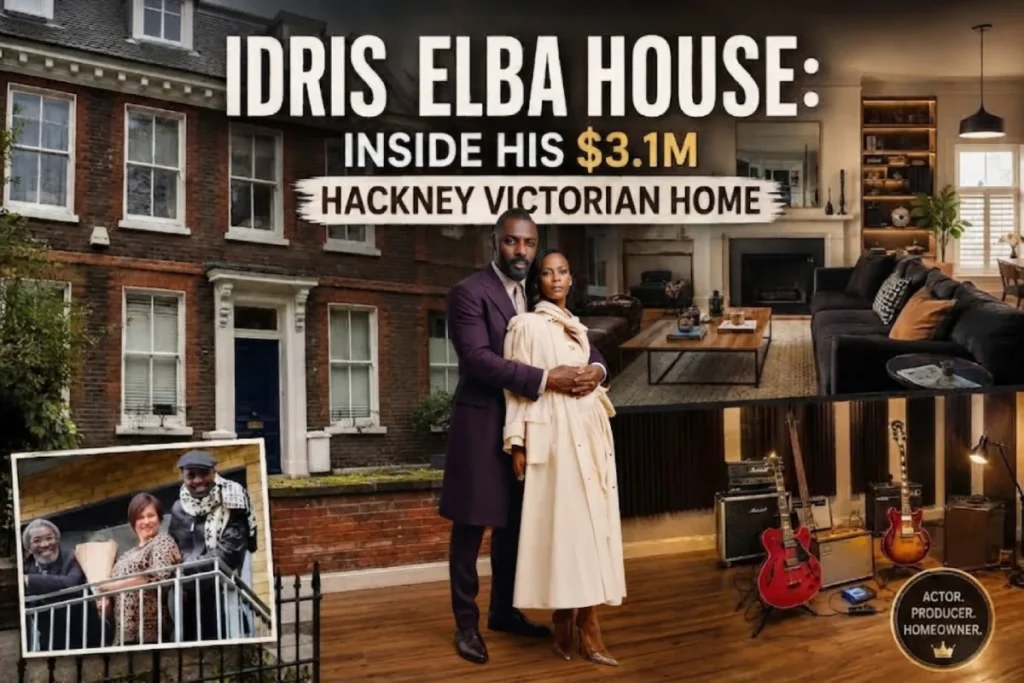
Most Hollywood stars trade their humble beginnings for gated mansions in Los Angeles or New York penthouses. Idris Elba took a different path. The Luther actor still lives in Hackney, the East London neighborhood where he grew up, in a Victorian house that tells a story about roots, success, and staying connected to where you came from.
His home isn’t just another celebrity property. It’s a Grade II listed building with protected status, historical significance, and the kind of character you can’t manufacture. Valued at roughly $3.1 million (around £2.5 million), it sits at the intersection of London’s architectural heritage and one of the city’s most vibrant, creative neighborhoods — and, as Elba has made clear in recent interviews, it may not be his final address.
Quick House Facts
| Detail | Information |
|---|---|
| Location | Hackney, East London |
| Estimated Value | ~$3.1 million (approx. £2.5 million) |
| Size | ~2,500 square feet |
| Style | Victorian terrace, built late 1800s |
| Heritage Status | Grade II listed |
| Exterior | Red brick facade, dormer windows, blue front door |
| Outdoor Space | Private rear garden |
| Notable Neighbors | Elliot Cowan, Tommy Walsh, Jeremy Corbyn |
Who Is Idris Elba?
Idris Elba is a British actor, director, DJ, and producer, best known for playing Stringer Bell in The Wire and the title role in Luther, who has remained based in Hackney, East London — the working-class neighborhood where he was born in 1972 — even after becoming one of Britain’s biggest international stars.
Beyond acting, Elba holds Sierra Leonean citizenship and a diplomatic passport, reflecting the West African heritage of his Sierra Leonean father and Ghanaian mother. He’s also a working DJ under the name DJ Big Driis, and he’s married to model and actress Sabrina Dhowre Elba. His career now spans Hollywood blockbusters, British television, and an expanding role as a producer and director — including upcoming projects like Luther 3 and Extraction 3 — alongside a growing personal investment in Africa’s film industry, detailed later in this article.
The $3.1 Million Victorian House in Hackney
The house stands in Hackney, East London, among rows of similar Victorian terrace homes that define the area’s character. Built in the late 1800s, the property covers approximately 2,500 square feet across multiple floors. The red brick exterior immediately signals its Victorian origins, complete with a steep roof punctuated by dormer windows that add both charm and functional space.
Estimates for the property settled around $3.1 million, or roughly £2.5 million, reflecting London’s property market surge and the home’s Grade II listed status. The house includes multiple bedrooms and bathrooms, though exact counts remain private.
What sets this property apart is its official designation. Historic England granted it Grade II listed status, placing it among roughly 400,000 protected buildings across England. This isn’t just a label. It’s a legal framework that governs what can and can’t be done to the structure.
What Makes This House Grade II Listed
Grade II listing represents the lowest tier of England’s three-level heritage protection system, but that “lowest” still means substantial restrictions and recognition. These buildings are considered nationally important and of special interest. More than 90% of all listed buildings in England fall into this category.
For Idris Elba’s house, the listing likely acknowledges its architectural integrity, period features, and role in Hackney’s historical streetscape. Victorian terraces from the late 19th century often earn this status when they retain original elements like window frames, decorative brickwork, interior fireplaces, or ceiling moldings.
The practical implications matter. Any significant alterations require listed building consent from Hackney Council. Want to replace windows? You need approval. Planning to knock through walls? Council review required. Even minor exterior changes fall under scrutiny. This protects the building’s character but limits renovation freedom.
Historic England works with local councils to balance preservation with livability. Owners can modernize interiors sensitively, but they must respect the building’s historic fabric. For someone like Elba, this means maintaining Victorian charm while creating a functional contemporary home.
Architectural Features Worth Noting
The exterior captures a classic Victorian aesthetic. Red brick dominates the facade, a hallmark of London buildings during that era when brick manufacturing became efficient and affordable. The steep-pitched roof with dormer windows adds vertical drama and creates usable attic space, common in Victorian terrace design that maximizes narrow urban lots.
Symmetrical window placement follows period conventions. These aren’t modern picture windows but traditional sash designs that preserve the building’s historical appearance. The blue front door provides a personal touch while respecting the overall character.
Inside, the layout reflects Victorian spatial planning adapted for modern living. High ceilings, likely 10 to 12 feet, create an airy feel despite the relatively compact footprint. Original features probably include decorative cornices, ceiling roses, and fireplaces, though reports suggest contemporary updates throughout.
The 2,500 square feet accommodate open-plan living areas, a modern kitchen with updated appliances, and private spaces across multiple floors. Victorian houses typically placed formal rooms on the ground floor, bedrooms above, and service areas below or at the rear.
A lush garden extends from the rear, offering private outdoor space rare in dense London neighborhoods. This is where Elba shares life with his wife, Sabrina Dhowre Elba, the model and actress he married in 2019 — a household detail that grounds the “family home” framing running through the rest of this story.
Why Hackney Over Hollywood Hills
Elba was born in Hackney in 1972 and spent his formative years in Holly Street, Dalston, just a short distance from his current home. He attended Laburnum Primary School in Haggerston before it closed, then Kingsland Secondary School in Shacklewell Lane. His father, Winston Elba, was a formative presence in his early life; Winston passed away in September 2013, at age 72, after a battle with lung cancer. Elba has spoken candidly in the years since about how much that loss shaped him, later naming his youngest son Winston in his father’s memory.
Staying in Hackney after achieving global fame represents a deliberate choice. In 2011, Elba returned to open an affordable housing project in Andre Street, E8. The developers named the larger building “Idris Elba House” to honor his achievements and connection to the community. He brought his father to the ceremony and described feeling moved by the recognition.
“It is well documented that I was in Hackney for quite a length of time,” he told the Hackney Gazette at the opening. “But just to have someone say: ‘We are so proud of what you have done, we are going to name a building after you that is cost-effective, clean and new,’ is a great honour.”
That sentiment has stuck. When Madame Tussauds London unveiled his wax figure in late 2025, the attraction’s general manager introduced him simply as “a Londoner through and through” — a description that still fits a man who, decades into global stardom, keeps a house a few streets from where he grew up.
The Neighborhood and Celebrity Connections
Hackney sits in East London, known for its vibrant street markets, independent cafes, and thriving arts scene. The borough underwent significant gentrification over the past two decades, transforming from a working-class area with pockets of deprivation into one of London’s most desirable neighborhoods.
Property values reflect this shift. The average house price in Hackney reached approximately £650,000 in 2024, though Victorian terraces in sought-after streets command much higher figures. Elba’s roughly £2.5 million property sits well above area averages, reflecting both its Grade II status and size.
Shoreditch’s hip bars and restaurants lie within walking distance. Dalston’s music venues and nightlife scene pulse nearby. The neighborhood attracts creative professionals drawn to its character and cultural offerings. Commuting to Central London takes roughly 15-20 minutes via public transport.
Elba shares the area with notable neighbors. Actor Elliot Cowan lives nearby, as does DIY expert and TV personality Tommy Walsh. Former Labour Party leader Jeremy Corbyn also calls Hackney home. This mix of entertainment professionals and political figures creates a diverse community unlike typical celebrity neighborhoods.
The Basement Studio Controversy
In 2017, reports surfaced that Elba planned to build a state-of-the-art recording studio in his basement. Documents submitted to Hackney Council outlined plans for a facility dedicated to “film, TV and music post-production” that would operate 15 hours daily, seven days per week.
Neighbors expressed concern about potential noise. One told the Daily Mail, “There is almost unanimous upset. We know he’s a DJ and we don’t want the noise.” The tension highlighted challenges when creative professionals seek to work from historic residential properties in dense neighborhoods.
The Grade II listing complicated matters further. Any structural work on a listed building requires special permission, and converting a basement into a professional studio involves significant modifications. The current status of these plans remains unclear, with no public records confirming approval or completion.
The controversy reveals Elba’s practical needs. As a working DJ who performs under the name DJ Big Driis, having a home studio makes sense. Balancing professional requirements with residential tranquility and heritage preservation creates complex negotiations.
Beyond Hackney: His Real Estate Portfolio
While Hackney serves as his anchor, Elba owns property elsewhere. In 2024, he listed a Buckinghamshire mansion for £9.5 million. The substantial country estate represents a different investment category than his London home.
Reports suggest he maintains properties in New York and Los Angeles to support his international career. These serve as working bases rather than primary residences. Many British actors maintain similar arrangements, keeping a UK home while securing accommodation in major entertainment centers.
His strategy appears straightforward: invest in property where you work, but keep your roots planted where you’re from.
The Next Chapter: A Planned Move to Africa
There’s a newer thread to Elba’s relationship with “home,” and it complicates the tidy Hackney-forever narrative in an interesting way. Elba holds Sierra Leonean citizenship and a diplomatic passport, granted in December 2019, and serves as a brand ambassador for the country — formal recognition of the heritage his father brought with him from Sierra Leone and his mother from Ghana.
More significantly, Elba has said publicly that he intends to relocate to Africa within the next five to ten years to help build up the continent’s film industry. Speaking to the BBC at the Africa Cinema Summit in Accra, he put it plainly: “I’m here to bolster the film industry — that is a 10-year process — I won’t be able to do that from overseas. I need to be in-country, on the continent.” Rather than settling on one base, he’s described splitting time across three cities: Accra in Ghana, Freetown in Sierra Leone, and Zanzibar in Tanzania.
The plan already has ground under it, literally. Zanzibar’s government has allocated Elba nearly 200 acres of land on the island of Unguja for a film studio, part of an effort local officials have jokingly nicknamed “Zollywood.” He’s also involved in an “eco city” development on Sherbro Island in Sierra Leone.
None of this cancels out the Hackney story — if anything, it extends it. The same instinct that kept Elba in his childhood neighborhood after Hollywood success is now pointed at a bigger, generational project: building an industry in the region his family came from. The Hackney house, for now, remains the London base for a man whose sense of home has always run wider than one postcode.
Final Thoughts
Idris Elba’s house tells a story that extends beyond architecture and property values. It demonstrates how someone can achieve global success without abandoning their origins. The Grade II-listed Victorian property provides historical character, modern comfort, and community connection — and its owner’s next stated ambition, a working life split across Accra, Freetown, and Zanzibar, suggests that instinct was never really about staying in one place. It was about staying close to what matters.
For those curious about celebrity real estate, Elba’s property offers a different model. Not every successful person needs a compound or penthouse. Sometimes the best home is the one that keeps you connected to what made you who you are — even as that idea of home keeps growing.