Is North Carolina a Community Property State? No, It’s an Equitable Distribution State.
North Carolina is not a community property state. It follows equitable distribution, which means a court divides marital property in a fair way, given the specific circumstances of your marriage, not automatically 50/50. Marital property includes most assets and debts acquired from the wedding date through the date of separation, while separate property, such as things you owned before marriage or received as an inheritance, generally stays with the original owner.
Equitable distribution starts with a presumption of equal division, but a judge can adjust that split based on factors like the length of the marriage, each spouse’s earning potential, and contributions made as a homemaker or caregiver. Understanding this distinction early can make a real difference in how you prepare for divorce or plan your finances.
Most People Get This Wrong, and Here’s Why
If you’ve ever watched a legal drama set in California or moved here from Texas or Arizona, you probably picked up the idea that divorce means splitting everything right down the middle. That’s how community property works in those states, and it’s the version most people see on TV. The problem is, it doesn’t apply in North Carolina.
North Carolina uses a completely different system called equitable distribution. It’s a common source of confusion, especially for people relocating from community property states or anyone who’s spent time Googling divorce laws without filtering by state. The good news is that the system is actually designed to be more flexible and to account for the real details of your marriage.
This article walks you through how North Carolina actually handles property in a divorce, what counts as marital versus separate property, and what steps you can take right now to protect yourself.
Is North Carolina a Community Property State?
No. North Carolina is an equitable distribution state. That one distinction changes almost everything about how divorce works here.
In community property states like California, Nevada, and Texas, the law treats most assets and debts acquired during marriage as jointly owned, 50/50, no matter who earned the money or whose name is on the account. When you divorce, those assets are split right down the middle.
North Carolina law, specifically General Statute § 50-20, takes a different approach. It starts with a presumption that marital property should be divided equally, but it gives courts the authority to adjust that split when equal doesn’t feel fair, given the full picture of your marriage. That’s the key difference between community property and equitable distribution: flexibility.
How Equitable Distribution Actually Works in NC
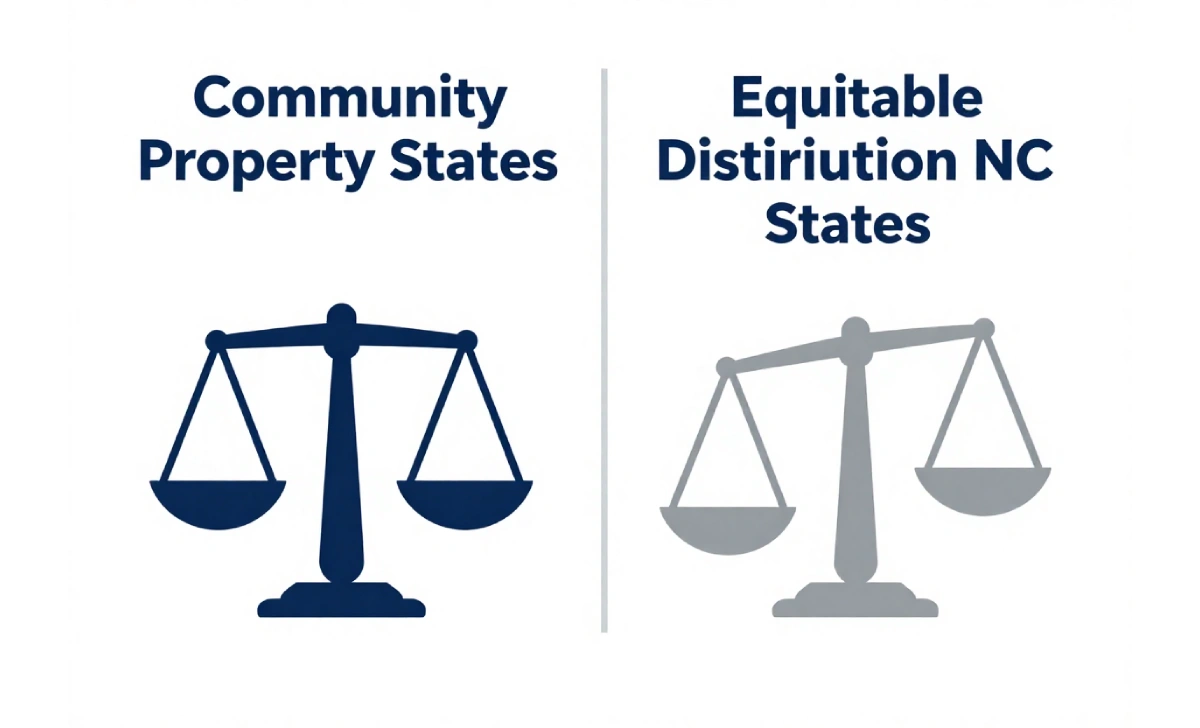
The phrase “equitable distribution” trips people up because equitable sounds like equal. It’s not the same thing. Equitable means fair, and fair depends on your specific situation.
Here is a concrete example. Imagine one spouse stepped away from their career for 10 years to raise children while the other built a six-figure salary and accumulated a substantial 401(k). In a community property state, that retirement account might be split 50/50. In North Carolina, a judge could award a larger share of that 401(k) to the stay-at-home parent to account for their lost career years and lower future earning potential. That’s equitable distribution in action.
The court classifies everything first, then values it, then divides it. The factors a judge weighs when deciding what’s fair include:
- How long did the marriage lasted
- Each spouse’s income, age, and health
- Each person’s earning potential going forward
- Which spouse has primary custody of the children
- Financial and non-financial contributions to the marriage
- Any wasteful spending or deliberate misuse of marital assets
A short marriage where one person brought far more assets into the relationship might end with an uneven split. A long marriage where one spouse gave up career opportunities for the family could lean toward protecting that lower-earning partner. There is no single formula because every marriage is different.
Marital Property vs. Separate Property in NC Divorce
Before a court can divide anything, it has to figure out what is actually on the table. North Carolina divorce laws draw a clear line between marital property and separate property.
What counts as marital property
Marital property is generally everything either of you acquired from your wedding date through the date you separated. That includes:
- Income earned by either spouse during the marriage
- Real estate purchased while married, even if only one name is on the deed
- Retirement accounts and pension benefits built up during the marriage
- Vehicles, furniture, and household items bought together
- Joint bank accounts and investment portfolios
- Marital debts, such as mortgages, joint credit cards, and car loans
What stays separate
Separate property is what you owned before the marriage, plus any gifts or inheritances given specifically to you during the marriage, even if you received them while married. If your parents left you money in their will and you kept it in your own name, that is generally yours to keep.
The critical word there is generally. Separate property can lose its protected status if it gets mixed with marital funds, and that happens more often than you’d think.
The Commingling Trap That Can Cost You
Commingling is when separate property gets mixed with marital funds to the point where a court can no longer clearly identify it as yours alone. This is where people make some of the most expensive mistakes in a North Carolina divorce.
Here is a straightforward example. Say you received a $10,000 inheritance and deposited it into the joint checking account you share with your spouse to help pay for a family vacation. In the eyes of the court, that money has likely lost its “separate” status. It was mixed with marital funds and used for a marital purpose. You will have a very hard time reclaiming it as separate property.
The same thing can happen when you use inherited funds to renovate a home you own jointly, or when you title a pre-marital asset in both names. The moment separate property blends into the marital estate, it is usually treated as marital property. If you want to protect an inheritance or a pre-marital asset, keep it in an account that only you control and avoid using it for shared expenses.
How NC Judges Decide What’s Fair
People often ask: if North Carolina isn’t a 50/50 state, how do judges decide what’s fair? The honest answer is that there is no simple formula. A judge looks at the full context of your marriage and uses the factors listed in the statute to reach a result that makes sense for your situation.
Age and health matter because they affect each person’s ability to recover financially. Earning potential matters because two people leaving a marriage with the same assets are not in the same position if one can earn $90,000 a year and the other has been out of the workforce for a decade. Length of marriage matters because a two-year marriage and a 25-year marriage involve very different levels of shared financial history.
Misconduct that hurts the marriage financially, like hidden assets or reckless spending, can also shift the division. It is not about punishing bad behavior in the relationship generally. It is specifically about protecting the other spouse from financial harm that was caused during the marriage.
Can You and Your Spouse Agree Without Going to Court?
Yes, and courts in North Carolina encourage it. If you and your spouse can reach an agreement on how to divide property and debts, you can submit a separation agreement to the court for approval. You keep control of the outcome, you move faster, and you typically spend far less money than you would in contested litigation.
Mediation is a popular option for couples who can still communicate but need a neutral third party to help them work through disagreements. A collaborative divorce process is another approach where both spouses work with their own attorneys to settle without going before a judge.
Whatever route you choose, make sure any agreement is in writing and reviewed by your attorney before you sign. Verbal agreements are not enforceable in North Carolina property division cases.
Prenuptial and Postnuptial Agreements
North Carolina allows couples to create their own rules through a prenuptial agreement signed before the wedding or a postnuptial agreement signed after. These contracts can define exactly what happens to specific assets if the marriage ends, which is decided out of a judge’s hands.
Bringing up a prenup can feel uncomfortable, but it is often just a straightforward conversation about transparency. Both of you know going in what you own, what you owe, and how things would be handled if the relationship ended. That clarity can actually reduce conflict later.
For an agreement to hold up in court, both parties need independent legal counsel, and the agreement must be in writing, signed voluntarily, and made with full financial disclosure. Courts take these agreements seriously when they are done correctly.

Practical Steps You Can Take Right Now
If separation or divorce is anywhere on your horizon, do not wait to start organizing your finances. Here are some concrete steps you can take before you even talk to an attorney:
- Gather financial documents: tax returns, pay stubs, bank statements, and retirement account summaries for at least the past three years.
- Make a complete list of assets and debts, including balances, account numbers, and whether each item is in one name or both.
- If you have separate property you want to protect, check whether it has ever been mixed with joint accounts or used for shared expenses.
- Write down a rough timeline of major financial events during the marriage: home purchases, business investments, large debts taken on, and significant gifts or inheritances received.
This is not about hiding anything. It is about having a clear picture of the marital estate before you sit down with a lawyer. That preparation saves time, reduces legal fees, and puts you in a much stronger position from the start.
When you do speak with an attorney, look for someone who handles family law in North Carolina every day and knows how judges in your specific county tend to rule. Local experience matters more than most people realize.
Bottom Line
North Carolina is not a community property state. It follows equitable distribution, which means the court divides marital property based on what is fair given the full reality of your marriage, not a simple 50/50 formula. That flexibility can work in your favor or complicate things, depending on your situation.
The most important thing you can take away from this is: do not assume you know how things will be divided. The rules here are detailed, and small decisions, like where you deposit an inheritance or how you title an asset, can have lasting consequences. A little preparation now puts you in a much better position later.
Frequently Asked Questions
If North Carolina isn’t a 50/50 state, how do judges decide what’s fair?
Judges weigh a list of factors defined in General Statute § 50-20, including the length of the marriage, each spouse’s earning potential, health, age, custody arrangements, and each person’s contributions to the marriage. The starting point is equal division, but the court can adjust that split when the evidence supports a different outcome.
Does an inheritance count as marital property in a North Carolina divorce?
Not automatically. An inheritance given specifically to you is generally treated as separate property, even if you received it during the marriage. The risk comes from commingling. If you deposit the inheritance into a joint account or use it for shared marital expenses, it can lose its separate status and become subject to equitable distribution.
What happens to the property I owned before I got married?
Property you owned before the marriage is generally considered separate property and stays with you. The exception is if that property was mixed with marital funds, titled in both names, or significantly improved using marital money. In those cases, all or part of it may be treated as marital property.
Can my spouse and I agree on how to split things ourselves?
Yes. A written separation agreement that both parties sign is legally enforceable in North Carolina and does not require a judge to divide your property. Courts prefer settlements because they are faster, cheaper, and give both parties more control. Just make sure both of you have independent legal counsel review the agreement before signing.
Does North Carolina recognize common law marriage?
No. Even if you have lived with a partner for many years, North Carolina does not grant you the same property rights as a legally married couple. Only people who were legally married in another state that recognized their common law marriage may have those rights recognized here.
How long do I have to file for equitable distribution after divorce?
You generally have three years from the date of divorce to file a claim for equitable distribution. Waiting that long usually makes things harder. Financial records become harder to trace, asset values change, and memories fade. Filing sooner gives you a cleaner, clearer process.
Disclaimer: This article is for general informational purposes only and does not constitute legal advice. Laws can change, and every situation is different. Please consult a licensed family law attorney in North Carolina for advice specific to your circumstances.