Waldorf Astoria Residences Miami: Design & Architecture Guide
Waldorf Astoria Residences Miami is a 1,049-foot supertall skyscraper under construction in Downtown Miami, featuring 360 luxury residences across 100 stories. Designed by Carlos Ott with interiors by BAMO, the tower’s distinctive stacked-cube architecture will make it Florida’s tallest building upon completion in 2027-2028.
What Makes Waldorf Astoria Miami a Supertall Tower
A supertall building reaches at least 300 meters (984 feet) in height, placing it among the world’s most ambitious architectural projects. Waldorf Astoria Residences Miami, at 1,049 feet, marks a significant milestone as Florida’s first building to cross this threshold.
The tower will surpass Atlanta’s 1,020-foot Bank of America Plaza to become the tallest structure in the southeastern United States. Within Miami, it easily outpaces the current record holder, Panorama Tower, which stands at 868 feet. This height achievement isn’t just about records—it represents Miami’s evolution from a regional market into a city competing with major metropolitan skylines.
Construction began in late 2022 on a site with its own history. The location at 300 Biscayne Boulevard was previously designated for the Empire World Towers, a project proposed in the 2000s that never materialized. Where that earlier vision failed, Waldorf Astoria Miami is rising as a realized symbol of the city’s luxury real estate boom.
Architectural Design and Structure
Uruguayan-Canadian architect Carlos Ott developed the conceptual design for Waldorf Astoria Miami, with Sieger Suarez Architects handling the technical execution. The building’s most striking feature is its composition of nine large glass cubes, stacked and offset to create a distinctive silhouette.
Each cube contains 10 to 11 floors, creating visual breaks in the vertical ascent while serving practical purposes. This staggered approach allows for varied terrace opportunities and ensures that units within different cubes receive unique sightlines across Biscayne Bay, the Miami skyline, and the Atlantic Ocean. The cantilevered design means some cubes extend beyond the footprint of those below, creating dramatic architectural moments.
The glass facade does more than showcase views. Floor-to-ceiling windows throughout the building maximize natural light penetration while the cube segmentation prevents the tower from appearing as a single monolithic structure. In Miami’s intense sunlight, this design choice balances transparency with the need for climate-appropriate construction.
Building a supertall structure in Miami presents specific engineering challenges. The city’s coastal location requires enhanced wind load calculations and corrosion-resistant materials. The foundation must account for Miami’s limestone bedrock and high water table. While the architects haven’t publicized specific engineering innovations, any Florida supertall must address hurricane-force wind resistance and storm surge considerations that don’t factor into projects in more sheltered locations.
Location and Downtown Miami Context
Building Address and Immediate Surroundings
Waldorf Astoria Residences Miami occupies a prime Downtown location at 300 Biscayne Boulevard, positioned between Northeast 3rd and 4th Streets. The site sits directly across from Bayfront Park, giving residents immediate access to Miami’s 32-acre waterfront green space.
Within walking distance, residents can reach Bayside Marketplace for shopping and dining, Whole Foods Market for daily groceries, and FTX Arena (formerly American Airlines Arena) for sports and entertainment. The building’s address places it in Downtown Miami proper, distinct from the Brickell neighborhood located just south.
Regional Significance
Downtown Miami has undergone substantial transformation over the past two decades. Once primarily a business district that emptied after work hours, the area now hosts a growing residential population. Waldorf Astoria Miami contributes to this shift, adding hundreds of full-time residents to a neighborhood increasingly defined by mixed-use development.
The location offers something increasingly rare in Miami’s sprawling geography: genuine walkability. Residents can access cultural venues like the Pérez Art Museum Miami, the Adrienne Arsht Center for the Performing Arts, and numerous waterfront restaurants without needing a car. This urban density represents a different lifestyle proposition than Miami Beach’s resort atmosphere or Coral Gables’ suburban elegance.
Residence Types and Interior Design
Waldorf Astoria Residences Miami offers 360 units ranging from furnished studios to four-bedroom homes. The variety allows the building to serve different buyer profiles, from pied-à-terre owners to full-time families.
San Francisco-based BAMO designed the interiors with what they call a “Furniture as Art” philosophy. This approach treats each piece not just as functional but as sculptural. Upon entering units, residents encounter Bec Brittain’s Hanging Flags installation—a luminous arrangement of mirrors, metals, and glass that shifts appearance based on viewing angle.
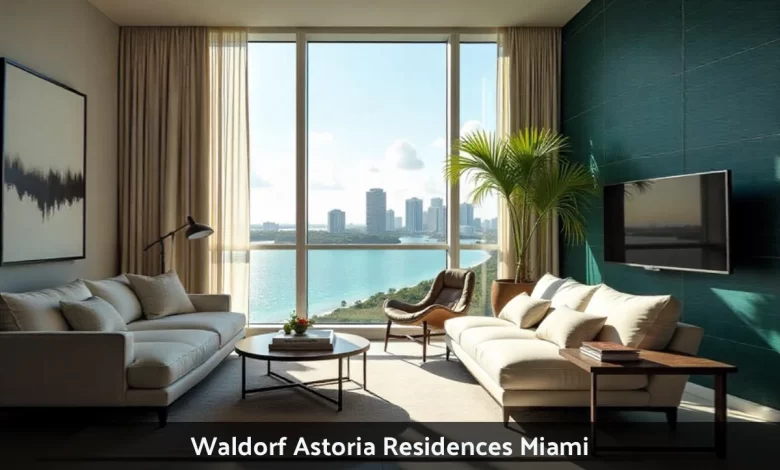
Standard residences feature 10-foot ceilings with floor-to-ceiling glass windows. The glazing provides unobstructed views while creating bright, open living spaces. Penthouses, occupying floors 86 through 100, receive 12-foot ceilings that amplify the sense of space at the building’s highest levels.
Kitchens come equipped with Sub-Zero and Wolf appliances, including integrated wine storage, built-in convection ovens, and panel-ready dishwashers that blend with custom Italian cabinetry. Bathrooms feature Dornbracht fixtures and Duravit accessories, with master bathrooms including rainfall showers and custom Italian vanities.
The building incorporates smart technology throughout, with a custom Waldorf Astoria Residences app connecting residents to 24-hour concierge services and building amenities. This digital integration represents the modern expectation that luxury living should be both high-touch and high-tech.
Each residence includes a private elevator entrance, eliminating shared hallway interactions. Built-in washer-dryer units, fully customized closets designed by BAMO, and pre-wiring for high-speed data connections come standard. These details matter more than flashy features—they’re the everyday elements that define quality of life.
Amenities and Services
Hotel-Branded Residence Concept Explained

A hotel-branded residence differs from a traditional luxury condominium in service level and operational model. Waldorf Astoria operates the building’s 205-key hotel component while also extending its service standards to the 360 residential units.
This means residents access amenities operated by hospitality professionals rather than typical building staff. Concierge services function like a five-star hotel front desk. Housekeeping, room service, and maintenance requests follow hospitality industry response standards. Residents can book spa treatments, reserve private dining rooms, or arrange in-residence catering through the same systems hotel guests use.
Some branded residences allow owners to place their units into a rental program when not in use, with the hotel managing bookings and splitting revenue. Whether Waldorf Astoria Miami offers this option hasn’t been publicly detailed, but it’s common in similar developments.
The Waldorf Astoria name itself carries weight. The brand, managed under Hilton’s luxury portfolio, has global recognition. For international buyers, this association provides familiarity and a quality benchmark in an unfamiliar market.
Resident Facilities
The amenities program spans multiple floors and includes both shared hotel-residential facilities and residents-only spaces. The building features a resort-style pool deck managed by Waldorf Astoria, complete with an outdoor café and private cabanas. A separate pool deck serves only residents, providing a retreat from hotel guest activity.
Wellness facilities include a signature spa and a fitness center with private training studios. These spaces receive professional management and regular equipment updates typical of hotel operations rather than the often-neglected fitness rooms in standard condos.
Social spaces include an owner’s lounge with high ceilings, billiards and entertainment rooms, and an adjacent catering kitchen. A private wine tasting room serves collectors and enthusiasts. Meeting and boardrooms accommodate residents working from home or hosting business associates. The Waldorf Astoria Kids Club provides supervised activities for families.
Peacock Alley, a Waldorf Astoria signature space named after the famous corridor in the New York flagship, likely serves as a social hub. The building includes multiple dining venues: a signature restaurant, an all-day brasserie, and a lobby bar. Residents receive preferred rates and reservations access.
Service elements include 24-hour valet parking, doormen, lobby desk attendants, and security. A live-in resident manager provides on-site oversight. The “Concierge Closet” system manages package and service deliveries, addressing the logistics challenge of a 100-story building.
Construction Timeline and Development Team
Construction on Waldorf Astoria Residences Miami began in late 2022 after years of planning and sales. The building is expected to top out—reaching its full structural height—in 2026. Completion is projected for 2027 or early 2028, with some sources citing January 2028 specifically.
Property Markets Group (PMG), led by Ryan Shear and Kevin Maloney, serves as the lead developer. PMG has become a major player in Miami’s luxury condo market, with a portfolio that includes other high-profile projects. Greybrook Realty Partners joined as a development partner, providing additional financing and expertise.
Sales launched in May 2021, with reported strong buyer interest. By late 2022, all one-bedroom units had sold, with two-bedroom residences starting at $3.3 million. The project’s total sellout is expected to exceed $1 billion, reflecting both the unit count and the premium pricing associated with the Waldorf Astoria name.
The five-story penthouse spanning over 33,000 square feet sold for an undisclosed amount. This unit represents the largest residential space south of New York City, appealing to ultra-high-net-worth buyers seeking trophy properties.
John Moriarty & Associates serves as the builder, handling the complex logistics of constructing a supertall tower in an active urban environment. The scale of the project—100 stories rising over four years—represents one of the most ambitious construction undertakings in Florida’s history.
Understanding the Branded Residence Market
Hotel-branded residences emerged as a distinct real estate category in the early 2000s, with brands like Ritz-Carlton, Four Seasons, and St. Regis entering residential development. The concept addresses several market dynamics.
For luxury hotel brands, residential components provide capital for development while extending brand presence. Unlike a traditional hotel, which might occupy a single property in a city, branded residences put the logo on hundreds of units, creating marketing value even after the developer has moved on.
For buyers, branded residences solve the “who will manage this?” question that plagues luxury condo buildings. Many high-end towers promise exceptional service but deliver disappointing results because condo associations lack hospitality expertise. A hotel operator brings institutional knowledge and accountability.
Miami has seen explosive growth in branded residences. Aston Martin, Porsche Design, and Armani have all lent their names to Miami towers, joining established hospitality brands. This proliferation raises questions about oversupply, but strong sales suggest continued demand from domestic and international buyers.
Waldorf Astoria’s entry into Miami represents the brand’s confidence in the market. While Hilton operates multiple Miami hotels, this is the brand’s first local residential project. The choice of a supertall signature tower rather than a boutique building indicates the company sees Miami as a marquee market worth a landmark investment.
The Downtown location distinguishes Waldorf Astoria Miami from many competitors. Brands like Porsche Design (Sunny Isles Beach) and Ritz-Carlton Residences (Miami Beach) chose beachfront sites. Waldorf Astoria’s urban positioning appeals to a different buyer—one prioritizing city access over resort lifestyle.
As of late 2024, Miami’s luxury condo market shows continued strength despite broader economic uncertainty. International buyers, particularly from Latin America and Europe, continue to view Miami real estate as a stable investment. The combination of Florida’s tax advantages, Miami’s cultural evolution, and the city’s positioning as a gateway to Latin America sustains demand at price points that would struggle in other markets.
Waldorf Astoria Residences Miami enters this environment with multiple advantages: an established brand, a record-setting height, a prime location, and a development team with a track record of successful projects. The building won’t just add units to Miami’s inventory—it will redefine the city’s skyline and set a new benchmark for luxury residential development in Florida.