Garden Annexes: Your Complete Guide to Self-Contained Garden Living
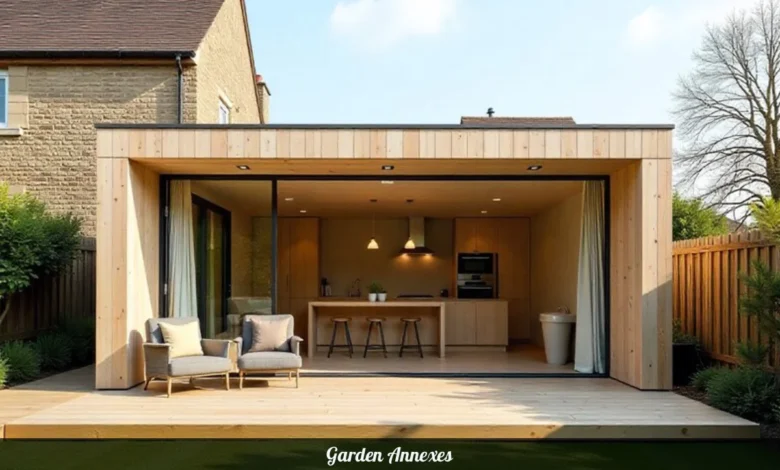
Garden annexes provide self-contained living spaces in your garden, complete with bathrooms, kitchens, and bedrooms. Unlike standard garden rooms used for offices or hobbies, annexes serve as true homes for elderly relatives, adult children, or guests. They offer privacy and independence while keeping families close together.
Prices range from £38,900 for compact studio designs to £120,000+ for two-bedroom layouts. You can build under full planning permission for permanent structures or use the Caravan Act route for mobile homes. Most projects take 8-16 weeks from design to completion, with additional time for planning approval when required.
Your garden could solve your housing problem. Families across the UK face pressure to accommodate aging parents, returning adult children, or relatives needing support. A survey by Make Room Outside found 71.4% of adults open to multi-generational living, motivated by caregiving needs, financial savings, and family support.
What Makes Garden Annexes Different from Garden Rooms
Garden annexes differ from standard garden rooms in one key way: they’re habitable spaces. This legal distinction matters for planning and construction.
Garden annexes must include:
- Full bathroom with shower or bath
- Kitchen or kitchenette with cooking facilities
- Sleeping accommodation
- Living space
Garden rooms typically serve as home offices, gyms, or studios. They lack kitchens and bathrooms. Garden annexes provide complete self-contained living—think tiny houses in your backyard.
This distinction affects regulations, costs, and construction standards. Annexes require either planning permission or Caravan Act compliance. Garden rooms often qualify for permitted development, avoiding formal approval.
Two Legal Routes: Planning Permission vs. Caravan Act
This creates permanent structures built to house standards. Building Regulations approval costs £200-£500, with planning applications around £460. These annexes feature solid foundations, full compliance with current building codes, and superior insulation.
Companies like Garden Annexes, Swift Unlimited, and Custom Garden Rooms specialize in planning-approved builds. Expect 8-12 weeks for planning approval, then 6-12 weeks for construction.
Planning-approved annexes add more property value and provide certainty. You build once without future compliance concerns.
Caravan Act Route
This route lets you install annexes without planning permission when meeting specific criteria:
- Maximum two sections assembled on-site
- Physically movable by road transport
- Under 20 meters in length, 6.8 meters in width
- Internal height below 3.05 meters
- Remains ancillary to the main dwelling
Mobile homes enjoy 0% VAT rates when including both bathroom and kitchen, compared to 20% VAT for traditional annexes. This saves thousands on larger projects.
Booths Garden Annexes and A Room in the Garden specialize in Caravan Act compliance. Installation takes days rather than weeks.
The risk? If your annexe cannot demonstrate its movable, you face enforcement action, and HMRC may recoup unpaid VAT. Some providers avoid this route entirely, citing legal uncertainty.
Which suits you? Planning permission gives certainty and builds permanent value. The Caravan Act offers speed and tax savings but requires careful compliance.
Garden Annexe Costs: What You’ll Actually Pay
The average cost for a new garden annexe ranges from £60,000 to £120,000. Granny annexe kits start between £25,000 and £60,000.
Studio and one-bedroom designs work for single occupants, guests, or teenage children. Custom Garden Rooms’ Darby annexe starts at £38,900 for 15 sqm. Garden Annexes’ Annexxa 430 provides a similar space for around £40,000-£50,000.
Expect basic kitchenettes with two-ring hobs, mini-fridges, and sinks. Living and sleeping areas combine in open-plan layouts. Compact shower rooms save space.
Mid-Size Annexes (25-45 sqm): £60,000-£85,000
This category offers proper one-bedroom layouts with separate living spaces. Executive Garden Rooms created a 33.75 sqm annexe in Verwood featuring a kitchenette, shower room, and spacious living area for around £65,000-£75,000.
Swift Unlimited built a 31.5 sqm one-bedroom annexe in Dorset with Douglas Fir cladding and quality finishes. Total project costs reached approximately £75,000-£85,000, including all extras.
Large Annexes (45-70+ sqm): £90,000-£150,000+
Two-bedroom annexes start around £120,000. Custom Garden Rooms’ Ludlow annexe begins at this price for 62.5 sqm with two double bedrooms, a full kitchen, a separate living room, and a modern bathroom.
AMC Garden Rooms designed a 70.78 sqm L-shaped annexe in Hertford with high-spec finishes. Total costs reached £130,000-£150,000.
Hidden Costs to Budget For
Your quoted price rarely covers everything:
- Site preparation and base: £3,000-£8,000
- Utility connections: £4,500-£5,000
- Planning consultant: £500-£2,000
- Landscaping and paths: £2,000-£5,000
Total project costs often run 20-30% above the base annexe price. A £60,000 annexe might cost £75,000-£80,000 when including all extras.
Design Options: Choosing Your Layout
Open-plan designs maximize limited space. Everything shares one room except the bathroom. These work for single occupants who value simplicity and efficiency.
Garden Annexes’ Annexxa 430 (4m x 3m) exemplifies smart studio design. Storage becomes creative—under-bed drawers, wall-mounted shelves, fold-down tables.
One-Bedroom Annexes
Separate bedrooms provide privacy. Living areas give space to entertain. Most include 10-15 sqm living rooms, 8-12 sqm bedrooms, 3-4 sqm bathrooms, and 4-6 sqm kitchens.
Timeless Garden Rooms built a one-bedroom annexe with vaulted ceilings, creating an airy feel. The bedroom is separated from the living space, forming distinct zones.
Two-Bedroom Annexes
Perfect for couples or those needing home offices alongside bedrooms. Heritage Garden Studios created an 8m x 4.5m two-bedroom annexe in Sheffield with SIPs construction and year-round insulation.
The second bedroom serves multiple purposes—craft rooms, studies, or guest spaces.
Design Features That Matter
Modern annexes include:
- Vaulted ceilings from pitched roofs (creates 30-40% more perceived space)
- Bi-fold or sliding doors connecting indoor and outdoor areas
- Corner glazing maximizing natural light
- Covered decking extends the usable space
Garden Annexes’ St. George range demonstrates how pitched roofs transform interiors, making spaces feel larger through architectural design.
Construction Quality: What to Look For
Three approaches dominate:
Garden Annexes uses 222mm thick timber frame walls with glulam on 550mm centers. Cavities filled with insulation provide warmth.
Super SIPs offers structural insulated panels—insulation sandwiched between structural boards. These deliver superior insulation values.
Vita Modular employs steel frames. Stronger than timber, resistant to warping, but more expensive.
All methods work well when properly specified. Focus on U-values (heat loss measurements) rather than construction method.
Insulation Standards
Year-round comfort demands proper insulation. Building Regulations require:
- Walls: U-value 0.30 W/m²K or better
- Roof: U-value 0.20 W/m²K or better
- Floor: U-value 0.25 W/m²K or better
Caravan Act buildings don’t meet these standards. Mobile homes lack stringent insulation requirements, affecting long-term comfort and energy bills.
Cladding Choices
External finishes affect maintenance:
- Thermowood: Pre-treated, no maintenance needed, ages naturally
- Cedar: Classic choice, requires treatment every 2-3 years
- Composite: Zero maintenance, multiple colors, higher initial cost
- Render: Modern finish, repaint every 10-15 years
Heritage Garden Studios used Millboard composite cladding on their Sheffield project, eliminating maintenance while creating visual interest.
Installation Process: Timeline and Steps
Site Survey (Week 1)
Reputable companies provide free site surveys. Technical surveyors assess garden access, ground levels, drainage, and utility connection points. Garden Annexes emphasizes their detailed site visits, producing fixed-price quotations.
Design Phase (Weeks 2-4)
Finalize layouts, door positions, kitchen specifications, bathroom fittings, cladding colors, and internal finishes. Custom Garden Rooms offers comprehensive design consultations. Standard ranges provide less flexibility but faster delivery.
Planning or Compliance (Weeks 5-16)
Planning permission adds 8-12 weeks minimum. Suppliers or consultants submit drawings and documents. Councils review, request changes, and eventually approve or refuse.
Caravan Act builds skip this step, but requires documentation proving legal compliance.
Groundworks (Weeks 1-2 of construction)
Prepare the site before annex arrival:
- Install a concrete pad or timber base
- Lay utility trenches
- Run electrical cables from the main house
- Install water supply pipes
- Connect waste pipes to drainage
Delivery and Installation (Weeks 3-5)
Prefabricated annexes arrive on trucks. Garden Annexes were installed within a few days. Teams position panels, assemble sections, and make connections.
On-site builds take 6-12 weeks. Tradespeople construct similar to small houses.
Final Touches (Week 6)
Finish work includes internal decoration, kitchen fitting, bathroom installation, flooring, landscaping, and utility testing. Many suppliers offer turnkey packages that handle everything.
Running Costs and Practical Maintenance
A 30-40 sqm well-insulated annexe costs £600-£1,200 annually for heating and power. Electric heating is most common—radiators, underfloor heating, or air source heat pumps.
Budget £50-£100 monthly for occupied annexes.
Maintenance Requirements
External maintenance depends on cladding:
- Composite: Annual washing with soap and water
- Thermowood: No treatment needed
- Cedar: Treatment every 2-3 years
- Render: Repaint every 10-15 years
Roofs need inspecting every 5 years. Rubber roofing lasts 50+ years with minimal maintenance. Check window and door seals annually.
Budget £200-£500 annually for basic upkeep.
Council Tax Implications
Separate dwellings may attract separate council tax when occupants have no connection to the main house facilities. Annexes used ancillary to main dwellings (elderly relatives, dependent adults) typically don’t trigger separate taxes.
Check with your local authority before building.
Choosing Your Supplier
Request completed project examples similar to your needs. Visit showsites when possible. Garden Annexes operates three furnished show models at its Suffolk site.
Ask detailed questions:
- What insulation thickness and U-values?
- What warranty period? (10 years should be standard)
- What’s included in quoted prices?
- Do you handle planning applications?
- What’s the typical timeline?
Regional Coverage
Some companies operate nationally, others regionally. Use the Garden Room Directory to find suppliers working in your area.
Swift Unlimited covers the South and Southwest. Garden Annexes operates from Suffolk but serves much of England.
Planning Support
Companies pursuing planning permission should provide in-house expertise, partner with specialist consultants, or offer clear process guidance.
Swift Unlimited works with experienced planning consultants on every application, achieving higher success rates.
Common Mistakes to Avoid
Site preparation, utilities, landscaping, and contingency funds add significantly. Budget at least 25% above the quoted annexe price.
Skipping Professional Advice
Planning specialists cost £1,000-£2,000 but dramatically improve success rates. DIY applications often face rejection, costing time and resubmission fees.
Choosing Size Over Quality
Smaller, well-insulated, properly constructed annexes beat larger, poorly built ones. Focus on U-values, build quality, and warranties rather than maximizing square meters.
Ignoring Access Issues
Can trucks reach your garden? Is space available for cranes if needed? Some properties can’t accommodate large annex deliveries. Identify access constraints early.
FAQs
Can I use my garden annexe as an Airbnb?
This requires planning permission specifically for holiday letting. Standard annexes approved for family use can’t be commercially rented without permission.
Do I need Building Regulations approval for a Caravan Act annexe?
No. Caravans are exempt from Building Regulations as movable property. This saves time and cost but means lower insulation standards.
What’s the smallest viable annexe size?
Functional annexes start around 15-18 sqm. This provides an open-plan living/sleeping space, kitchenette, and shower room.
Will an annexe increase my property value?
Usually yes, especially with planning permission. Expect 5-15% value increase on average properties, depending on local market conditions and annexe quality.
Can I connect the annexe to my existing heating system?
Possible but often impractical. Running pipes 20-30 meters loses heat and requires larger boilers. Independent heating systems work better.
How long does a garden annexe last?
Properly maintained annexes should last 50+ years. Quality suppliers offer 10-year structural guarantees.
What happens if I sell my house?
Planning-approved annexes transfer with the property, often increasing buyer appeal. Caravan Act annexes are technically movable property, but usually stay.
Can I convert a garage or shed into an annexe?
Yes, but you’ll need planning permission and Building Regulations approval. Converting existing structures typically costs 40-60% of new-build prices.
Garden annexes solve real housing problems facing UK families. They keep generations connected while preserving independence. Initial costs seem high, but compare against care home fees (£3,000-£6,000 monthly) or helping adult children with deposits (£50,000-£100,000+).
Visit show sites, meet suppliers, and request detailed quotations before deciding. Your garden has the potential to transform unused lawn into a valuable living space that serves your family for decades.