Couch Dimensions Decoded: The Complete Sizing Guide for Your Perfect Fit
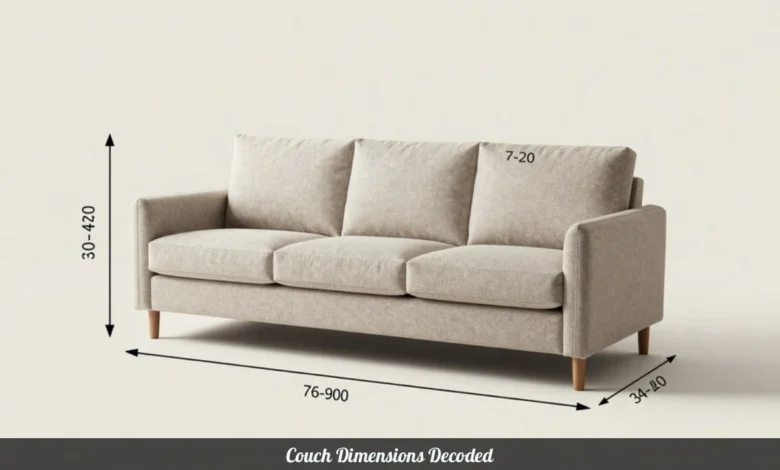
Standard couches measure 76-90 inches wide, 34-40 inches deep, and 30-36 inches tall. Loveseats span 56-72 inches, while sectionals range from 90-140 inches, depending on configuration. Seat depth typically sits at 20-24 inches, seat height at 17-20 inches, and each person needs 22-24 inches of width for comfortable seating.
Understanding What Couch Measurements Actually Mean
You found the perfect couch online. The price fits your budget, the color matches your walls, and the style screams “you.” Then delivery day arrives, and the movers can’t get it through your doorway. Or worse, it arrives perfectly but swallows your entire living room, leaving no space to walk.
Couch shopping shouldn’t feel like gambling. When you understand what those dimension numbers mean and how they translate to real life, you can shop with confidence.
Width refers to the distance from one armrest to the other—the longest measurement on most couches. Depth measures from the front edge to the back, showing how far the couch extends into your room. Height spans from the floor to the top of the backrest. These three numbers give you the couch’s footprint.
Seat depth matters more than you’d think. This measurement runs from the front cushion edge to where your back meets the cushion. Most couches offer 20-24 inches of seat depth. Anything under 21 inches feels upright and formal. Depths over 24 inches let you curl up, but make your feet dangle if you’re shorter than 5’8″.
Seat height determines how easily you sit down and stand up. Standard couches sit 17-20 inches from the floor to the cushion top. Lower seats (15-17 inches) create a modern, lounge vibe but challenge anyone with knee issues. Higher seats (18-20 inches) help with mobility and work better for formal seating.
Armrest width and height affect both comfort and total size. Wide armrests (8-10 inches) provide great support for lounging and reduce overall seating space. Narrow arms (4-6 inches) maximize seats but offer less comfort. Measure armrest height from the seat cushion to the top—this should align with your elbow when sitting.
Standard Three-Seat Couch Dimensions
A standard three-seater serves as the baseline for most living rooms. These couches typically measure 76-90 inches wide, giving three adults room to sit without touching shoulders. At this width, you get about 25 inches per person—enough space for comfort without excess.
Depth on standard couches runs 34-40 inches overall. This includes the cushion depth plus the backrest thickness. Your actual seating depth (where you sit) usually measures 20-24 inches. Deeper cushions mean more lounging comfort, but eat more floor space.
Height varies based on design, but most three-seaters stand 30-36 inches tall from floor to backrest top. Low-back modern designs might only reach 28-30 inches, while traditional styles with tufted backs climb to 36 inches or higher.
Seat specifications make the real difference. Standard three-seaters offer 17-19 inch seat heights and 21-23 inch seat depths. These numbers accommodate most adults comfortably for both sitting upright and relaxing.
Diagonal depth becomes critical when moving your couch through doorways. Measure from the top back corner to the bottom front corner. This measurement (typically 34-38 inches) determines if movers can angle your couch through narrow spaces. Your diagonal should be at least 2 inches smaller than your narrowest doorway.
Loveseat Sizing Details
Loveseats pack two comfortable seats into a compact frame. Standard loveseats measure 56-72 inches wide—perfect for couples or small spaces. The sweet spot sits around 64 inches, giving each person about 32 inches of personal space.
Depth mirrors three-seaters at 34-40 inches overall. The seating depth typically matches full-size couches at 20-24 inches. You sacrifice width for space-saving, not comfort.
Height ranges from 30 to 35 inches, identical to standard couches. Manufacturers design loveseats to match their three-seat counterparts, letting you mix and match in the same room without creating visual chaos.
Seat measurements stay consistent with larger couches. Expect 17-20 inch seat heights and 20-24 inch seat depths. Some “apartment loveseats” reduce these slightly to 16-18 inch heights and 18-20 inch depths for ultra-compact spaces.
Armrest widths on loveseats often slim down to 4-6 inches to maximize seating width. Some designs eliminate one arm when placed against walls, gaining precious inches.
Sectional Couch Measurements
L-shaped sectionals combine a long side with a shorter return or chaise. The long side typically spans 90-120 inches, while the short side measures 60-85 inches. Total width from arm to arm reaches 100-140 inches, depending on configuration.
U-shaped sectionals wrap around to create conversation pits. These monsters can measure 120-160 inches wide and 90-120 inches deep. Only consider U-shapes if your room measures at least 15×18 feet.
Modular sectionals arrive in individual pieces measuring 30-40 inches wide each. A three-piece modular might total 90-120 inches assembled. The beauty here—you can rearrange pieces or add sections later.
Chaise length on sectionals runs 60-80 inches from the back cushion to the chaise end. This extra length lets someone fully recline. Make sure you have at least 80 inches of clear space along the chaise wall.
Corner pieces measure 36-40 inches square. These connecting sections eat more space than you’d expect. Factor them into your total footprint when planning.
Measuring Your Space Before You Buy
Start with your room dimensions. Measure the wall length where the couch will sit. Your couch should take up roughly two-thirds of that wall length—anything more feels cramped, anything less looks lost.
Check doorway widths and heights. Measure every doorway between your front door and the couch’s final spot. Standard doors measure 30-36 inches wide and 80 inches tall. Remember that diagonal depth number from earlier? It needs to be smaller than your narrowest doorway.
Hallway width matters for maneuvering. Measure the width at the narrowest point. You need at least the couch’s depth measurement plus 6 inches for turning. Tight 90-degree turns demand even more space.
Stairway measurements become critical for upper floors. Measure stair width, ceiling height above stairs, and landing space. Most movers need 36 inches of stair width. Spiral stairs or stairs with tight turns often block any couch over 70 inches long.
Leave walking space around furniture. Plan for 30-36 inches between your couch and coffee table. Allow 14-18 inches between the couch and walls for cleaning and air circulation.
The Pivot Method Explained
The pivot method saves countless deliveries. This technique involves standing the couch on one end and rotating it through doorways. When a couch won’t fit straight through, tilting often works.
Calculate if pivoting works with simple math. Measure your couch’s height and depth. Use the formula: diagonal = √(height² + depth²). If this diagonal measures less than your doorway width, you can pivot the couch through.
For example, a couch measuring 32 inches high and 36 inches deep has a diagonal of 48 inches. This would fit through a 50-inch doorway at an angle, but not a 45-inch doorway.
Test the pivot before delivery day. Measure your current couch or use cardboard to create a full-size model. Try angling it through doorways. You’ll quickly discover problem spots.
Remove obstacles that block pivoting. Take doors off hinges to gain 2-3 inches. Move side tables, lamps, and decor away from doorways. Every inch counts when maneuvering tight spaces.
Special Couch Types and Their Dimensions
Sleeper sofas measure the same as standard couches when closed. When opened, the mattress extends 75-90 inches forward. Measure from your wall to ensure you have this clearance plus walking space. Queen sleepers need 90 inches of front clearance, twins need 75 inches.
Reclining couches require 12-18 inches of clearance behind them. Wall-hugger recliners reduce this to 4-6 inches. Measure from the wall to the back of your closed recliner, then add the required clearance.
Apartment-sized couches shrink to 68-78 inches wide and sometimes reduce depth to 32-35 inches. These smaller proportions work in spaces under 12×14 feet. The trade-off—you typically lose one seat of capacity.
Oversized couches stretch beyond 90 inches wide and often add depth to 38-42 inches. These work in rooms larger than 15×18 feet. Anything smaller feels cramped.
Curved couches measure differently at various points. Check the widest point from end to end, the deepest point from back to front, and the height at the tallest section. Curved designs often need more floor space than their measurements suggest.
Smart Shopping Tips for Perfect Fit
Measure twice, order once. Before clicking “buy,” verify every dimension. Compare the couch measurements to your room layout, doorways, and existing furniture. Create a floor plan on paper or use a room planning app.
Test comfort in person when possible. Sit on similar models in furniture stores. Notice the seat depth and height that feels best for your body. Use these comfort measurements as your baseline when shopping online.
Read product descriptions carefully. Some retailers list assembled dimensions while others show shipping box sizes. Look for “overall dimensions” or “assembled measurements.” Check if measurements include or exclude legs.
Ask about delivery and assembly. Will the couch arrive fully assembled or in pieces? Can legs be removed for easier maneuvering? Some retailers offer white glove delivery where professionals handle all setup.
Consider modular options for difficult spaces. Modular couches arrive in separate pieces that you assemble inside. Each piece measures 30-40 inches—much easier to navigate through doorways than a single 90-inch couch.
Common Sizing Mistakes to Avoid
Buying based on seating capacity alone leads to oversized furniture. A couch that “seats five” might measure 110 inches wide—too large for most average living rooms. Focus on your daily needs, not party maximums.
Forgetting about coffee table spacing creates cramped arrangements. Leave 16-18 inches between your couch front and coffee table. This distance lets you reach drinks while maintaining walking space.
Ignoring traffic patterns blocks natural movement. Map out how people walk through your room. Your couch shouldn’t force guests to squeeze between furniture or walk the long way around.
Choosing style over size creates buyer’s remorse. That gorgeous 100-inch sectional might match your aesthetic perfectly, but if your room only measures 12×14 feet, you’ll hate navigating around it daily.
Skipping doorway measurements results in delivery nightmares. One reader shared their story of ordering a 90-inch couch for a home with 32-inch doorways. The diagonal wouldn’t pivot through. They paid $200 in return shipping and waited eight weeks for a smaller replacement.
How Different Body Types Affect Couch Choice
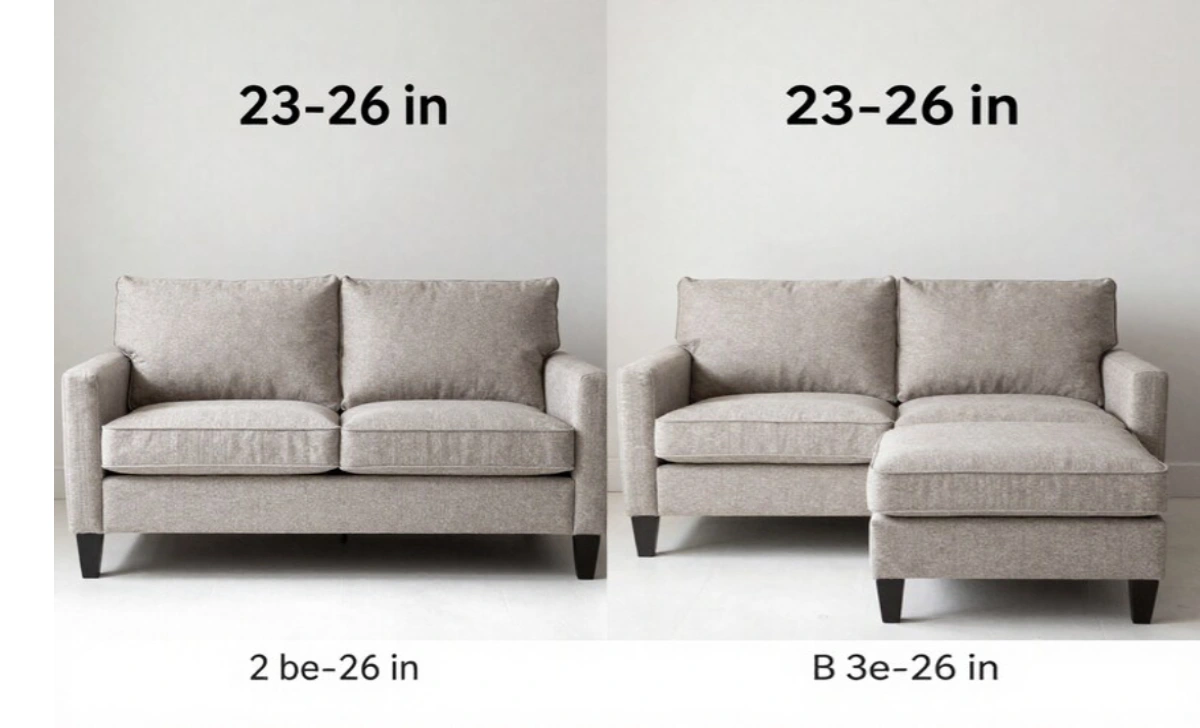
Taller people (over 6 feet) need different dimensions. Look for seat depths of 23-26 inches so legs don’t dangle. Consider couches with chaises or ottomans for leg support. Higher seat heights (18-20 inches) make standing easier.
Shorter people (under 5’4″) feel more comfortable with shallower seats. Aim for 18-21 inch seat depths so feet touch the floor when sitting back. Lower seat heights (16-18 inches) prevent dangling feet.
Mobility concerns demand specific measurements. Seat heights of 18-20 inches help with sitting and standing. Firmer cushions (rather than deep, soft ones) provide better support. Arms at 24-26 inches high give leverage when standing.
Families with kids benefit from deeper couches. Children love to sprawl and play on couches. A 24-inch seat depth accommodates fort-building and lounging. Consider the couch height—lower backs (28-30 inches), so parents can see over to supervise.
Pet owners should think about fabric and clearance. Cats love arm perches—wider arms (8-10 inches) give them space. Dogs benefit from lower seat heights (15-17 inches) for easier jumping. Furniture legs at least 4 inches tall allow for cleaning underneath.
Room Size Guidelines for Couch Selection
Small rooms (10×12 feet or less) work best with loveseats or apartment sofas measuring 60-75 inches wide. Pair with a couple of accent chairs rather than maxing out with a larger couch.
Medium rooms (12×16 feet) comfortably fit standard three-seaters measuring 78-88 inches. You can add a coffee table and a chair or two without crowding.
Large rooms (16×20 feet or bigger) can handle oversized couches (90+ inches) or sectionals. These spaces need larger furniture to avoid looking empty. A 100-inch couch or L-shaped sectional fills the space without overwhelming it.
Open floor plans require zone thinking. Use your couch to define the living area, separate from dining or kitchen spaces. Larger sectionals (110-140 inches) work well for creating these boundaries.
Awkward spaces with windows, doors, or architectural features need careful planning. Measure around obstacles. Sometimes a smaller couch plus creative chair placement works better than forcing a large piece into an odd layout.
Final Thoughts
Perfect couch dimensions balance three factors: room size, body comfort, and lifestyle needs. Start by measuring your space—walls, doorways, and walking paths. Compare these numbers to standard couch dimensions, then adjust based on your daily use.
Remember that dimensions on paper feel different in person. A 90-inch couch sounds reasonable until you mark it out on your floor with painter’s tape. Taking this extra step prevents costly mistakes.
Don’t sacrifice comfort for size or vice versa. A couch that technically fits but forces uncomfortable seating positions or blocks traffic will frustrate you daily. Trust your measurements and your gut.
FAQs
What’s the difference between overall depth and seat depth?
Overall depth measures from the couch’s back to the front edge, typically 34-40 inches. Seat depth only counts the cushion where you sit, usually 20-24 inches. Seat depth affects comfort more directly.
How do I know if a couch will fit through my door?
Calculate diagonal depth: √(height² + depth²). This number must be at least 2 inches smaller than your doorway width to pivot through. Also, verify that the length is less than the ceiling height above the doors.
What’s the ideal distance between a couch and a TV?
Multiply your TV screen diagonal by 1.5-2. For a 55-inch TV, sit 82-110 inches away. For a 65-inch TV, sit 97-130 inches away. Adjust based on whether you watch mostly HD or 4K content.
Can I customize standard couch dimensions?
Many manufacturers offer semi-custom options. You can often adjust the width by 6-12 inches, choose between arm styles that affect overall dimensions, and select seat depths. Fully custom couches cost 20-30% more than standard sizes.
Do couch legs count in the dimensions?
Most manufacturers include legs in height measurements, but verify in product descriptions. Some list “seat height” (floor to cushion) separately from “overall height” (floor to backrest top). Legs can often be removed for delivery, reducing height by 3-5 inches.