Commercial Real Estate Construction Loans: What Borrowers Need to Know in 2026
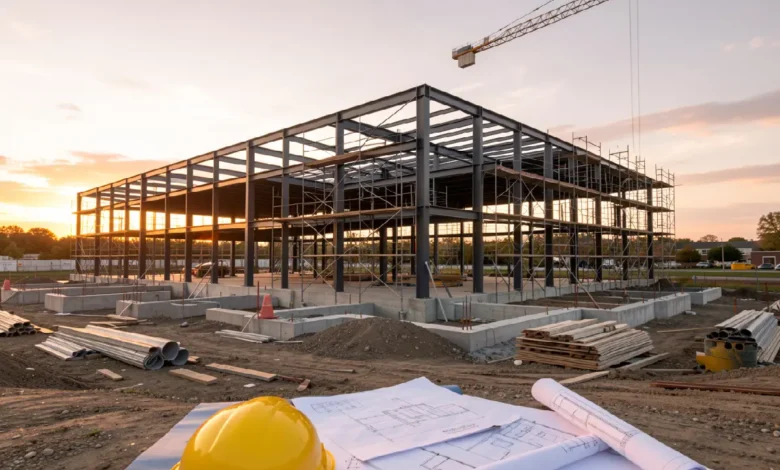
Commercial real estate construction loans are short-term financing tools used to fund the building or renovation of income-producing properties. They typically cover land acquisition, materials, and labor costs, with interest-only payments during the construction phase. Once the project reaches completion, borrowers transition to permanent financing. In 2026, rates range from 7.5% to over 10%, and lenders are applying tighter underwriting standards across the board.
If you’re planning a ground-up development or major renovation, understanding how these loans work before you approach a lender will save you time and money. This guide covers loan structures, qualification criteria, lender types, draw schedules, and how to prepare your application in today’s lending climate.
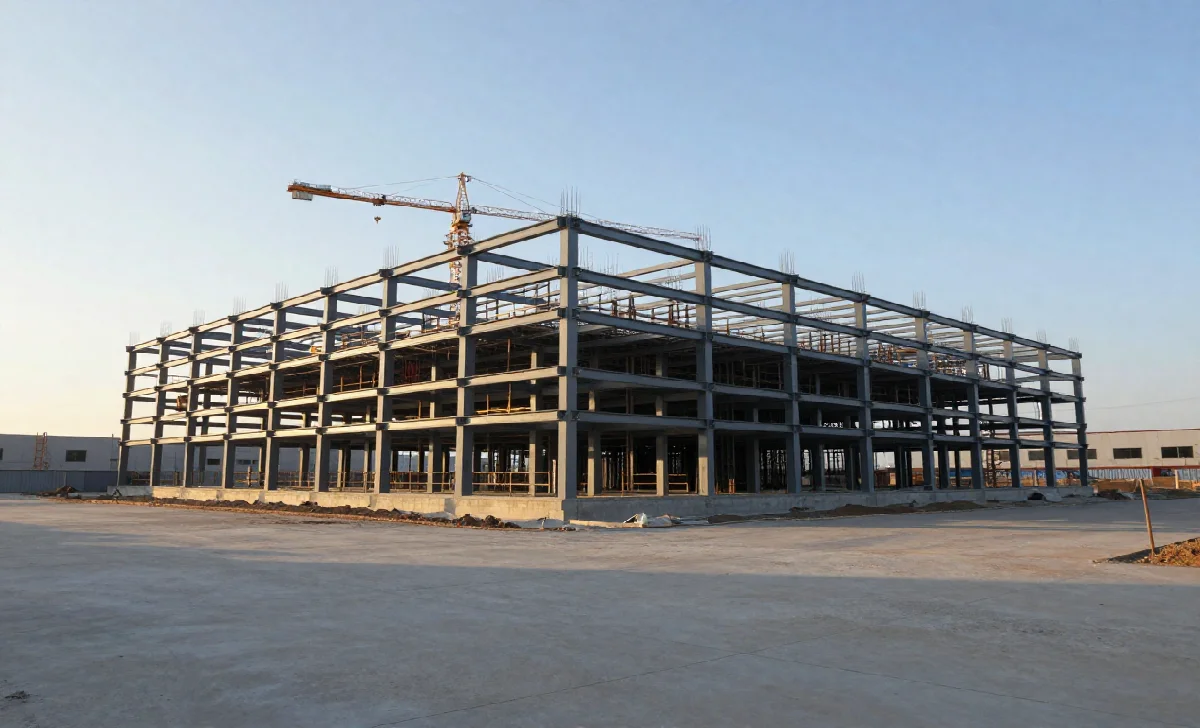
What Is a Commercial Real Estate Construction Loan
A commercial construction loan funds the development of commercial property, whether that’s an office building, industrial facility, retail center, or multifamily project. Unlike a standard commercial mortgage, where a lender holds a finished asset as collateral, a construction lender is financing something that doesn’t yet exist. That added risk is precisely why rates are higher and approval requirements are stricter.
Construction loans are typically priced higher than other mortgage types because of increased risk, with most current rates ranging between 7.5% and over 10%, depending on borrower creditworthiness, location, loan amount, and lender.
These loans are short-term by design. Most carry terms are between 12 and 36 months. Once your project is complete and stabilized, you’ll either refinance into a permanent loan or convert through a construction-to-permanent structure that handles both phases under one agreement.
How Commercial Construction Loan Rates Work in 2026
Your rate on a commercial construction loan won’t be fixed in the traditional sense. Most are floating rates tied to the prime rate or the SOFR index.
Community banks typically price commercial construction loan rates at prime plus 1.00% to 1.50%. With the Fed holding rates steady in early 2026, that puts most community bank construction loans in the 8.75% to 9.25% range for standard projects. Stronger borrowers with proven track records and larger project sizes can sometimes negotiate closer to prime flat.
On January 28, 2026, the Federal Reserve kept the federal funds rate unchanged at 3.50% to 3.75%, marking the first pause following three straight cuts in late 2025. The 10-year Treasury yield sat at approximately 4.26%, keeping long-term commercial rates from declining further.
What does this mean practically? If you’re building in 2026, expect your construction loan rate to float and adjust as the Fed moves. Budget with that variability in mind, and don’t anchor your pro forma to the lowest rate scenario.
Construction Loan Terms You’ll See From Lenders
Before you walk into a lender meeting, know the standard parameters. Most commercial construction loans in 2026 share these characteristics:
- Minimum loan size: $5 million for most conventional lenders
- Loan-to-cost (LTC): Up to 70%, though some lenders have pulled back to 60% on riskier projects
- Amortization: Interest-only during construction
- Term: 12 to 36 months, depending on project complexity
- Recourse: Non-recourse options are generally available for loans above $20 million
- Rate structure: Floating, tied to prime or SOFR
For projects requiring higher leverage, some lenders allow mezzanine financing or preferred equity stacked on top of senior debt, potentially reaching 85% LTC. This can fund more of your project costs, but the blended cost of capital rises sharply.
The Draw Schedule: How Funds Get Released
One detail many borrowers underestimate is the draw schedule. Your lender won’t hand over the full loan amount at closing. Funds are released in stages, tied to construction milestones.
A typical draw schedule looks like this: an initial draw to cover land acquisition or site preparation, followed by subsequent draws tied to foundation completion, framing, mechanical and electrical rough-in, and completion. Each draw usually requires an inspection from a third-party construction monitor that the lender hires at your expense.
Missing a milestone or running over budget can delay your next draw. That delay costs money because your carrying costs continue accumulating while work stalls. Prepare a detailed construction budget with at least a 10% contingency built in. Lenders will want to see it, and you’ll be glad you have it.
Qualification Requirements: What Lenders Examine
Getting approved for a commercial construction loan requires more documentation than a standard commercial mortgage. Lenders are not just evaluating you as a borrower; they’re evaluating your project, your contractor, and your exit strategy simultaneously.
Borrower qualifications lenders look for:
- Minimum credit score of 680 to 700, with most strong approvals above 720
- Net worth equal to or greater than the loan amount
- Liquidity of at least 10% of the total project cost after closing
- Proven development experience in the same property type
Project documentation typically required:
- Detailed construction budget and timeline
- Architect and contractor agreements with licensed, insured parties
- Market study or feasibility analysis
- Signed leases or letters of intent, especially for commercial tenants
Your exit strategy matters as much as your project. Lenders want to know how you’ll pay off the construction loan. Either you’ve already secured permanent financing commitments, or your project’s projected stabilized NOI supports a refinance at completion. Without a credible exit, many lenders won’t advance.
Types of Lenders for Commercial Construction Loans
Not every lender does construction lending, and among those that do, their appetite varies significantly by project type and size.
Community and regional banks are the most active construction lenders for projects in the $5 million to $25 million range. They know local markets, they build relationships, and they often have more flexibility on structure. The tradeoff is that they hold these loans on their books, so they’re selective and conservative on LTC.
Large national banks like JPMorgan Chase, Bank of America, and Wells Fargo have dedicated construction lending arms that work primarily with experienced developers on larger projects, typically $25 million and up. They offer lower rates for the strongest borrowers but require deep documentation and extended timelines.
Life insurance companies are known for fixed-rate permanent loans, but also do construction financing for very large, stabilized projects. Life companies prefer lending at 65% LTV or less, with the lowest long-term fixed rates and loans that can be locked for up to 25 years. They prefer large cities and financially strong, experienced borrowers.
Private debt funds and bridge lenders fill the gap when banks decline. They move faster, ask fewer questions about borrower experience, and can fund projects in secondary markets that banks won’t touch. You’ll pay for that flexibility: rates from private lenders run 10% to 15% or higher. Use them as a tool, not a default.
If you’re a first-time developer or working on a smaller project, an SBA 504 loan can partially fund construction or renovation tied to owner-occupied commercial property. Rates are government-backed and lower than conventional construction financing.
Construction-to-Permanent Loans: One Deal, Two Phases
If you want to avoid the risk and cost of refinancing after construction, a construction-to-permanent loan may be your best structure. You close once, fund the construction phase, and at completion, the loan automatically converts to a long-term mortgage.
30-year construction-to-permanent loan rates generally fall in the 6.9% to 8.2% range. Lenders offering these products often bundle closing costs and provide rate-lock options, making them ideal for borrowers who want simplicity and a single approval process.
The advantage is certainty. You lock your permanent rate at closing, so you’re protected if rates move during construction. The disadvantage is less flexibility: if your project stabilizes at a different value than projected, you’re locked into a loan that may not reflect that outcome.
What the 2026 Lending Environment Means for You
The broader CRE market context matters when you’re applying for a construction loan. Over $1.5 trillion in commercial real estate loans will mature by the end of 2026, with refinancing complicated by higher rates and falling property valuations. The office sector faces the most pressure, while data centers and industrial properties show relative strength.
Lenders are aware of this. They’re more cautious with office and retail construction right now, and more willing to engage on industrial, multifamily, and data center projects. If your project type sits in a disfavored category, you’ll need to bring a stronger story, more equity, and a pre-leasing commitment to get a serious look.
Transactions with strong cash flow and conservative leverage continue to close, while marginal deals remain difficult. The borrowers getting funded in 2026 are the ones who show up prepared: clean financials, experienced teams, and projects in markets with real demand.
How to Prepare Before Approaching a Lender
Before you contact a single lender, get your materials in order. A disorganized application signals risk to a lender before they’ve read a word of your financials.
Prepare a project summary that explains the development plan, the market opportunity, your team’s qualifications, and the exit strategy in plain language. Attach your construction budget, architectural plans, contractor bids, and any signed tenant commitments. Have your personal financial statement, tax returns for the last three years, and a schedule of your real estate assets and liabilities ready to submit.
Then target your lender outreach. Match your project size to the lender’s typical deal range. Don’t waste time sending a $6 million construction loan request to a national bank that starts at $25 million. Research which lenders are actively closing construction deals in your market right now.
A commercial mortgage broker who specializes in construction lending can compress this process significantly. They know which lenders have an appetite for your specific project type, and they can help you structure the deal before it hits a lender’s desk.
FAQs
What credit score do I need for a commercial construction loan?
Most lenders want a minimum of 680, with stronger approvals above 720. Borrower experience in the relevant property type often carries as much weight as the credit score itself.
Can I get a commercial construction loan with no prior development experience?
It’s difficult. Most lenders require at least one completed project of a similar type and scope. Partnering with an experienced co-developer is one way around this requirement.
How long does it take to close a commercial construction loan?
Expect 60 to 90 days from application to funding for a bank. Private lenders can close in 30 days or less, but at a higher cost.
What happens if my project goes over budget?
The lender’s obligation stops at the committed loan amount. Cost overruns are your responsibility. This is why a contingency reserve of 10% or more is standard practice and why lenders require it before approving your budget.
What’s the difference between LTC and LTV in construction lending?
LTC (loan-to-cost) compares the loan amount to the total project cost. LTV (loan-to-value) compares the loan to the projected completed value. Lenders underwrite construction loans on LTC, typically capping at 70%. They may also run an LTV analysis on the projected stabilized value as a secondary check.