Pulsation Dampers Working Principle, Types, Applications, and Selection Guide
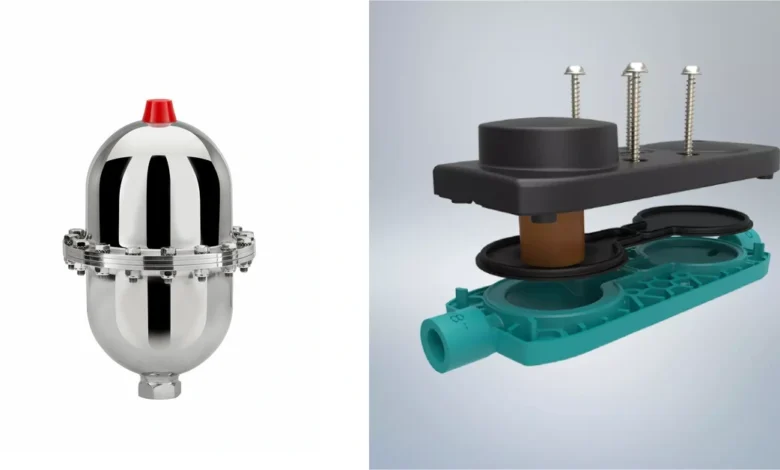
Pressure pulsations represent a persistent challenge in fluid handling systems. These fluctuations occur naturally in many pumping applications, particularly those using positive displacement pumps. Without proper control, these variations can damage equipment, reduce system efficiency, and create operational problems.
Industries ranging from oil and gas to pharmaceutical manufacturing face these issues daily. Chemical processing plants deal with precise metering requirements that pressure spikes can disrupt. Water treatment facilities need consistent flow rates for proper dosing. Hydraulic systems require stable pressure to function correctly.
Pulsation dampers address these problems by absorbing pressure peaks and releasing energy during low-flow cycles. This function protects downstream equipment, reduces noise and vibration, and maintains process stability.
What Is a Pulsation Damper?
A pulsation damper is a pressure vessel that absorbs and dampens pressure fluctuations in fluid systems. The device contains a gas-filled chamber separated from the liquid flow by a flexible barrier—typically a diaphragm or bladder.
When pressure increases, the gas compresses and absorbs excess energy. During pressure drops, the compressed gas expands and releases this energy back into the system. This exchange smooths pressure variations and creates more consistent flow.
While pulsation dampers and accumulators share similar construction, they serve different purposes. Accumulators store energy for later use, providing auxiliary power or compensating for pump failure. Pulsation dampers focus solely on reducing pressure variations in active systems.
Why Pressure Pulsations Occur
Positive displacement pumps create inherent pressure variations through their operation. Reciprocating pumps—including piston, plunger, and diaphragm designs—discharge fluid in discrete volumes rather than continuous streams. Each stroke generates a pressure spike.
The severity of pulsations depends on several factors:
1. Pump configuration
Single-acting pumps produce larger fluctuations than duplex or triplex designs. Fewer cylinders mean fewer overlapping discharge cycles and greater pressure variation between strokes.
2. Operating speed
Higher pump speeds increase pulsation frequency but may reduce amplitude relative to average pressure.
3. System characteristics
Long pipe runs, sharp bends, and valve placement affect how pressure waves travel and reflect through the system. These reflections can amplify or dampen existing pulsations.
4. Fluid properties
Compressibility, viscosity, and density influence how pressure waves propagate through the system.
How a Pulsation Damper Works
The working principle relies on gas compressibility and energy transfer. Inside the damper, a pre-charged gas chamber sits above or beside the fluid section, separated by a flexible barrier.
During the pump’s discharge stroke, pressure increases rapidly. Fluid enters the damper and pushes against the diaphragm or bladder. The gas compresses, absorbing excess pressure energy. This compression reduces the pressure spike transmitted to downstream equipment.
Between strokes, system pressure drops. The compressed gas expands, pushing fluid back into the system. This release maintains pressure during the pump’s suction phase, filling the gaps between discharge pulses.
The cycle repeats with each pump stroke. The gas acts as a spring—compressing under load and releasing stored energy when pressure decreases. This continuous exchange smooths pressure variations into a more stable output.
Proper pre-charge pressure is critical. If set too low, the damper provides insufficient dampening. Too high, and the device cannot compress enough to absorb pressure peaks effectively.
Read More Here … https://pulsation-dampers-hidracar.com/en/products/pulsation-dampers/
Types of Pulsation Dampers
1. Diaphragm Pulsation Dampers
These units use a flexible diaphragm to separate gas and liquid. The diaphragm is typically elastomeric (rubber-based) or metal, depending on application requirements.
Elastomeric diaphragms handle moderate pressures and temperatures. They’re suitable for most water-based systems and many chemical applications. Metal diaphragms withstand higher temperatures and corrosive fluids but cost more.
Advantages: Simple construction, low maintenance, good for moderate conditions, available in many materials.
Limitations: Diaphragm fatigue over time, temperature restrictions (especially elastomeric types), limited to lower pressure ranges.
Typical uses: Water treatment, food processing, light chemical applications, metering systems.
2. Bladder-Type Pulsation Dampers
A replaceable bladder sits inside the pressure vessel, containing the gas charge. Fluid surrounds the bladder in the vessel body. This design protects the bladder from direct contact with pipe connections and fluid turbulence.
Bladders are usually rubber-based with reinforcement layers. They can handle higher pressures than simple diaphragms due to their shape and construction.
Performance characteristics: Better pressure range than diaphragms, longer service life in many applications, easier bladder replacement than diaphragm models.
Maintenance considerations: Bladders eventually wear and require replacement, typically every 2-5 years depending on cycle frequency and operating conditions. Replacement is straightforward but requires system shutdown.
3. Piston-Type Pulsation Dampers
These designs use a solid piston to separate gas and liquid chambers. The piston moves along a cylinder bore, sealed by O-rings or similar sealing elements.
This construction handles the highest pressures among damper types. The mechanical separation prevents gas permeation into the liquid—a concern with elastomeric barriers in some applications.
Working mechanism: The piston slides axially in response to pressure changes. Springs or gas pressure returns it to the neutral position.
High-pressure suitability: Piston dampers handle pressures exceeding 10,000 psi, making them suitable for hydraulic systems and high-pressure industrial processes.
Industrial applications: Hydraulic circuits, high-pressure chemical injection, oil and gas production equipment, heavy-duty industrial machinery.
4. Inline vs Bottle-Type Dampers
Inline dampers connect directly into the pipeline, with inlet and outlet ports aligned. They’re compact and suitable for space-constrained installations. However, they typically offer less dampening volume for their size.
Bottle-type dampers mount perpendicular to the pipe, with a single connection point. They provide larger gas volumes relative to their footprint and generally offer superior dampening performance. The trade-off is additional space requirements and more complex mounting.
Key Benefits of Using Pulsation Dampers
Pressure stabilization protects system components from stress cycles. Pumps, valves, seals, and pipe connections all experience reduced wear when pressure variations decrease. This protection extends equipment lifespan and reduces maintenance frequency.
Noise reduction improves the working environment. Pressure pulses generate hydraulic hammer—sharp sounds from rapid pressure changes. Dampers absorb these pulses before they create noise.
Vibration decreases when the flow becomes more consistent. Many pipes, manifolds, and mounting systems vibrate in response to pressure variations. Reducing these variations minimizes vibration transmission to surrounding structures.
Flow measurement accuracy improves with stable pressure. Flowmeters—especially differential pressure types—perform better without pulsations. This matters in chemical dosing, blending operations, and any application requiring precise flow control.
Process quality benefits from consistency. Many manufacturing processes depend on stable flow rates and pressures. Variations can affect product quality, batch consistency, or reaction conditions.
Industrial Applications of Pulsation Dampers
- Oil and gas: Metering skids for custody transfer, chemical injection systems for well treatment, hydraulic control lines, fuel dispensing equipment.
- Chemical processing: Metering pumps for reactor feed, polymer injection systems, catalyst dosing, pH control systems, additive blending.
- Water treatment: Chlorine and other chemical feed systems, high-pressure membrane systems, dosing pumps for coagulants and flocculants, filtration system feed pumps.
- Food and beverage: CIP (clean-in-place) systems, beverage carbonation, ingredient dosing, homogenizer feed systems, filling line pumps.
- Pharmaceutical manufacturing: Sterile process systems, active ingredient dosing, buffer preparation, fermentation feed control, chromatography systems.
- Hydraulic systems: Mobile equipment, injection molding machines, presses, testing equipment, actuation systems.
- Metering and dosing: Laboratory pumps, analytical instruments, pilot plants, quality control systems, automated dispensing.
Pulsation Dampers vs Accumulators
Both devices use similar construction but serve different functions. Understanding this distinction helps in proper equipment selection.
- Functional differences: Pulsation dampers work continuously to smooth pressure variations in active systems. Accumulators store energy for intermittent release—compensating for pump downtime, providing emergency power, or supplying short-duration high flow rates.
- Design differences: Dampers are sized for dampening capacity and response time. Accumulators are sized for stored volume and energy capacity. While a damper might be 5-10% of pump displacement, an accumulator could be much larger.
- System placement: Dampers mount close to the pump discharge, where pulsations originate. Accumulators mount at strategic points where stored energy is needed—often near high-demand consumers or as backup power sources.
- Use-case scenarios: Use a damper when you need to protect equipment from pressure variations or improve flow consistency. Choose an accumulator when you need stored energy, emergency power, or compensation for fluctuating demand.
Some systems use both. A hydraulic circuit might have a damper at the pump outlet to protect the pump and valves, plus an accumulator downstream to handle peak demand loads.
How to Select the Right Pulsation Damper
Document pump type (piston, plunger, diaphragm), number of cylinders (simplex, duplex, triplex), displacement per stroke, and operating speed. Simplex pumps require larger dampers than triplex designs.
Operating pressure
The damper must handle maximum system pressure with an adequate safety margin. Pre-charge pressure typically ranges from 60-80% of the minimum operating pressure.
Flow rate
While dampers don’t handle full flow (fluid mostly bypasses them), their volume must absorb pressure pulses. Larger pumps and higher speeds generally require larger damper volumes.
Fluid compatibility
Check chemical compatibility between the fluid and all wetted materials—especially the diaphragm or bladder. Consider corrosiveness, pH, solids content, and temperature.
Temperature limits
Elastomeric materials have temperature restrictions. Natural rubber handles -20°F to 180°F. EPDM extends to 250°F. Metal diaphragms handle much higher temperatures but cost more.
Damper volume sizing
A common rule of thumb sizes the damper at 5-10 times the pump’s displacement per stroke for simplex pumps, 3-5 times for duplex, and 1-3 times for triplex. More precise sizing considers pulsation frequency, acceptable residual variation, and system characteristics.
Installation location
Mount as close to the pump discharge as practical. Additional dampers may be needed at critical points further downstream if system length or complexity generates secondary pulsations.
Industry standards
Certain industries require specific certifications. ASME pressure vessel codes, 3-A sanitary standards for food/pharma, ATEX for explosive atmospheres, or other regulatory requirements may apply.
Installation Best Practices
- Mounting position: Install on the pump discharge side, ideally within 10 pipe diameters of the pump outlet. Mount vertically when possible to prevent gas pocket formation in the fluid chamber.
- Pre-charge pressure: Set pre-charge to 60-80% of minimum operating pressure. Too low reduces effectiveness; too high prevents adequate gas compression. Check and adjust pre-charge with the system depressurized.
- Orientation considerations: Vertical mounting with the gas chamber on top prevents sediment accumulation at the barrier. If horizontal mounting is necessary, ensure the gas valve remains accessible for maintenance.
- Piping support: Support the damper independently—don’t rely on pipe connections to carry its weight. Vibration isolators help if the installation is noise-sensitive.
- Safety precautions: Install pressure relief devices per local codes. Provide isolation valves for maintenance. Follow proper lockout/tagout procedures before servicing.
- Common mistakes: Undersizing the damper for the application, incorrect pre-charge pressure, mounting too far from the pump, failing to support the damper’s weight, neglecting fluid compatibility checks.
Maintenance and Troubleshooting
Routine inspection: Check pre-charge pressure quarterly or per manufacturer recommendations. Inspect external surfaces for corrosion, leaks, or damage. Verify mounting hardware remains tight.
Gas pre-charge checks: Depressurize the system before checking pre-charge. Use a nitrogen charging kit—never use compressed air due to oxygen’s reactivity. If pre-charge drops repeatedly, the barrier may be damaged.
Signs of diaphragm or bladder failure: Rapid pre-charge pressure loss, fluid leaking from the gas valve, reduced dampening performance, unusual noise or vibration, visible bulging or distortion of the damper body.
Common performance issues: If dampening decreases, check pre-charge pressure first—it’s the most common issue. Verify the damper size matches the application. Confirm installation location is appropriate. Check for system changes that might have altered operating conditions.
Replacement intervals: Diaphragms and bladders are wear items. Typical life ranges from 2-7 years depending on cycle frequency, chemical exposure, and operating conditions. High-cycle applications or harsh fluids shorten service life. Replace barriers during scheduled maintenance before failure occurs.
Common Myths and Misconceptions
“Pulsation dampers eliminate all pressure fluctuations”
No device completely eliminates pulsations. Dampers reduce variations to acceptable levels—typically 80-95% reduction. Some residual pulsation always remains. Proper sizing and installation determine actual performance.
“One damper fits all systems”
Each application requires specific sizing based on pump characteristics, operating conditions, and required performance. Using an existing damper or incorrect size compromises effectiveness. Proper engineering analysis is necessary.
“No maintenance required”
All pulsation dampers need periodic maintenance. Pre-charge pressure naturally decreases over time. Diaphragms and bladders wear with use. Neglecting maintenance reduces performance and can cause premature failure.
“Bigger is always better”
Oversized dampers can be counterproductive. Excessive volume may respond too slowly to rapid pressure changes. Proper sizing balances dampening effectiveness with response time.
“Installation location doesn’t matter”
Damper placement significantly affects performance. Mounting far from the pump allows pulsations to propagate through piping first, potentially damaging components before dampening occurs. Proximity matters.
Conclusion
Pulsation dampers protect fluid systems from the damaging effects of pressure variations. By absorbing pressure peaks and releasing energy during low-flow periods, these devices extend equipment life, reduce noise, improve flow stability, and enhance process quality.
Selection requires careful analysis of pump characteristics, operating conditions, and performance requirements. Proper sizing, installation, and maintenance determine actual performance. While simple in concept, these devices deliver substantial benefits when applied correctly.
System designers should consider pulsation dampers whenever positive displacement pumps are used—particularly in applications requiring precise flow control, operating under high pressure, or involving sensitive equipment. The investment in proper dampening typically pays for itself through reduced maintenance costs and improved system reliability.
For operators, regular maintenance ensures continued performance. Check pre-charge pressure quarterly, inspect for damage, and replace diaphragms or bladders according to manufacturer schedules or when performance degrades.