Sedona Cliff House: Two Unique Red Rock Homes You Should Know
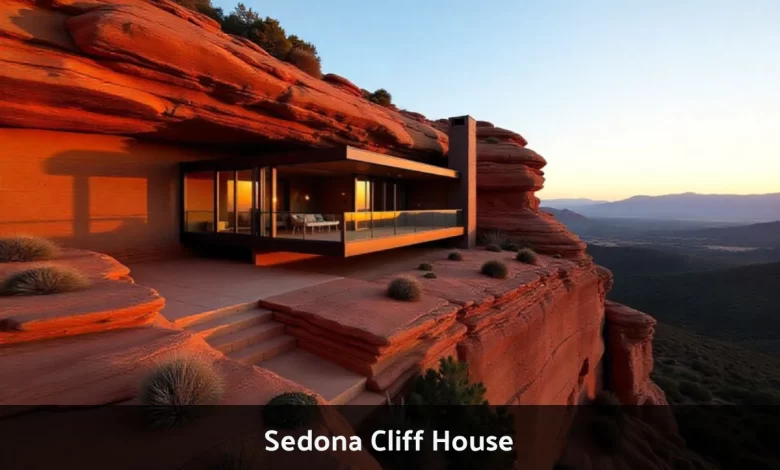
The term “Sedona cliff house” refers to two distinct properties in West Sedona. Red Tail Cliff is Glendon Good’s architectural masterpiece, built 200 feet above ground, accessible only by tramway. The home took over two decades to complete, from the 1998 land purchase to finishing construction in 2021.
The Sedona Cliff House vacation rental sits on Red Rock Loop Road, offering 5 bedrooms, an infinity pool, and panoramic views. It won the People’s Choice on the 2006 Sedona Art and Architecture Tour. Managed by VacayAZ, this property sleeps up to 14 guests and features both a main house and a guest house.
What Makes These Sedona Cliff Houses Different
Searching for “Sedona cliff house” brings up two completely different properties. One is a private residence that pushes the limits of what you can build on solid rock. The other is a luxury vacation rental designed for families and groups seeking solitude with red rock views.
Red Tail Cliff belongs to furniture designer Glendon Good. You reach it by riding a tramway that climbs 200 feet up a red rock butte. The three-minute journey through increasingly strong winds delivers you to a 2,150-square-foot home literally carved into the cliff. Good designed and built much of it himself, solving complex engineering problems that took years to figure out.
The vacation rental shares the “cliff house” name but sits at ground level. This 5,877-square-foot property combines contemporary architecture with practical luxury. You can book it through vacation rental platforms for group stays. The location provides seclusion while keeping Sedona’s restaurants and shops just three miles away.
Both homes earned recognition from the Sedona Art and Architecture Tour. Red Tail Cliff attracted national media attention in 2024, including features in the Wall Street Journal and Sedona Monthly Magazine. The vacation rental won its award back in 2006, when feng shui principles guided its design.
Understanding which property matches your interest matters. One represents an architectural achievement you can admire from afar. The other offers an actual place to stay while exploring Sedona.
Red Tail Cliff: Living 200 Feet Above Sedona
Glendon Good purchased a red rock formation in West Sedona in 1998. He spent the next 23 years turning that raw geological feature into a home. The project required learning architecture, engineering a tramway system, and personally fabricating many of the custom components.
The tramway alone consumed 12 years of planning and engineering. Good needed it to transport every construction material up the cliff. Building codes required installing a landline phone inside the elevator car. The Sandoval Elevator Company handled the installation, but Good solved most of the technical challenges himself.
Construction crews started work at 5 a.m. Good met them before they arrived, having his coffee at 4 a.m. Many workers initially balked at the site’s difficulty. Good showed them how to make the impossible possible, walking them through each step until their fear subsided.
The home sits on rock tested by geotechnical engineers. The red rock proved twice as strong as concrete. These formations are millions of years old. Good drilling and hammering into them during construction, confirming their solidity firsthand.
Interior space measures 2,170 square feet across three bedrooms and three bathrooms. A 20-foot sliding glass wall connects indoor and outdoor areas. Multiple decks at different elevations provide 360-degree views of Oak Creek Canyon below and the surrounding red rocks. An interior elevator moves between floors in a cylindrical shaft that uses air pressure to function.
Solar panels on the roof deck generate the home’s electricity. Good designed all the doors to slide into the walls rather than swing open. No door knobs exist anywhere. You press a button and the door glides smoothly into a pocket in the wall. The foyer serves as a transition zone between outside and inside, a design element Good believes modern homes overlook.
Good lived on the property’s lower level during construction and moved into Red Tail Cliff in October 2021. His furniture designs, typically crafted from aluminum with signature curves, fill the rooms. The windows frame red rocks so close you could touch them from certain bathrooms and closets.
The home remains private. Good occasionally opens it for architectural tours, but you cannot simply show up and request a visit. Media coverage in 2024 brought wider attention to what locals had known for years—Sedona has a house on a cliff that defies conventional building logic.
The Engineering Behind Building on a Cliff
Building 200 feet above ground changes every construction decision. You cannot park a concrete truck at the site. No lumber delivery can pull up to unload materials. Everything travels up the tramway in pieces small enough to fit.
Good consulted with builders and excavators, who confirmed they could chip away rock to create foundations and level surfaces. A dowser located water from a well that could be pumped to the site. His background in designing furniture translated directly to architecture. Both require understanding complex structural layers and how materials bear weight.
The circular stainless steel piece at the tram’s top needed helicopter delivery. It weighs too much for the tramway and was too large to assemble on site. The helicopter insertion felt like something from a science fiction film, according to visitors who witnessed it.
Rock stability was never the concern. The formations handle wind, weather, and geological time without issue. The challenge was integrating modern utilities and comfort systems into an environment that resists modification. Running electrical lines, plumbing, and HVAC systems required custom solutions for each obstacle the cliff presented.
The Sedona Cliff House Vacation Rental Experience
The vacation rental sits on Red Rock Loop Road in an area locals consider one of Sedona’s best-kept secrets. The property includes a main house and a separate guest house, totaling 5,877 square feet. Five bedrooms and multiple bathrooms accommodate up to 14 guests.
Feng shui master Valmai Howe Elkins consulted on the design when the property was completed in 2006. The layout emphasizes flow and natural light regardless of season. Passive solar design keeps summer spaces cool while winter sunlight streams through southern windows. Ultra-low VOC materials throughout support the green building approach.
The negative edge pool creates the illusion of water flowing into the valley below. Heating the pool costs an additional $175 per night with a three-night minimum, which guests must request at least three days before arrival. The infinity edge frames red rock views that shift throughout the day as light changes.
Outdoor spaces include multiple decks, a large grass area suitable for group activities, and a wood-burning fire pit. The game room in the guest house provides entertainment when guests want a break from hiking. Reviews consistently mention the comfortable furniture, particularly the leather sofas that remain inviting after long days on the trails.
Sedona’s Cliff Dwelling Heritage
The Sinagua people built cliff dwellings in Sedona between 1100 and 1400 AD. These ancient structures at Palatki and Honanki Heritage Sites demonstrate that humans have long recognized the advantages of building into cliffs in this region.
The Sinagua chose cliff locations for protection, climate control, and access to water sources. Their dwellings used red rock as both foundation and building material. Pictographs and petroglyphs on the walls document their lives and spiritual practices.
Modern Sedona architects draw inspiration from this heritage, though their goals differ. Where the Sinagua sought survival and community, contemporary builders pursue aesthetic integration with landscape and views that justify difficult construction.
The red rock provides both challenge and opportunity. Its strength supports structures that would fail on softer ground. Its color and texture become architectural elements rather than obstacles to hide. Architects who work in Sedona learn to see the rock as a partner in design, not merely a substrate.
Planning Your Sedona Cliff House Visit
Red Tail Cliff remains private property. Glendon Good does not operate it as a tour destination or vacation rental. The home occasionally appears on the Sedona Art and Architecture Tour or in special media features, but these opportunities are rare and must be arranged in advance.
If you want to see Red Tail Cliff, your best option is viewing it from a distance during hikes in the area or hoping for a future inclusion in the Art and Architecture Tour. The Wall Street Journal and Sedona Monthly published extensive photo essays that provide virtual tours for those curious about the interior.
The Sedona Cliff House vacation rental requires booking through VacayAZ or platforms like VRBO. Rates vary by season, with premium pricing during peak times when weather and events draw visitors to Sedona. The property requires a minimum stay that changes based on demand.
Contact VacayAZ directly for current availability and pricing. Ask about pool heating if you want that amenity, as it must be arranged before arrival. Review all house rules carefully before booking to ensure the property’s quiet, family-oriented atmosphere matches your group’s expectations.
Why Sedona Attracts Cliff Architecture
Sedona’s geology creates natural platforms where cliffs meet relatively flat surfaces. These ledges and benches provide building sites that combine dramatic elevation with structural stability. The red rock formations act as both foundation and backdrop.
Views from these locations span miles. You see other red rocks, distant mountain ranges, and the vegetation-filled valleys between. The elevation provides cooling breezes and separation from ground-level heat. Privacy comes naturally when your neighbors need binoculars to see you.
The artist and architect community in Sedona values pushing boundaries. The annual Art and Architecture Tour celebrates homes that treat living spaces as artistic statements. Judges and visitors reward innovation, especially when it responds to the landscape rather than imposing generic designs.
Architects who work here must navigate strict building codes designed to protect viewsheds and natural character. You cannot build anything anywhere. Regulations limit height, require specific materials, and mandate that structures blend with surroundings. These constraints challenge designers to create within tight parameters.