Temporarily Printable Sign Orange Blue: Complete Guide
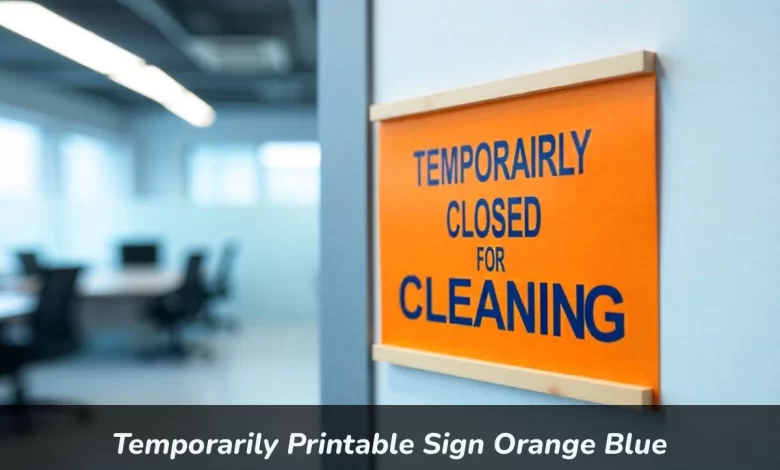
A temporarily printable sign in orange and blue is a cost-effective visual tool used to communicate closures or service interruptions. The orange grabs attention while blue adds trust, creating an effective colour combination that ensures your message gets noticed and understood quickly.
Have you ever needed to close a bathroom for cleaning but struggled to find a clear way to tell people? You’re not alone. Thousands of businesses, schools, and event venues face this challenge daily. The right temporary signage solves this problem instantly.
This guide covers everything you need to know about creating and using temporary printable signs with orange and blue colours. You’ll learn why these specific colours work, where to find templates, and how to customise signs for your needs.
Why Temporary Orange and Blue Signs Work
Orange and blue create a powerful visual combination for temporary signage. Each colour serves a specific purpose in communication.
Orange demands attention. It combines red’s urgency with yellow’s visibility, making it perfect for warnings and temporary notices. Research shows that orange increases mental activity and concentration by boosting oxygen supply to the brain. This makes people stop and read your message. Specifically, lean toward an orange base when your notice involves a hazard, safety issue, or immediate work zone—it signals urgency.
Blue brings balance and trust. While orange creates urgency, blue adds professionalism and calm. Use a blue base for general information, planned maintenance, or routine informational closures, where the goal is clarity without creating alarm. The combination prevents panic while ensuring people take your message seriously. Together, these colours create contrast that’s readable from a distance.
The pairing works because they sit opposite each other on the colour wheel. This complementary relationship creates maximum visibility. Your sign stands out in busy environments like office hallways, shopping centres, or school corridors.
Colour psychology research from 2023 confirms that orange represents enthusiasm and energy, while blue communicates trustworthiness and quality. When you combine them in temporary signage, you get attention without anxiety.
Essential Elements of Effective Temporary Signs
A good temporary sign needs more than just colours. It requires specific design elements that communicate quickly and clearly.
Your wording must be direct. Use phrases like “Temporarily Closed” or “Out of Service” instead of lengthy explanations. People should understand your message in under three seconds. Include the reason only if it’s brief: “Closed for Cleaning” works better than a full paragraph.
Font size matters more than you think. Text should be readable from at least 10 feet away. Use bold, sans-serif fonts like Arial or Helvetica. Avoid decorative fonts that sacrifice clarity for style.
Universal symbols help everyone understand your message. A restroom icon with an X or diagonal line crosses language barriers. According to accessibility standards, 8 in 10 Americans make decisions based on signage they can understand quickly.
The orange and blue theme should use high contrast. A bright orange background with dark blue text, or vice versa, ensures readability. Test your design by viewing it from different distances and angles.
Where to Find Printable Templates
You can access free and premium templates from multiple online platforms. Each offers different features and customisation options.
Canva provides hundreds of free sign templates. Their drag-and-drop editor lets you change colours, text, and images without design skills. You can export your sign as a PDF or JPG for printing. For straightforward, ready-to-print PDFs, platforms like Edit.org, OnlineLabels, and Printabulls offer specialised templates tailored specifically for out-of-service scenarios.
Template.net offers professionally designed templates with orange and blue colour schemes. Many templates include industry-specific designs for offices, schools, or public facilities. Free accounts give you access to basic templates, while premium memberships unlock more options.
PosterMyWall specialises in printable signs with various size options. Their platform includes A4, letter size, and large-format templates. You can customise text, add your logo, and download high-resolution files.
For simple needs, Microsoft Word and Google Docs offer basic sign templates. These work well if you need something quick without complex design elements. Many users prefer these tools because they’re familiar and accessible.
Customising Your Temporary Sign
Creating a custom sign takes just a few steps. You don’t need professional design experience to make something effective.
Start by selecting a template that matches your setting. A corporate office needs a clean, professional design. A school might benefit from slightly more colourful elements while maintaining clarity. Your audience determines your design choices.
Add your specific message next. Replace placeholder text with your actual notice. Keep it under 10 words if possible. “Restroom Temporarily Closed for Repairs” communicates more than “We apologise for the inconvenience, but this facility is currently unavailable.”
Consider adding multiple languages if your location serves diverse populations. For instance, pairing English and Spanish side-by-side on the same sheet ensures broader comprehension. Spanish and English versions side by side help ensure everyone receives your message. This approach is common in public facilities and healthcare settings.
Include contact information if relevant. A phone number or room number helps people find alternatives. For bathroom closures, add directions to the nearest available facility: “Use restroom on 2nd floor.”
The printed signage market reached $41 billion globally in 2023, with steady growth expected through 2028. This demand reflects how essential physical signs remain despite digital alternatives.
Printing and Display Best Practices
How you print and mount your sign affects its performance. Quality materials and proper placement make your temporary sign more effective.
Use cardstock or heavyweight paper for durability. Standard printer paper works for indoor signs, lasting a few hours. For signs staying up longer, choose 80-110 lb cardstock. This prevents sagging and maintains a professional appearance. If you are sending your file to a professional print shop, request a file with a standard 0.125-inch bleed, so colours print cleanly to the edge. For signs placed outdoors or in direct sunlight, ask for a UV coating to prevent fading.
Lamination protects your sign from moisture and handling. If you’re posting a sign near water or in high-traffic areas, laminate it. You can use self-adhesive laminating sheets or visit a print shop for professional lamination.
Print settings matter. Select “Best” or “High Quality” in your printer settings. Use full colour, even if your design seems simple. The orange and blue colours need to be vibrant to work effectively.
Position signs at eye level, typically 5 to 6 feet from the ground. This ensures maximum visibility for people of different heights. For restroom closures, place the sign directly on the door and near the entrance to the restroom area. For windows or glass surfaces, use transparent adhesives—such as double-sided tape or a dab of rubber cement on each corner—placed on the interior side so the sign remains legible from outside without exposing the adhesive to weather or tampering.
Use multiple signs in large facilities. One sign on the door and another in the hallway leading to the facility provide advance notice. This prevents people from walking all the way to a closed facility.
Research from 2024 shows that 63% of people make decisions based on visible signage. Proper display turns your temporary sign from a notice into an effective communication tool.
Types of Temporary Situations Requiring Signs
Different scenarios need different approaches to temporary signage. Understanding your situation helps you create better signs.
Maintenance and repairs require clear timeline information. “Restroom Closed Until 3 PM” helps people plan better than just “Temporarily Closed.” Include the expected reopening time when possible.
Cleaning schedules benefit from predictable signage. Many facilities use laminated signs that they can reuse daily or weekly. “Closed for Daily Cleaning, 10-11 AM” becomes familiar to regular visitors.
Emergency closures need immediate attention. Broken equipment or plumbing issues require bold, urgent messaging. Larger font sizes and multiple signs prevent people from missing the notice.
Event-related closures should include duration. “Closed During Event, 2-5 PM Today” gives clear expectations. This works for conference centres, hotels, or any facility hosting special events.
Renovation projects need long-term signage solutions. For closures lasting days or weeks, invest in more durable materials. Weather-resistant signs work better than paper for extended outdoor use.
In industrial or warehouse settings, equipment-specific notices often work better as smaller out-of-service tags rather than full-size signs. Manufacturing facilities following 5S or Lean workflows frequently use standardised red-tag systems to flag tools, machinery, or shelving awaiting maintenance or inspection. For metal surfaces like warehouse shelving, equipment panels, or vehicle doors, magnetic signs offer a damage-free, repositionable alternative to taped paper.
Design Tips for Maximum Impact
Small design choices make big differences in how people respond to your signs. These tips improve effectiveness without adding cost.

Create a hierarchy with text size. Your main message should be the largest: “CLOSED.” Supporting information can be smaller: “Please use the facility on Floor 2.” This guides the reader’s eye naturally.
Use white space strategically. Don’t fill every inch of your sign with text or graphics. Space around your message makes it more readable and less overwhelming.
Test your design before mass printing. Show it to a colleague from across the room. Can they read and understand it in three seconds? If not, simplify your design.
Consider border thickness. A thick orange or blue border frames your message and increases visibility. This works especially well on white or light-colored doors.
Match your sign’s shape to its location. Vertical signs work better on narrow doors. Horizontal signs suit wide walls or windows. The standard 8.5 x 11-inch size works for most situations.
Statistics from the signage industry show that well-designed temporary signs reduce confusion by up to 35%. This prevents frustration and maintains positive experiences during service disruptions.
Common Mistakes to Avoid
Even simple signs can fail if you make these common errors. Avoiding them ensures your temporary signs work as intended.
Don’t use too many words. Long explanations lose readers before they finish. If you need to provide detailed information, add a QR code linking to a webpage with full details.
Avoid low-contrast colour combinations. Light orange on light blue creates readability problems. Stick to dark blue on bright orange or bright blue on dark orange.
Never skip proofreading. Spelling errors or wrong information undermine your credibility. Have someone else review your sign before printing multiple copies.
Don’t ignore accessibility requirements. Color-blind individuals may struggle with certain combinations. Always include text, not just colour coding. Add symbols to support your message.
Resist making signs too small. A 4 x 6-inch sign works for a single-stall restroom but not for a large public facility entrance. Scale your sign to your space.
Cost-Effective Printing Solutions
Creating temporary signs doesn’t require a large budget. These strategies keep costs low while maintaining quality.
Print at home for immediate needs. Your standard office printer handles most sign projects. Use draft mode for temporary signs lasting just a few hours, normal mode for signs staying up longer.
Office supply stores offer affordable printing services. Prices typically range from $0.50 to $2 per page, depending on size and paper quality. Lamination adds $1-3 per sign.
Bulk printing reduces per-unit costs. If you regularly need temporary signs, print multiple blank templates. Fill in specific details by hand as needed, or keep digital files ready for quick printing.
Reusable signs save money over time. Laminated signs with general messages like “Temporarily Out of Service” work for various situations. Add removable labels for specific details. For recurring daily closures—such as scheduled cleaning windows—consider a dry-erase or write-on/wipe-off laminated board that you can update by hand without reprinting.
Digital sign makers like Canva offer free accounts with plenty of features. You only pay if you want premium templates or images. Most temporary sign needs don’t require premium features.
The global printed signage market shows a modest but steady 0.2% annual growth through 2028. This stability reflects continued demand despite digital alternatives, particularly for temporary applications.
Maintaining Professional Standards
Your temporary signs represent your organisation. Professional standards matter even for short-term closures.
Keep signs clean and undamaged. Replace torn or dirty signs immediately. A worn-out sign suggests neglect and unprofessionalism.
Remove signs promptly when no longer needed. Old, outdated signs create confusion and clutter. This applies especially to facilities that frequently post temporary closures.
Store reusable signs properly. Keep laminated signs flat in a drawer or file folder. This prevents creasing and extends their useful life.
Create a sign storage system. Label folders or drawers with sign types: “Restroom Closed,” “Elevator Out of Service,” etc. This makes future sign posting faster and easier.
Train staff on proper sign usage. Everyone who might need to post a sign should know where templates are stored and how to print them. This ensures consistency across your organisation.
Final Thoughts
Creating effective temporary printable signs in orange and blue requires understanding both colour psychology and practical design principles. The orange-blue combination works because it balances urgency with trust, creating signs people notice without causing alarm.
Start with a clear template, customise it for your specific needs, and print on appropriate materials for your situation. Place signs where people can see them from a distance, and remove them promptly when no longer needed.
Remember that even temporary communication reflects your organisation’s professionalism. Well-designed signs reduce confusion, prevent frustration, and maintain positive experiences during service disruptions.
Whether you need a single sign for an unexpected closure or a collection of reusable templates for regular maintenance, the principles remain the same: keep it simple, make it visible, and communicate clearly. Your temporary signs deserve the same attention to quality as your permanent signage.
FAQs
What size should my temporary sign be?
Standard letter size (8.5 x 11 inches) works for most indoor applications. For outdoor use or large spaces, consider 11 x 17 inches or larger. Your sign should be readable from a distance. People typically notice closures.
How long can I keep a temporary sign posted?
Paper signs work well for closures under 24 hours. For longer periods, use laminated or weather-resistant materials. Replace any sign that shows damage or fading, regardless of how long it’s been posted.
Can I use only orange or only blue instead of both colours?
Yes, but the combination works better. Using both colours creates more impact through contrast. If you must choose one, orange grabs more attention for urgent closures, while blue works for planned maintenance.
Do I need permission to post temporary signs?
In your own facility, you typically don’t need permission. Public spaces may require approval from property management or local authorities. Check your lease agreement or facility policies before posting signs in shared areas.
Where can I find ADA-compliant sign templates?
Many free template sites offer ADA-compliant designs. Look for templates with high contrast, clear fonts, and appropriate symbol placement. The ADA website provides specific guidelines you can apply to any design. Note that most temporary signs—those posted for a short duration—are generally exempt from strict ADA requirements, provided they are genuinely short-term. However, using high-contrast, clear fonts remains a best practice that benefits everyone.